Our Road Trip from New York City to Seattle
Posted by Angela Brett in News on September 8, 2026
Hey, remember when I shared a video in which I took down my poster wall in Vienna to prepare for moving to the US, and then another one as a summary of the trip to New York City aboard the Queen Mary 2? Well, in case you’re wondering how we got from there to where I now live in the Seattle area, I’ve just finished a summary video of that. We took a road trip, with various stops to see people, places, and events. Here’s a video summary of that incorporating various video clips and still photos I took on my phone, with some short clips of relevant songs whenever there’s not much else to listen to. You might not want to turn the volume up too high until you reach the first song clip; I realise now it’s a bit loud.
The beginning is a reference to a Father Ted scene.
Songs used:
Central in My Heart (feat. Josh Gad) from Central Park Season One, The Soundtrack – Song-tral Park (Original Soundtrack) (If you have Apple TV and you like animated musical comedies, watch this show!)
Fans of Apple, by Jonathan Mann
What’s Really In My Hotdog, by Devo Spice (I know at least three songs on this topic, but this one seemed most appropriate for showing autographs of all-American symbols of pride such as Big Bird, Gene Kranz, and Emo Philips)
Thrift Store Owner by The Barmitzvah Brothers (this is from an album of songs about various professions; it’s cool.)
Fireworks Pornography & Cheese by Dave Stagner (I used the version from the MarsCon Fundraiser)
Suddenly There’s a Valley, as sung by Petula Clark (this is perhaps the most widely-known song on this thing)
Rocks and Trees, by The Arrogant Worms
Home, by K’s Choice (from the album Almost Happy)
Perhaps I should get some kind of affiliate thing to link to the ones that aren’t on Bandcamp or the artist’s own sites, but you probably know how to find music on your chosen services.
You can see all my videos relating to moving (including several hours of 4K footage from aboard the Queen Mary 2) in this playlist, and those plus a few other instances of Joey and I being cute at each other in this one. Longer versions of those two clips from MoMath, plus some other mathematical things I’ve recorded, are in this playlist.
Here are some panoramic photos I took during the road trip. Flickr doesn’t seem to display panoramas well in Safari for Mac, but I remember being able to see them properly on my phone.
I had time to finish this video because I finally finished watching, writing overly-verbose descriptions of, splitting, and uploading all my footage from JoCo Cruise 2026 that I’m allowed to share. It’s about 24 and a half hours. I’d usually have this uploaded by the first of May, but they didn’t sing that song this year, so I had no deadline, and I do have a job with a commute, and a cutie to watch Star Trek with. I’ve also shared video of the two times I’ve seen James Dempsey since my last post about him.
Some silly songs we sing around the house a lot
Posted by Angela Brett in Performances on August 2, 2026
Recently Joey Marianer and I recorded a couple of songs we keep singing at/with each other. Here’s Baby Shark sung to the tune of Edelweiss. Usually, Joey sings harmonies, but we experimented with adding ukulele for the video, and Joey liked this version with just me singing the best:
Guess which one of those two songs is popular in Austria!
Lyrics:
Baby shark, baby shark
Do do do do do do do
Mommy shark, mommy shark
Do do do do do do do
Daddy shark, grandma shark, grandpa shark
Do do do do do do
Run away, safe at last
Do do do do do do do
Daddy shark, grandma shark, grandpa shark
Do do do do do do
Run away, safe at last
Do do do do do do do
This prompted me to finally write lyrics for another version of Baby Shark I’ve been thinking about. Here’s ‘Ode to my Shark Family’, a parody of ‘Ode to My Family‘, by the masters of ‘do do do do do do do’ songs, The Cranberries.
Do do do do
Do do do do
Do do do do
Do do do do

Do do do do
Do do do do
Do do do do
Do do do do

Baby shark and mummy shark
And daddy shark as well
And grandma shark and grandpa shark
They’ll chomp you right to hell
You can’t run here, you can’t run
It’s the ocean.
It’s the ocean, not the ground.
You’re not safe here; you’re not safe
It’s the ocean. It’s the ocean
Get ate or get drowned
I imagine ‘ate’ is pronounce /ɛt/ in this, although I’m not sure whether that pronunciation is actually common in Ireland. I’m a much bigger fan of The Cranberries than I am of my own singing, so I’m unlikely to further disgrace them by singing this.
The next one that we did record is what I guess you could call a ‘studio recording’ of something we sang at Dumb Parody Ideas at MarsCon, as mentioned in my last post. It’s ‘Garbanzo Beans (a.k.a. Chick Peas)’ (to the tune of O Tannenbaum, which is also probably popular in Austria) except that we’ve also added a French translation, titled Pois chiches (aussi appelés « garbanzos »). The fact that Joey is wearing an Arrogant Worms ‘Canadian Famous’ shirt while we sing in English and French is a coincidence. Today is the Swiss National Day, but Canada gets the presents! (Perhaps we can translate it into German, Italian, and Romansch in time for the next Canada Day.)
I’m not sure which one of us started singing ‘les haricots de garbanzos’, nor whether anyone actually calls them that, but I can take the credit/blame for the other line.
Lyrics:
Garbanzo beans, garbanzo beans
Some people call them chickpeas
Garbanzo beans, garbanzo beans
Some people call them chickpeas
Garbanzo beans, garbanzo beans
Garbanzo beans, garbanzo beans
Garbanzo beans, garbanzo beans
Some people call them chickpeas

Les haricots de garbanzo
Certains les appellent pois-chiches
Les haricots de garbanzo
Certains les appellent pois-chiches
Les haricots de garbanzo
Les haricots de garbanzo
Les haricots de garbanzo
Certains les appellent pois-chiches
These songs can both be found in my playlist of dumb parody ideas by the two of us.
On the subject of song translation, a long time ago Joey’s father translated Robert Frost’s ‘Stopping by Woods on a Snowy Evening’ into Hebrew. A less long time ago, Joey came up with some music for the original, and sang it. A short time ago, the translation was found somewhere, and Joey sang that too.
Also on the subject of song translation, Le Ton beau de Marot: In Praise of the Music of Language is a great book by Douglas R. Hodstadter. Three days after I finally got a hold of a copy of it (after a few cancelled orders), back in 2007, I unexpectedly saw Douglas Hofstadter give a talk. It could happen to you!
I think that’s all I have to say for now… I was considering mentioning a puzzle I made for a recent event, but I think I’ll save that for another post.
A Golden Apple Anniversary
Posted by Angela Brett in News on April 2, 2026
April 1, 2026 is the 50th anniversary of the founding of Apple, Inc. That’s a golden jubilee! I’m not quite that old, but for my birthday in 2001 ago my mother gave me a gold Apple logo pendant that she’d had a manufacturing jeweler make for me. My oldest brother, a staunch Windows user, gave me a copy of Mac OS X (back in those days, Apple still charged for operating systems.) A year earlier, my sister had got Steve Wozniak to call me on my birthday, and not long after that, Woz had bought me an iBook to replace a laptop that was stolen. So you can see how these were perfectly appropriate gifts — I did, thanks to Woz, have a Mac capable of running Mac OS X. This was a few years before that time Steve Wozniak taught me to Segway and then played Tetris and pranks through a concert, but that’s not quite relevant to this story — it’s just to help set the scene for yet another ridiculous Apple story.
Here’s what that Apple pendant looked like in 2015, pictured with a Space Shuttle orbiter pendant I’d just bought at Kennedy Space Center:

It was still in pretty good nick at that point.
Over the years, the leaf got bent backwards a little, and the chain broke and was replaced or fixed a few times, but I never lost the pendant.
On December 10, 2025, I arrived at work to discover the chain hanging open on my neck, snapped. The pendant was gone. I checked everywhere I’d walked in the building, and later checked Joey’s car, the work (non-space) shuttle, and various places around the house where it might have fallen off, but it was nowhere to be found. I could only hope that my golden Apple had ended up being inanimate happily every after near an Apple building.
The lovely Joey Marianer (to whom, in a ridiculous stroke of luck which can only foreshadow the end of this story, I am married!) bought me a smaller Apple logo pendant for Christmas! How sweet! So I got the chain repaired and all was right with the world.
On 28 January, 2026, Joey and I pulled up at the Park & Ride whence I take a (non-space) shuttle to work. As I opened the door to get out, I saw my original Apple pendant right there on the ground next to the car. I made excited noises, passed it to Joey, and hurried to get on the (still not space) shuttle.
Later I was able to inspect the pendant’s shiny new battle scars. Here’s what it looked like after 49 days (that’s a generous count of Liz Truss’s time as Prime Minister of the UK!) in a parking lot being run over:
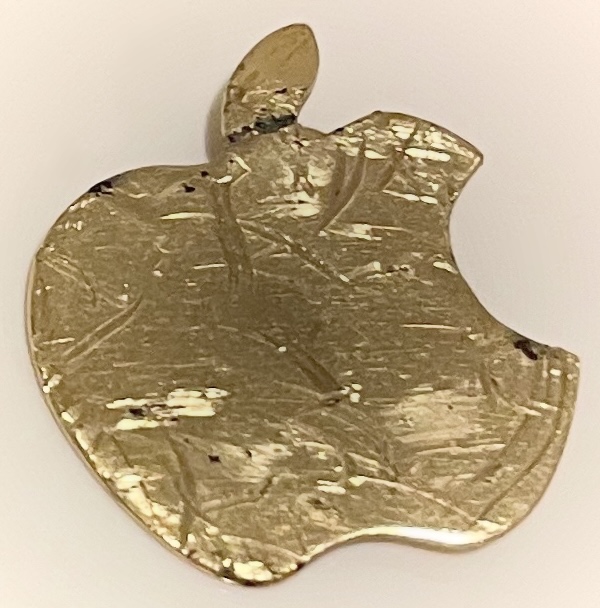
Isn’t it pretty? The loop at the back which the chain goes through is bent, but still open enough that the chain can fit through it. I could probably get it ‘fixed’ but I don’t want to erase a story like this.
Here are both the pendants together, with some cheap spacer beads between them, shown over the 50th anniversary T-shirt I wore today:
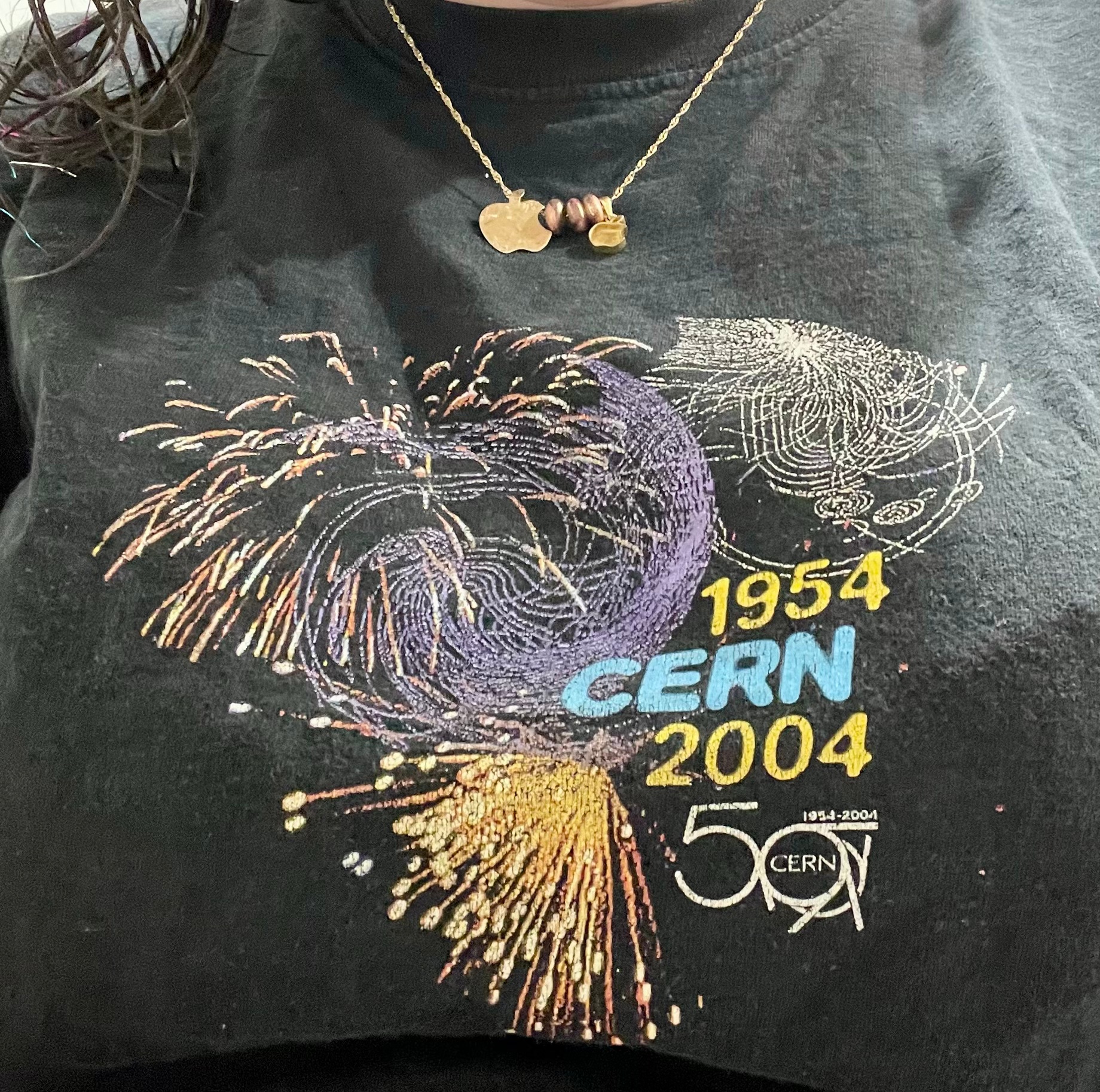
I don’t have an Apple 50th Anniversary T-shirt, so I made do with a CERN one. On the subject of CERN, check out their April Fools joke today.
And on the subject of space (not shuttles), check out the Artemis II mission which launched today!
And finally, on the subject of Apple’s 50th anniversary, check out this video of an event at the Computer History Museum a few weeks ago. I haven’t watched it yet (I was going to watch it today but barely have time to write this blog post) but I’m sure it’s interesting.
In unrelated news, Joey and I sang some Dumb Parody Ideas at MarsCon last month (one about rubber duck debugging, one about garbanzo beans, and one which we’ll need to make a better recording of) but I’ll make a separate post about them later. I also went on JoCo Cruise 2026 and will be uploading many hours of video of that to YouTube in the coming months.
Arithmancy Pants for macOS and iOS: Because everything’s a magic number if you’re brave enough
Posted by Angela Brett in My Software on October 31, 2025
TL;DR: I made an app to derive a lot of ‘lucky’ numbers from any text. You can get it on the App Store now, for iOS and macOS.
Many years ago I came across Uri Geller’s page about how he notices the number 11 a lot and it’s somehow a magic number. I didn’t read all of it, because it’s nonsense, but I was intrigued by the list of ‘Names, events and places that add up to 11 letters.’ It contains:

- Many words, names, and phrases that happen to have 11 letters
- The words ‘hell heaven’ that sound a bit like 11
- Events that happened on the 11th of some month, or in November, or at 11:11
- The fact that Queen Elizabeth II is often written EIIR, which looks like E11R (of course, if you know Roman numerals, it clearly means E2R, but when I was a little kid I thought the Commodore 64 game Saboteur II was Saboteur 11, so I shouldn’t judge)
- Numbers whose digits add up to 11, if you keep adding the digits of the result until you get to 11
- Dates whose digits add up to 22, if you keep adding the digits of the result until you get to 22
- Phrases that have two consecutive As in them (because A is the first letter of the alphabet)
- Numbers that have two or more consecutive 1s in them
- Numbers that have two or more non-consecutive 1s in them, separated by zeroes
- Numbers that have 2 in them
It was clear to me that if you look hard enough, you can find 11s anywhere. Not only that, but you could find whatever other smallish (under 1000 or so) numbers you’re looking for. So I wrote code to look for a lot of these things automatically, and put it in an iOS and macOS app called Arithmancy Pants. It’s called that because ‘Numerologist’ was taken, arithmancy is an older word for numerology, and I’m a two-time Fancy Pants Parade winner.
I broke down everything into independent steps, so that we can find as many numbers as possible without doing the same thing twice — for instance, instead of converting AA to 11, we first convert it to 1, 1, and then concatenate them in a separate step to make 11.
Here are the things Arithmancy Pants can do in its quest to find numbers:
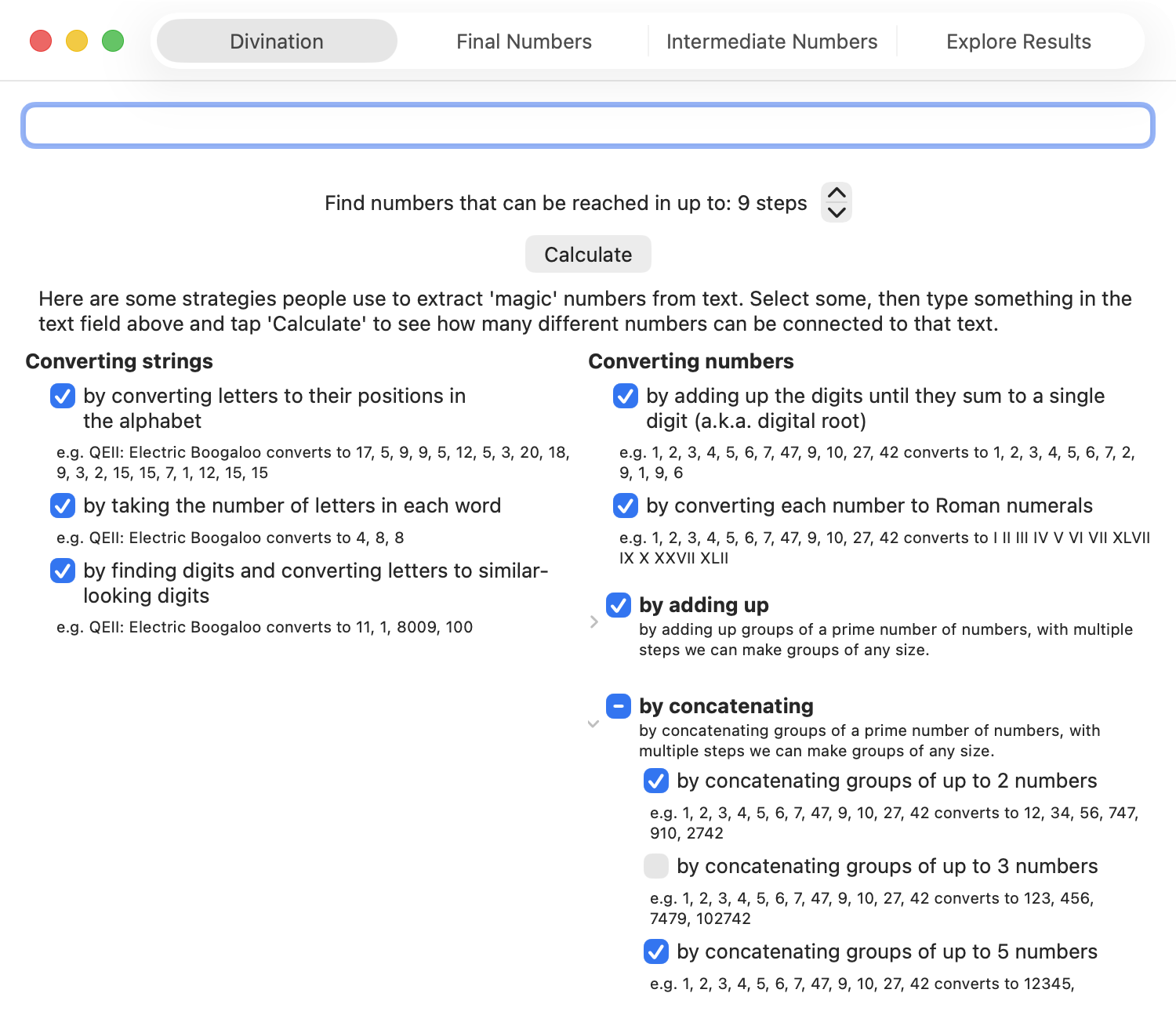
- Convert text into numbers
- by converting letters to their positions in the alphabet — Uri only uses this one for converting A to 1, but I’ve seen it quite often elsewhere
- by taking the number of letters in each word — this covers all the 11-letter words, and when combined with ‘adding up all the numbers’, covers other names and phrases with 11 total letters.
- by finding numbers that are already in the text, and letters that look like numbers — this covers the EIIR example.
- Convert numbers into other numbers
- By adding up the digits until they sum to a single digit (also known as digital root, this is equivalent to finding the remainder when dividing the number by 9, except using 9 instead of 0 unless we started at 0.)
- By converting each number into Roman Numerals — I think I only added this because I’d already written code to do that for something else. However, this covers the ‘numbers that have 2 in them’ case, as we can convert 2 to 11 by converting it first to II, and then to 11 by converting letters that look like numbers. This is a much more manageable way of turning 2 to 11 than adding a generic ‘convert each number into every possible combination of numbers that add to that number’ step.
- By adding up numbers
- Adding up all the numbers — this covers most of the adding-up cases on Uri’s page
- Adding up numbers in groups of up to 2, 3, 5, 7, and 11 numbers. By using prime-sized groups, in multiple steps we can add the numbers in groups of any size — e.g., we can add up groups of 6 numbers by first adding groups of 3 numbers, then adding those results in groups of 2.
- By concatenating numbers — combined with converting letters to their positions in the alphabet, this covers converting AA to 11
- Concatenating all the numbers
- Concatenating numbers in groups of up to 2, 3, 5, 7, and 11 numbers.
I stop at combining groups of 11, because while I could handle even larger numbers internally by using a different data type:
- I’ve got to stop somewhere, and not many people’s supposed lucky numbers have enough digits for concatenations or sums of multiples of 13 numbers to matter.
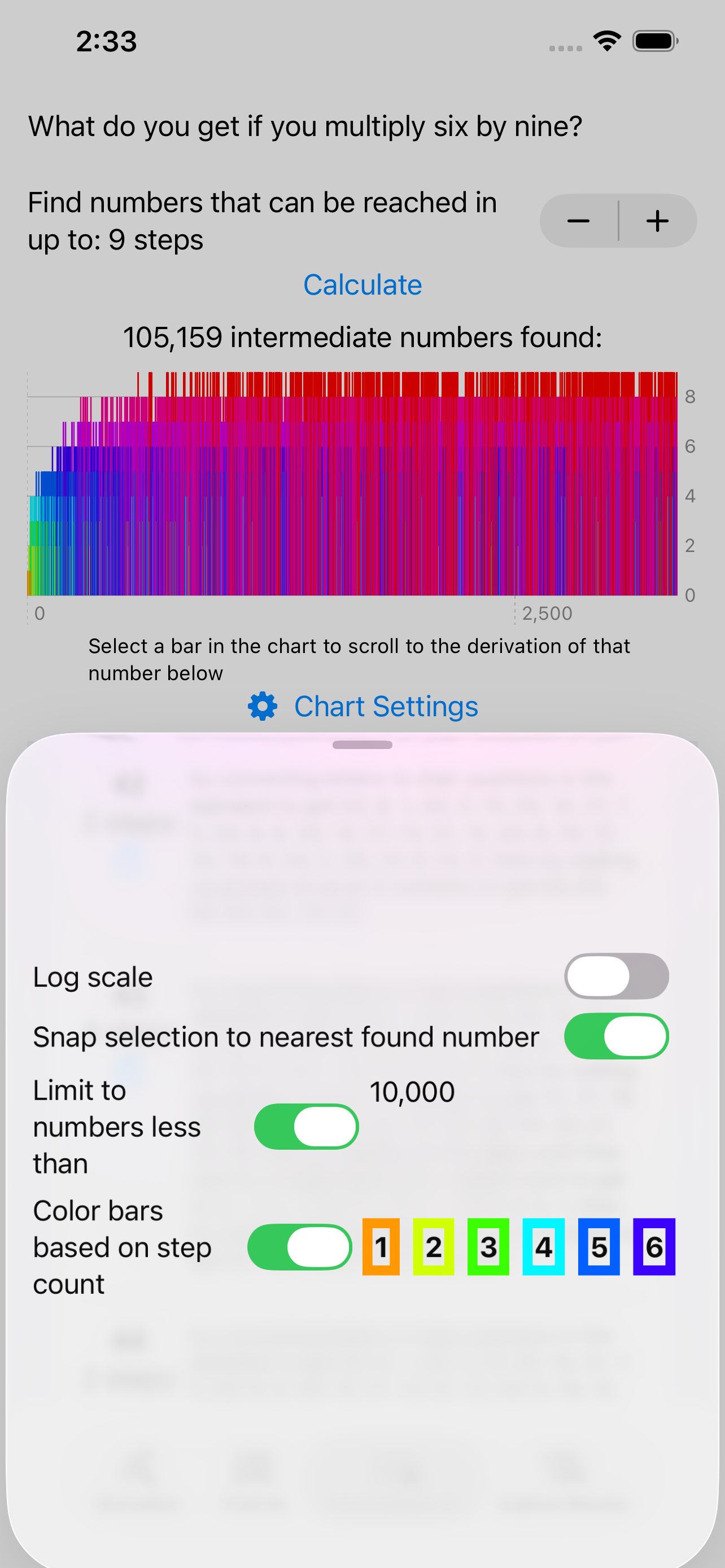
- I show charts of the numbers found, and there seems to be a bug (FB20491693, if you’re at Apple) in Swift Charts when I include more than one result that would convert to the same
Doublevalue. So I’m limited to final numbers under 253. - 13 is an supposedly an unlucky number anyway.
The app shows the final numbers you get when you complete enough of these steps to get down to a single number. On another tab it shows the intermediate numbers found alongside other numbers partway through the process. You can also explore the results yourself by expanding each intermediate result to see what was derived from it in the next step.
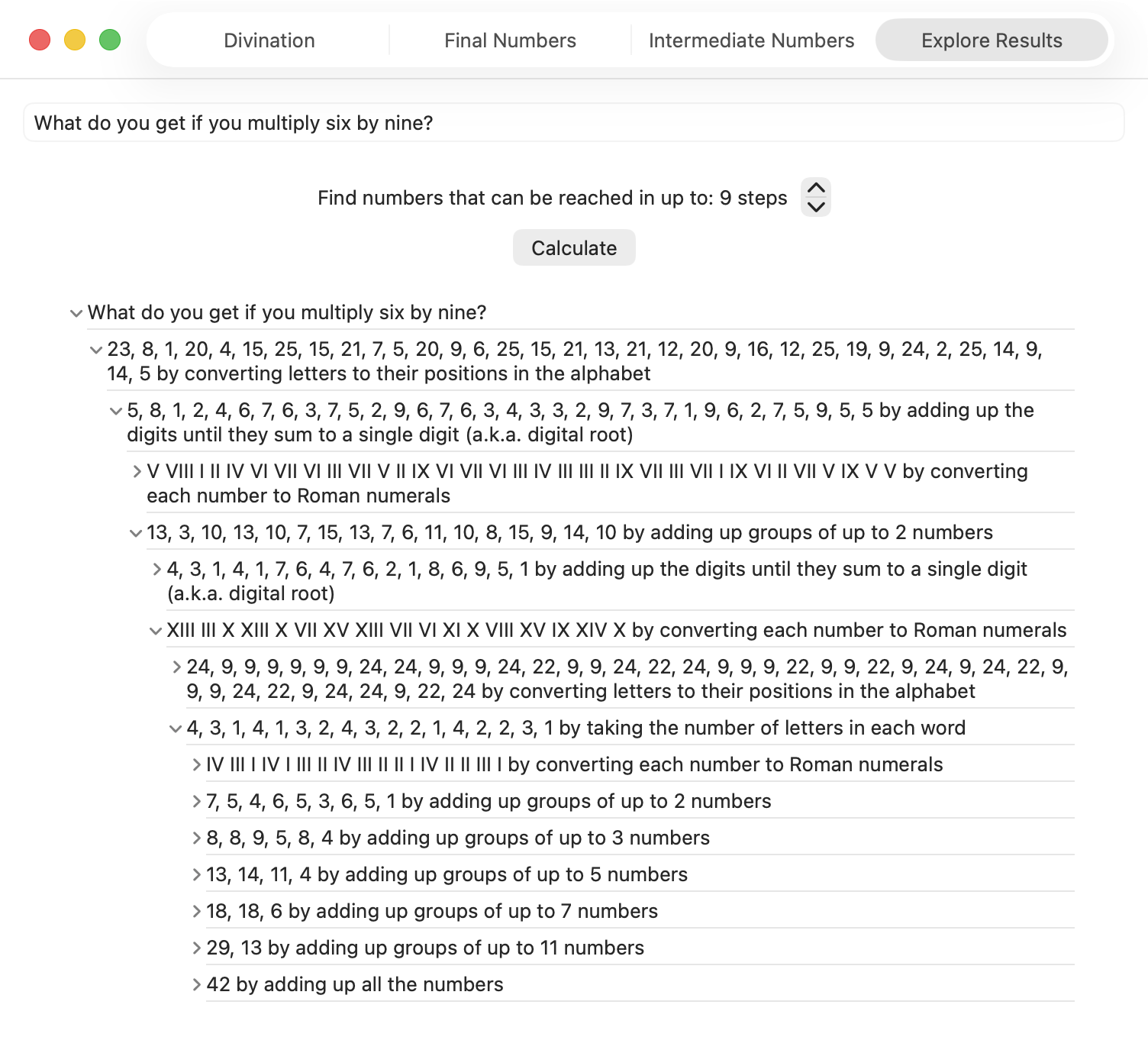
Note, there were many years between when I saw that page and when I actually wrote the app. So I don’t cover:
- Words that sound like numbers. I could have easily done something like this, at least on macOS, as I have a lot of experience with the text-to-speech APIs, but I simply forgot that was one of the tactics. Actually, I would probably just have a list of known words (too, to, for, non-rhotic Severn, etc.) that sound like numbers, or perhaps I would derive such a list by searching through a lot of text using the text-to-speech API. Uri’s suggestion of ‘hellheaven’ would not have come up though, since it doesn’t actually sound like eleven.
- Numbers that have consecutive or non-consecutive ones in them… although, this depends on how we got the numbers. If we obtained 10001 by concatenating 10, 0, 0, and 1, we would also have added those numbers to get 11.
- Stopping halfway when calculating the digital root — e.g., adding up the digits of 254 to get 11, but not continuing to add up the digits in 11 to get 2. I just take the remainder when dividing by nine to do the whole thing in a single step, so this won’t even be shown in the intermediate values.
I think that’s all I have to say about that… as I mentioned in my last post, this could also be a MathsJam talk some day. You can download the app for free on any device running macOS 26 or iOS 26. You could use it to debunk the claims of numerologists, or to make your own claims for fun — but please don’t use it to take advantage of gullible people.
Holiday Inn Express Geometry
Posted by Angela Brett in News on October 26, 2025
On our road trip across the USA, Joey Marianer and I stayed at many Holiday Inn Express hotels. I noticed that (at least for the Eastern side of the country) they had a lot of geometrical decor. In particular, some intriguing wallpaper, which I will analyse in the second hald of the post.
But first, some other geometrical art. For instance, this art made of triangles, shown here with a copy of the book I read on the trip, Matt Parker’s ‘Love Triangle‘:

This art featuring hexagons, and occasional quadrilateral half-hexagons:

And this art with triangles inside hexagons!
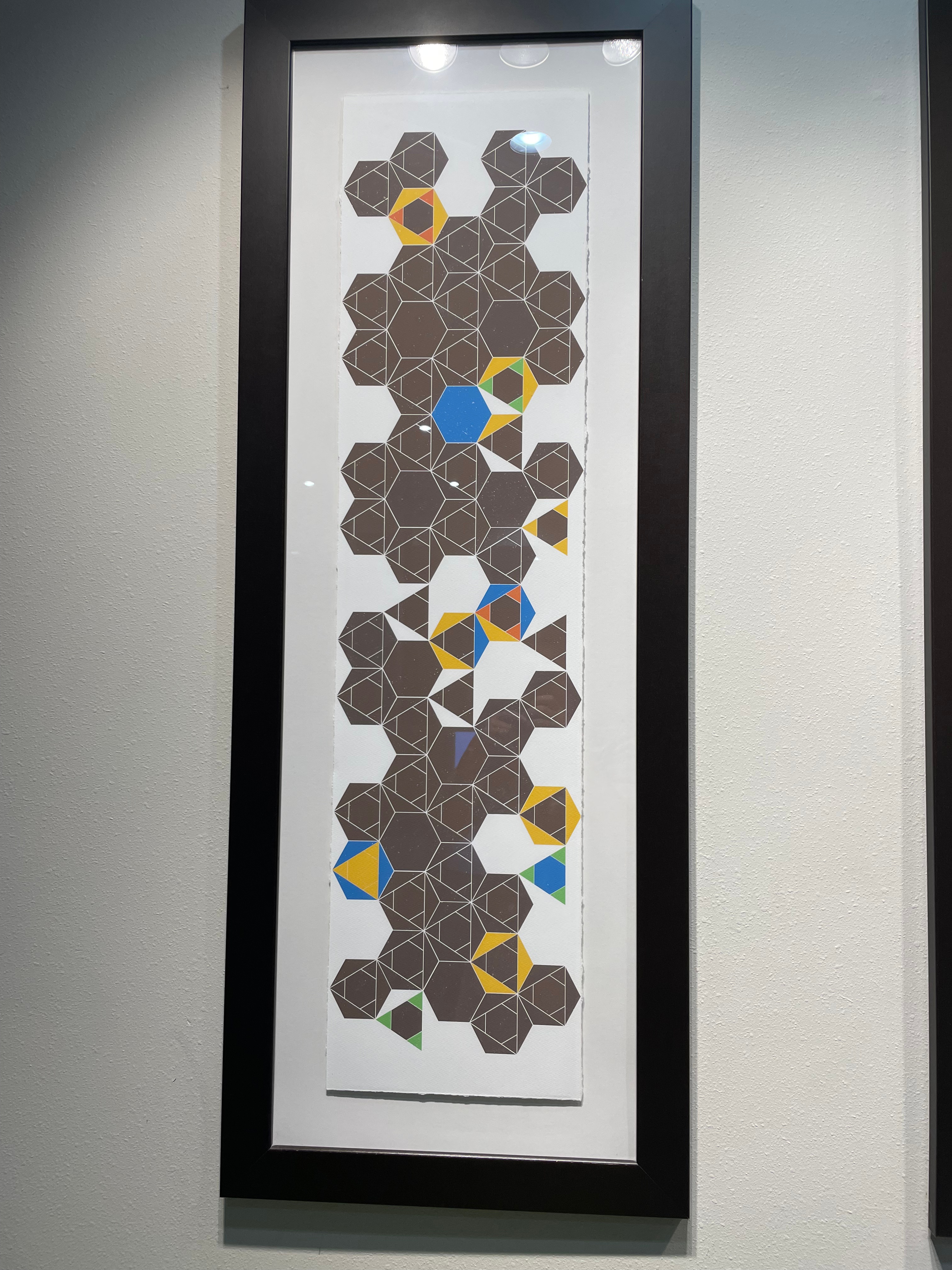
This door decorated in triangles, diamonds, and parallelograms:

This more abstract collection of overlapping quadrilaterals making the occasional triangle:

Then there are perhaps less-artistic tesselations which I might not have noticed if not for the other decor. For instance, this couch featuring two different kinds of triangle:

This floor which seems to have at least two different lengths of floorboard:

This bedspread tesselation of diamonds and parallelograms:
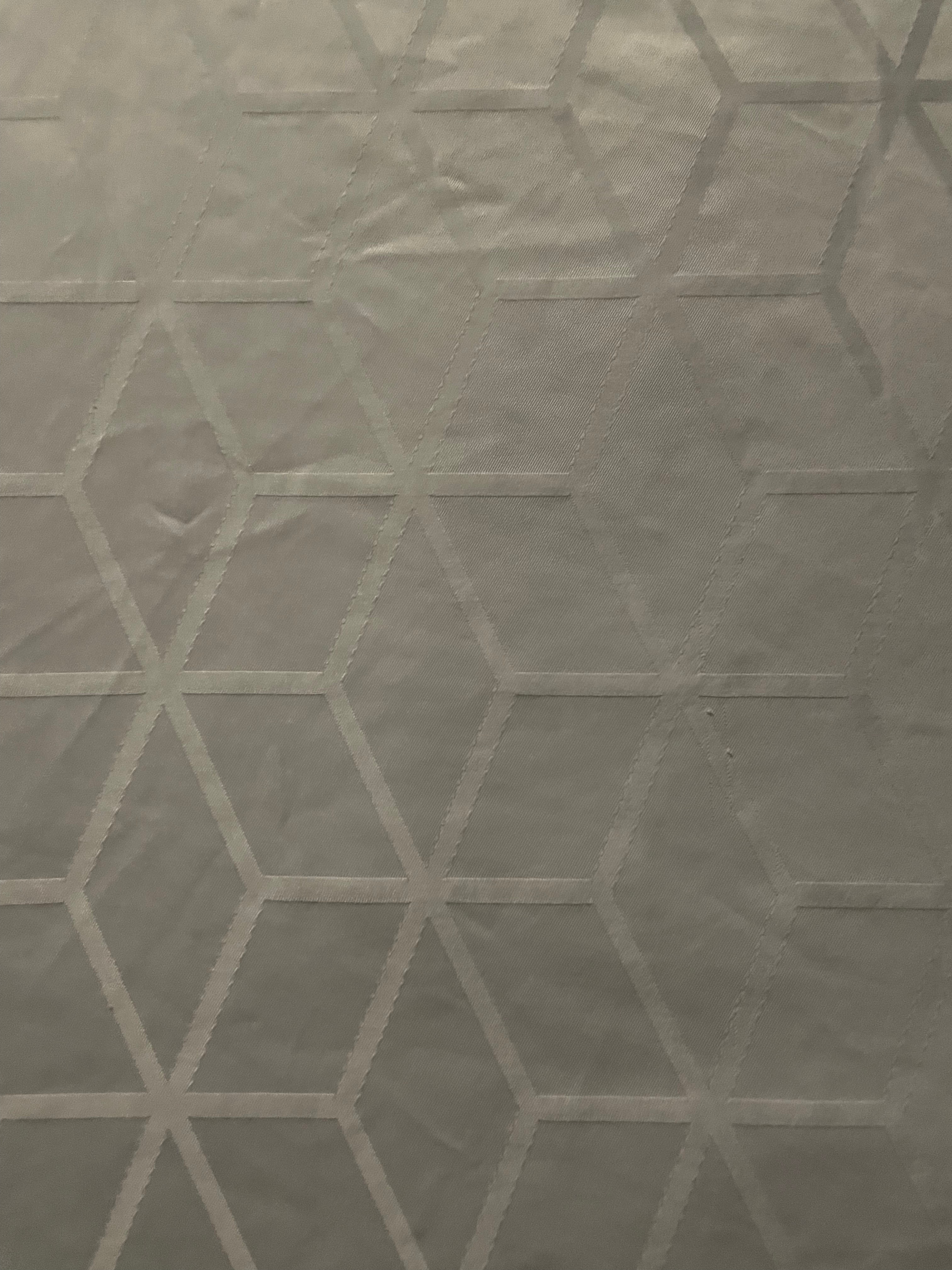
Now, onto the wallpaper. This was present in many different Holliday Inn Express hotels. Here’s the photo I took:

Here it is after I unskewed, cropped, and lightened it in GraphicConverter:
This raises a lot of questions:
- What is the repeating unit here?
- Which wallpaper group is it?
- What’s with all those lines that don’t meet the other side? Would the pattern make any more sense if I completed them?
- Is there some kind of pattern to the way the rectangles, the rectangles divided into triangles, and the rectangles with unfinished lines in them are arranged?
Okay, to answer the first question, here I’ve cropped it to show enough of the repeating units to recreate the whole thing, and converted it to black and white so we’re not distracted by the lighting:

At this point I switched from GraphicConverter to OmniGraffle. Here I’ve drawn in the repeating tiles:
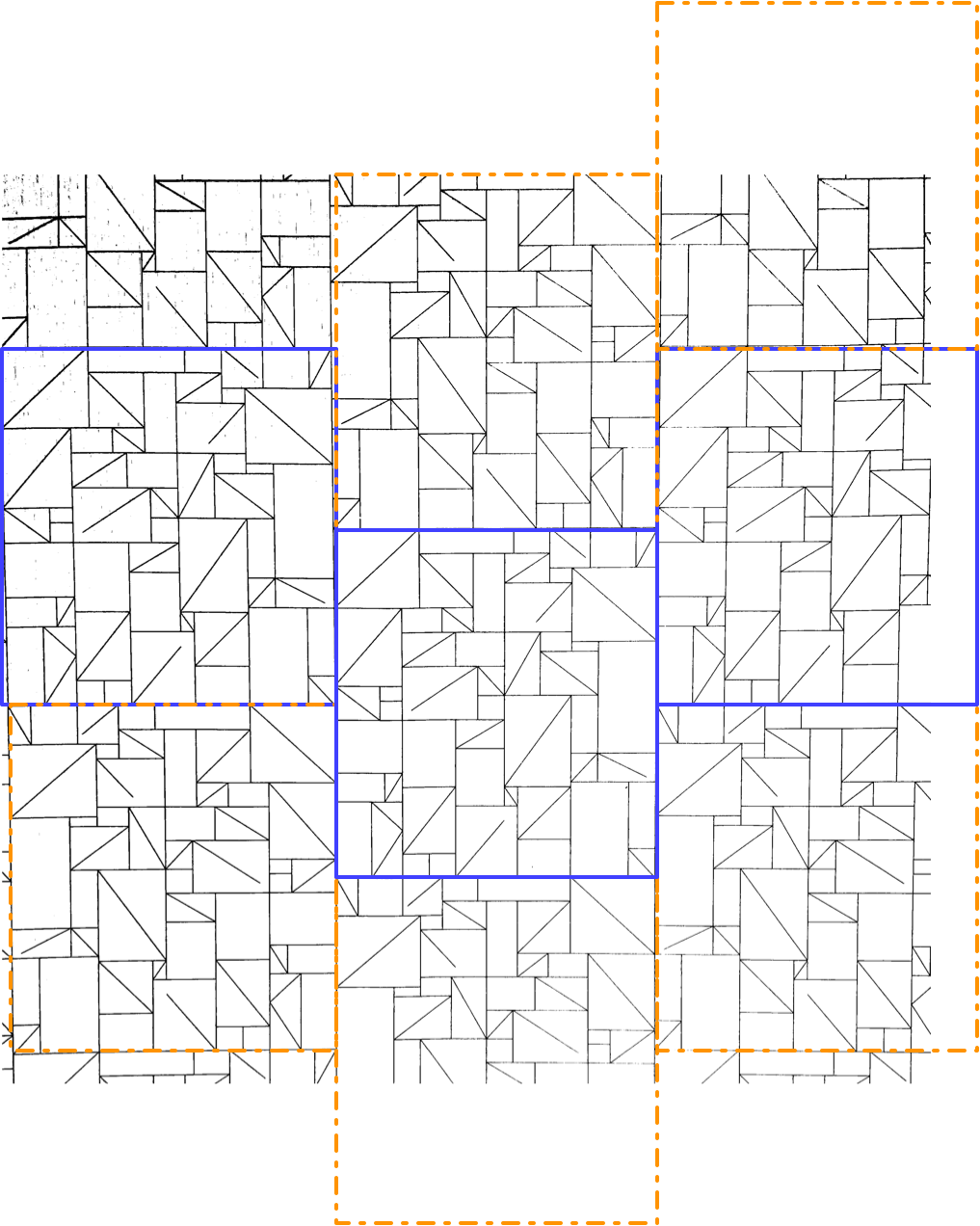
There are two kinds of tile, which I’ve outlined in solid purple and dashed orange. Vertically, the two kinds of tile alternate. Each column of tiles is offset vertically by half a tile from the ones next to it, so if you follow across the wallpaper, you’ll be alternating between top and bottom halves of tiles, and they might all be the same kind of tile, or they might be alternating kinds of tile, depending on where you start.
It took me a while to realise (actually, I think Joey pointed it out), but the orange tile is in fact the same as the purple tile, just flipped horizontally. That means we have what’s called a glide symmetry, or glide reflection — it’s like a reflection, but the reflection is moved along. The classic example of a glide symmetry is a trail of footprints — the two feet are mirror images of each other, but since they were walking when they made the footprints, they are never exactly next to each other.
So that means we can answer the question about wallpaper groups. It’s a rectangular lattice with only glide symmetries, no rotations or reflections. That’s called pg, and you can see other examples of it on wikipedia.
Here’s a single tile of it, from which we can construct the whole wallpaper:
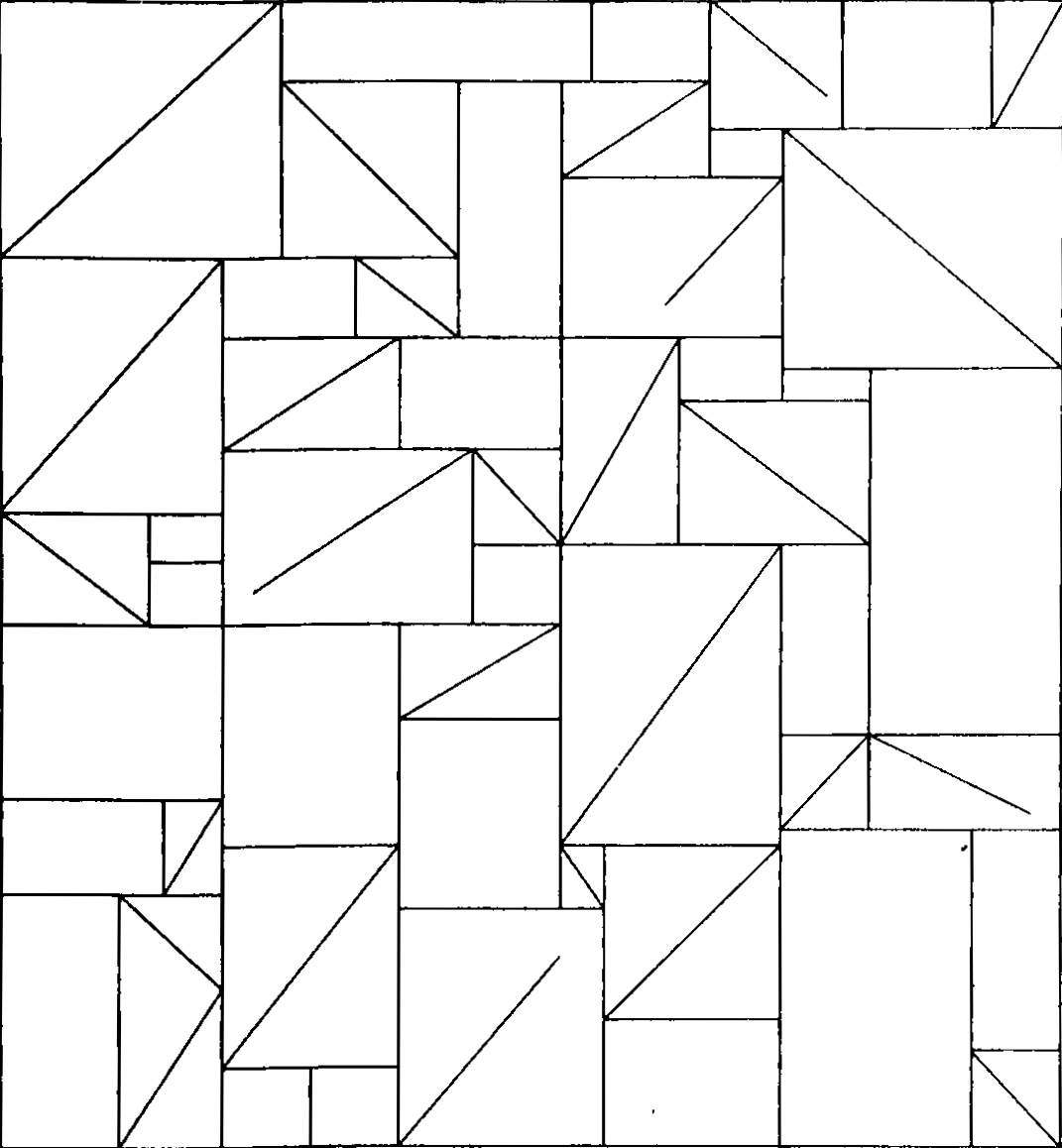
It has 43 triangles (mostly in rectangles divided into two triangles, but there’s one divided into three triangles on the bottom left), 24 plain rectangles, and 5 rectangles that have a diagonal line going partway across them.
Okay, so onto question three. What’s with those lines that don’t quite reach the other side? Here, I completed them, and approximately measured the angles using the arc tool in OmniGraffle (I use OmniGraffle for a lot of things that aren’t graphs. For instance, this quark explainer, and the icon of my next app.)

There. Is that enlightening? No. Is that satisfying? Also, no. Two of the lines pretty much reach the other corner, if you squint, and three of them don’t. But perhaps knowing that you can give up on making any sense of this will give some relief.
Ah, but what about the arrangements of the three kinds of rectangle? Surely there’s something interesting about that. I haven’t found it, but maybe you could. Here’s a single tile, with a purple rectangle pattern for the plain rectangles, a pink zigzag pattern for rectangles divided into triangles, and a green pattern of short lines for rectangles with maddening partial lines in them. I’m not sure how useful the redundant coding is here, but it can’t hurt.
I’m not sure why I didn’t colour the three-triangle rectangle near the bottom left in a different colour from the two-triangle rectangles. I made these a while ago. [Next day edit: This bothered me too much to ignore. See below for a version with a different colour for that rectangle.]
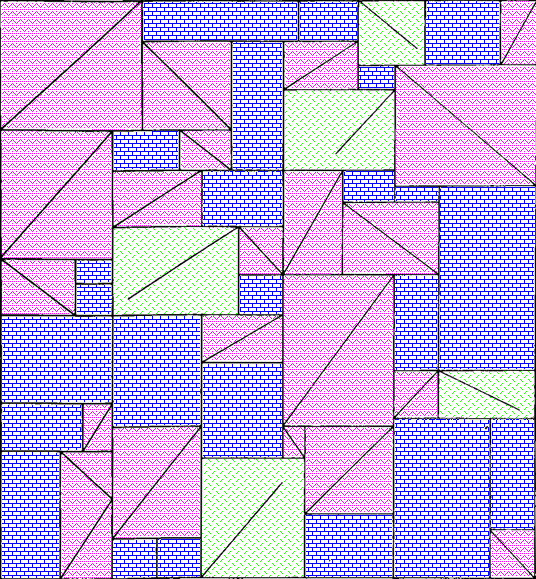
I can imagine the letter P and a dog standing on its hind legs in pink, but I don’t think there’s any kind of hidden message here. Just to be sure, here’s the colourised version extended to show more of the wallpaper:

Well now perhaps there are a bunch of dogs walking past each other doing the can-can. Do you see any interesting geometry or other mathematics that I missed in any of these images?
Next-day edit: Here’s a version with the three-triangle rectangle in checkered orange. I accidentally used a different shade of pink, but the shade of pink had no mathematical value, so it’ll do:
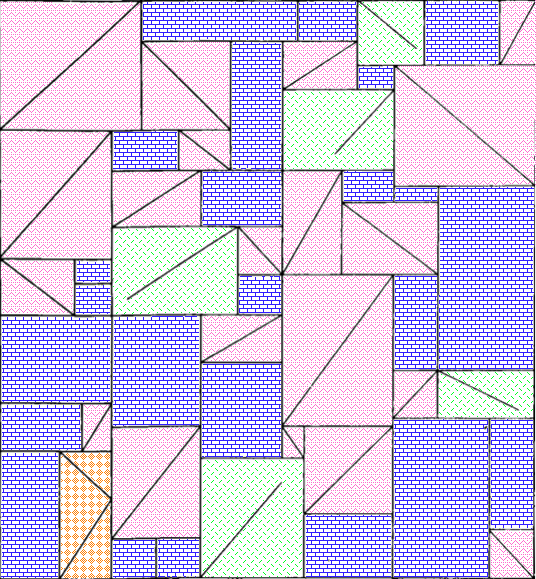
And here’s a larger section of wallpaper using that version:

When I took these photos, I thought they might make a good talk at the MathsJam Annual Gathering. We ended up deciding not to go this year (though we’ll probably join virtually) so I won’t be giving that talk. I have also made a new app which could be the focus of a MathsJam talk. I have submitted it to the App Store, so I hope it will be out very soon.
On the subject of apps, I got a job offer, though I haven’t started work yet. That means I’ve released a new version of Seddit, my text-to-speech-focused Reddit reader, where the only update is that it no longer says I’m looking for work on the ‘Support Seddit’ tab of the settings.
Seddit 1.5 supports multilingual Reddit listening. Also, Joey sang my half-baked PSOLA song!
Posted by Angela Brett in My Software on October 9, 2025
A while ago I added the possibility to configure Seddit (my text-to-speech-focused hands-free Reddit client for macOS and iOS) with multiple voices so that each user’s content could be read in a different voice. Of course, iOS and macOS come with voices that speak a huge variety of different languages, so you could theoretically select, say, a Japanese voice, a French voice, and three English voices, and download Reddit posts and comments in all of those languages. However, until now, Seddit would randomly assign a voice to each user, without regard for the language that user had written in, so if you did that, you could end up with English posts pronounced as if they were French, Japanese character names read out in English, and so on.
In the latest version, if you select voices that speak multiple languages in the Voices tab of the Settings screen, when Seddit encounters a post or comment by a user it hasn’t chosen a voice for yet, it will detect which of those languages the post or comment is probably in, and choose a voice that knows how to pronounce that language.
Of course, this isn’t perfect — it still always uses the same voice for each user, so if a user sometimes posts in French, and sometimes in English, or if they write in multiple languages within a single post because it’s a language-learning subreddit, then some of that is going to be spoken using an inappropriate voice. Also, if someone only writes in English but the first comment that Seddit encounters of theirs is an image meme and the text ‘c’est la vie!’ Seddit might determine that the user speaks French, and then hilariously mispronounce the rest of their posts. Note, if there is not enough text in the user’s first post for Seddit to even guess the language, it will not definitively choose a voice for that user until it encounters another post by them. I have yet to find either of these situations in practice, even while looking for them, so I hope it’s a rare issue.

Nonetheless, all of these situations are better than Seddit just randomly picking a voice for each user, regardless of which language they happen to be writing in. You should try it out, especially if you want to listen to Reddit content in various languages!
I also redesigned the Settings screen on iOS and iPadOS so it’s fullscreen and has a close button in the top right, as per Apple’s human interface guidelines, instead of a ‘Done’ button taking up a lot of space at the bottom and making the tabs look weird.
Note, while writing this post, I tested the regular ‘Start Speaking’ menu command on macOS and the ‘Speak’ command on iOS and found that it will sometimes switch to appropriate voices if I select multilingual text, even if my System Speech Language est réglé sur えい語。 Okay, it doesn’t work well for the French/English parts of that sentence. Maybe it’s only good with switching between languages if I switch scripts, e.g. בַּרְוָזָן утконос カモノハシ. Yep, that works, although if I select any other text along with πλατύπους, it’ll read it as ‘Greek small letter pi’ etc. I guess Greek letters are used too often in English for the speech engine to assume we actually switched to Greek. There were certainly plenty of Greek letters in the Princeton Companion to Mathematics.
Anyhow, I’m thinking I could improve Seddit further by giving each user a voice in each language you’ve selected voices for, and detecting the language for each post/comment, or for each sentence. Though macOS doesn’t do that unless you switch scripts… when I tried adding ‘J’imagine qu’il choisit une nouvelle langue pour chaque phrase.’ as a separate sentence and selected it along with a few English sentences, it read the whole thing in a French voice.
On the subject of interesting text-to-speech behaviour, and interesting behaviour in general, remember my half-written Lola parody about Pitch Synchronous Overlap and Add? Well, the lovely Joey Marianer had an appointment in town a while ago, and sneakily recorded the song in a parking building as a surprise, because I’m usually home so there’s little chance to record things at home without my hearing. I was duly surprised and delighted. Even the disclaimer about the missing bridge sounds like it scans as a bridge! Now you can also be surprised, delighted, and probably confused as to why this half-baked song was considered worth singing.
James Webb Space Telescope (now actually sung) and Seddit 1.4
Posted by Angela Brett in My Software, video on September 26, 2025
In my last post I gave lyrics to a parody of an Arrogant Worms song about the James Webb Space Telescope, and an update to my text-to-speech focussed Reddit client Seddit. I also said two things that turned out to be false:
- Joey and I will probably sing this parody, but it will take more mixing and video editing than our usual songs.
- This completes all the major features I have planned the app — I have other ideas for improvement, but I don’t think they’re essential. I’m hoping that the next update will be simply to remove the text saying I’m looking for a job.
Well, the other night Joey asked if I wanted to sing the song, and I said, “Okay! I should change into a more space-related shirt first” and then Joey produced two James Webb Space Telescope T-shirts out of nowhere, having secretly ordered them previously. So we changed into the shirts, and then we sang it, directly into a camera together, with no warmup or practice, and Joey trimmed the ends and put the video on YouTube. I had thought we’d sing our separate parts, get them perfect, then mix them, and make a video with some relevant educational images. Instead, here’s an imperfect but pretty good recording already!
I know where I made a mistake, but I’m not going to hang a lampshade on it so you’ll notice.
As for Seddit, well, not only did I not get the job I was hoping for when I wrote that, I also decided to update the app to use the new Liquid Glass design language that came out with iOS and macOS 26. I found and fixed a few other issues along the way. Here are the changes in Seddit 1.4:
- Features
- Added support for liquid glass appearance in iOS/macOS 26
- Moved playback controls to a liquid glass overlay so you can see more content around the edges
- Bug fixes
- Made sure compliments purchased on the Support Seddit screen are always shown in the same order
- Made the Voices Settings screen on macOS show which voices are Enhanced or Premium (I also filed bug FB20362911 with Apple about this, because there’s some system behaviour that’s inconsistent between iOS and macOS)
- Fixed an issue introduced in Seddit 1.2 whereby posts whose comments are not all read would be shown as read instead of partly read
You can get the latest version for Mac, iPhone, or iPad on the relevant App Store.
On the subject of songs and liquid glass, check out this song by James Dempsey about liquid glass:
Thanks to Seattle Xcoders, I was lucky enough to have seen the live debut of this, and another performance of it, which I recorded but don’t have permission to share yet.
I haven’t actually had any legibility issues with liquid glass though — and if I did, I know I could always turn on Reduce Transparency.
James Webb Space Telescope (Arrogant Worms parody lyrics) and yet another Seddit update
Posted by Angela Brett in My Software on September 15, 2025
This is to be sung to the tune of Big Fat Road Manager, by The Arrogant Worms:
Giant rocket to the sky
Not many people really know why
It’s gotta stay cool as the stars parade
It’s got a gold coat and some doped ass-shades
It’s the James Webb Space Telescope
James Webb Space Telescope
James Webb Space Telescope
James Webb Space Telescope!
It beat a hurricane and lots of delays
(James Webb Space Telescope)
Refused to fail in three hundred ways
(James Webb Space Telescope)
It had a long time and a lot to do
(James Webb Space Telescope)
On its way to Lagrange point two
It’s the James Webb Space Telescope
James Webb Space Telescope
James Webb Space Telescope
James Webb Space Telescope
It found a new moon and some old black holes
(James Webb Space Telescope)
A planet circling a mate of Sol’s
(James Webb Space Telescope)
Its pictures show 8-pointed stars
(James Webb Space Telescope)
That’s how you can tell they are
From the James Webb Space Telescope
James Webb Space Telescope
James Webb Space Telescope
James Webb Space Telescope
You may wonder why the space telescope’s so far
That way it can block the heat from our Earth and Moon and Star
It sees through clouds in infrared
(James Webb Space Telescope)
Back through time as the wavelengths spread
(James Webb Space Telescope)
So far back that now it sees
(James Webb Space Telescope)
Light from earliest galaxies
As our James Webb Space Telescope
James Webb Space Telescope
James Webb Space Telescope
James Webb Space Telescope
It’s still our James Webb Space Telescope
James Webb Space Telescope
James Webb Space Telescope
James Webb Space Telescope
∎
Recently I remembered that I’d started writing this parody back when the James Webb Space Telescope launched. So I filled in some of the gaps, and then watched this excellent documentary about the telescope to fill in some more:
I found out about that documentary from NASA’s Curious Universe podcast, which I found out about from NASA’s Houston We Have a Podcast podcast. I recommend both, but especially the latter.
I considered saying it had ‘huge-ass shades’ as a reference to the ‘big fat ass’ in the original lyrics, but then I discovered that the sunshades were coated with doped silicon, and I couldn’t resist making a reference to the phrase ‘dope-ass’ while also doing the xkcd 37 thing. They are ‘ass shades’ in a sense, because they’re behind the telescope, i.e. on the side it’s not looking towards.
I’ve put links in the lyrics to some of the things where I could find a specific-enough link. The hurricane referred to is Hurricane Harvey, which hit Texas while the JWST was undergoing testing in a cryogenic vacuum chamber. As you’ll see in the documentary, it was a nail-biting time! The next line refers to the 344 potential single-point failures during launch and deployment which there wouldn’t have been a way to recover from. Really there were a lot of nail-biting times. But it all went well!
I linked to NASA’s explanation of Webb’s diffraction spikes, but I think this diagram from wikipedia also shows it very well.
Joey and I will probably sing this parody, but it will take more mixing and video editing than our usual songs. On the other hand, I can hear Joey singing it in the other room as I type this, so it might be ready fairly soon.
In other news, I’ve released version 1.3 of my text-to-speech-focussed reddit client for macOS and iOS, Seddit. Here’s what I changed:
- Added ‘Go to currently speaking item’ button in the toolbar, so you can quickly find the post or comment that’s currently being spoken, e.g. to open links or open the post in a browser to respond
- Enabled the ‘Settings…’ menu item and standard Settings window style on macOS
- Added headings and other changes for improved navigation of posts and comments using VoiceOver or Switch Control.
This completes all the major features I have planned the app — I have other ideas for improvement, but I don’t think they’re essential. I’m hoping that the next update will be simply to remove the text saying I’m looking for a job. 🤞🏻
So I leave my bags behind (Galilee Song parody, now actually sung!) and another new version of Seddit
Posted by Angela Brett in My Software, video on September 2, 2025
Hey look, Joey Marianer sang the parody song lyrics from my last post! Check there for the lyrics and the aviation incidents referenced.
There are some more song parody lyrics, but first, a word from my sponsor: me. Just like last time, I’ve released a new version of Seddit, my text-to-speech-focussed Reddit client for macOS and iOS. This has a feature I’ve wanted to add for a while — the possibility to select multiple voices, and read each user’s posts and comments in a different one. The variety makes it easier to keep paying attention when listening for a long time, and having each user consistently use the same voice should make it easier to follow conversations.
I made some other changes in this version too. Here’s a full list of them:
Features
- Added the possibility to have each user’s posts and comments spoken in a different voice
- Added settings for whether to read out the subreddit name, and date and time for each post.
- Added the option to load no comments — this was for Joey, who wanted to try listening to short story subreddits while obeying the “don’t read the comments” rule of the internet.
Bug fixes
- Fixed a bug whereby turning off the ‘Say “Link” instead of reading out URLs’ setting would not work
- Fixed a bug where comments that weren’t loaded would be read as “comment by unknown user” Comments that aren’t loaded due to the comment depth settings are also no longer displayed.
- Fixed a potential crash when opening the app if posts had been deleted on another device
On the subject of text-to-speech, nine or ten years ago I read a book and a bunch of papers on speech synthesis in order to write a term paper for my Web Development for Linguistics degree. The term paper was longer than the text of my thesis, because my thesis also included source code for a web site and a Mac app. Anyway, from this book I learnt about PSOLA (Pitch Synchronous Overlap and Add) which is used to change the pitch and duration of sounds for text-to-speech, as one might do to change prosody, or create a robot choir.
Newer voices don’t use PSOLA so much, as (to put it simply) they have more samples of actual speech in different situations, so they don’t need to modify samples for the sake of prosody. Note, this is ‘newer voices’ as of a decade or two ago; I don’t know whether the latest crop of ML-based voices do things the same way. Anyway, I assume this is why the newer macOS voices don’t support the TUNE format I used for my robot choir.
At the time, I wrote an utterly silly partial parody of Lola, by The Kinks, about PSOLA. I thought maybe I’d finish it or maybe even make it less silly[why?], but I never did, and now I don’t remember enough about how PSOLA works to fully understand what I originally wrote. So here is that draft. It really doesn’t scan, but I hope it doesn’t scan in amusing ways:
I was trying to synthesise some prosody,
but my source and filter were mixed up just like granola
G-R-A-N-O-L-A, granola.
So I found a new way to make it sound rad
It’s called pitch-synchronous overlap and add, that is PSOLA
P-S-O-L-A PSOLA. Pso-pso-pso-P-SOLA.
Well I didn’t want to sound like a smallpox blight
So I really took care with my to get my epochs right
for PSOLA. Pso-pso-pso-P-SOLA.
If you’re not dumb then you’ll soon understand
How I speak like a woman then sound like a man
It’s P-SOLA. Pso-pso-pso-P-SOLA. Pso-pso-pso-P-SOLA.
[It doesn’t look like I wrote anything for the bridge (is that a bridge?) of the song, so just pretend it keeps going roughly like before]
It was used to make synthesized speech sound natural
But now there’s some super-sized features that fill that role-uh
R-O-L-E hyphen U-H role-uh
So that’s my guess if you’re wondering why r-
ecent voices don’t sing in my robot choir:
No PSOLA.

This work is licensed under a Creative Commons Attribution-Noncommercial-Share Alike 3.0 Unported License.
Please tell me if you do something cool with it.


