Posts Tagged space
A Golden Apple Anniversary
Posted by Angela Brett in News on April 2, 2026
April 1, 2026 is the 50th anniversary of the founding of Apple, Inc. That’s a golden jubilee! I’m not quite that old, but for my birthday in 2001 ago my mother gave me a gold Apple logo pendant that she’d had a manufacturing jeweler make for me. My oldest brother, a staunch Windows user, gave me a copy of Mac OS X (back in those days, Apple still charged for operating systems.) A year earlier, my sister had got Steve Wozniak to call me on my birthday, and not long after that, Woz had bought me an iBook to replace a laptop that was stolen. So you can see how these were perfectly appropriate gifts — I did, thanks to Woz, have a Mac capable of running Mac OS X. This was a few years before that time Steve Wozniak taught me to Segway and then played Tetris and pranks through a concert, but that’s not quite relevant to this story — it’s just to help set the scene for yet another ridiculous Apple story.
Here’s what that Apple pendant looked like in 2015, pictured with a Space Shuttle orbiter pendant I’d just bought at Kennedy Space Center:
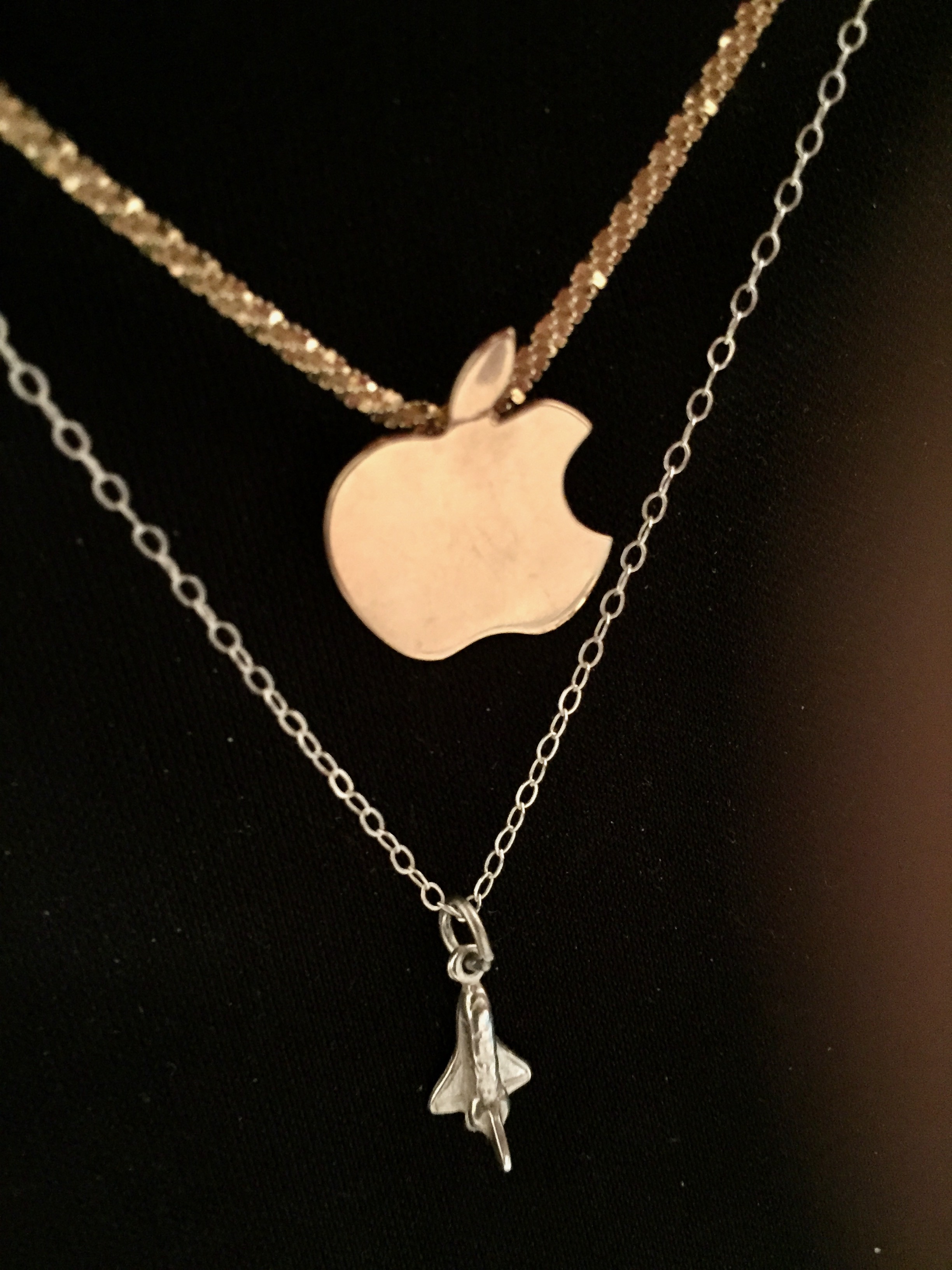
It was still in pretty good nick at that point.
Over the years, the leaf got bent backwards a little, and the chain broke and was replaced or fixed a few times, but I never lost the pendant.
On December 10, 2025, I arrived at work to discover the chain hanging open on my neck, snapped. The pendant was gone. I checked everywhere I’d walked in the building, and later checked Joey’s car, the work (non-space) shuttle, and various places around the house where it might have fallen off, but it was nowhere to be found. I could only hope that my golden Apple had ended up being inanimate happily every after near an Apple building.
The lovely Joey Marianer (to whom, in a ridiculous stroke of luck which can only foreshadow the end of this story, I am married!) bought me a smaller Apple logo pendant for Christmas! How sweet! So I got the chain repaired and all was right with the world.
On 28 January, 2026, Joey and I pulled up at the Park & Ride whence I take a (non-space) shuttle to work. As I opened the door to get out, I saw my original Apple pendant right there on the ground next to the car. I made excited noises, passed it to Joey, and hurried to get on the (still not space) shuttle.
Later I was able to inspect the pendant’s shiny new battle scars. Here’s what it looked like after 49 days (that’s a generous count of Liz Truss’s time as Prime Minister of the UK!) in a parking lot being run over:
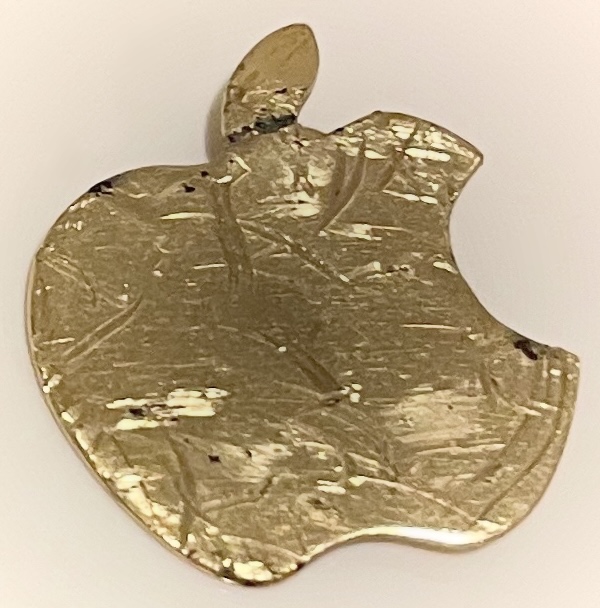
Isn’t it pretty? The loop at the back which the chain goes through is bent, but still open enough that the chain can fit through it. I could probably get it ‘fixed’ but I don’t want to erase a story like this.
Here are both the pendants together, with some cheap spacer beads between them, shown over the 50th anniversary T-shirt I wore today:
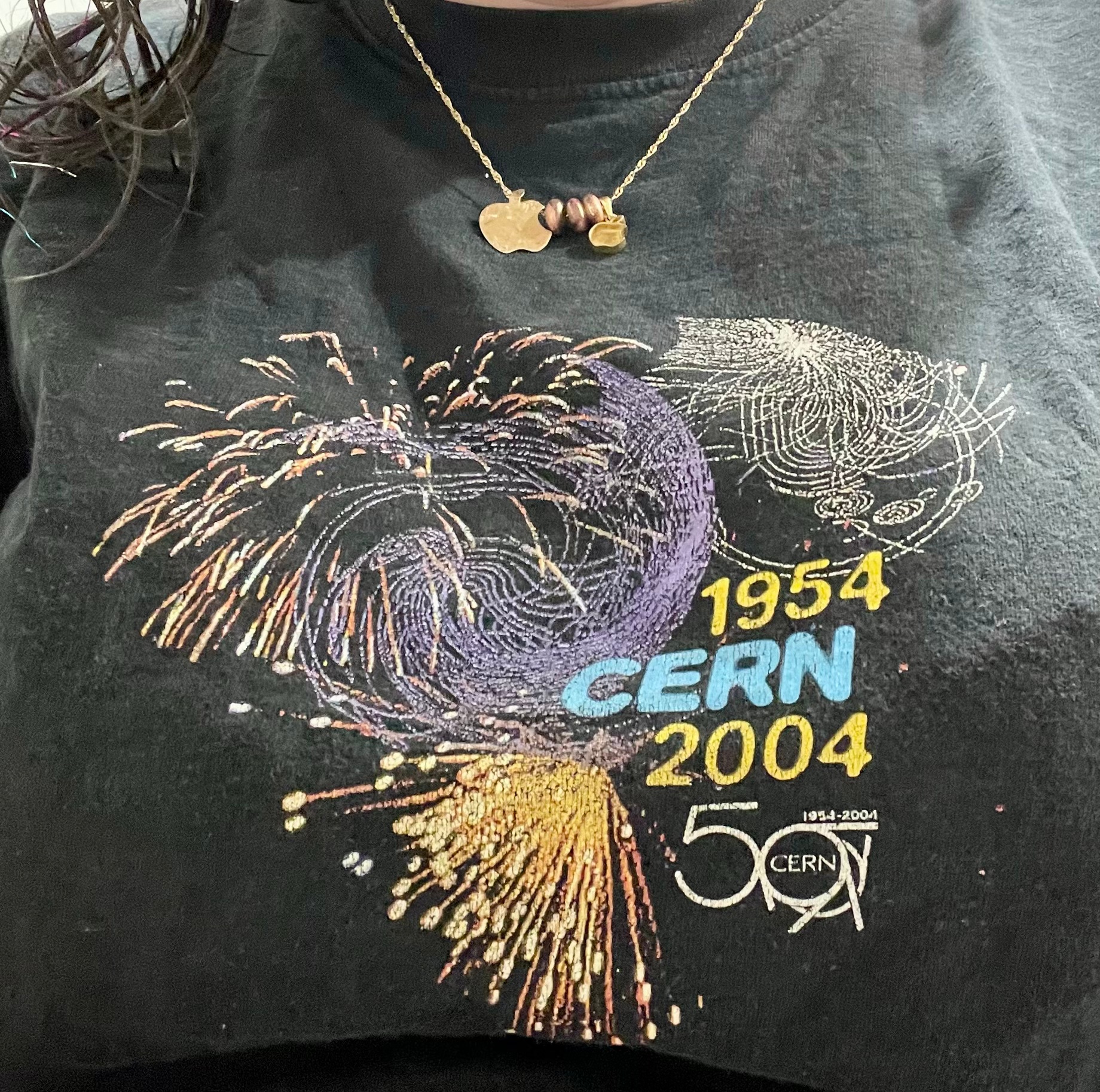
I don’t have an Apple 50th Anniversary T-shirt, so I made do with a CERN one. On the subject of CERN, check out their April Fools joke today.
And on the subject of space (not shuttles), check out the Artemis II mission which launched today!
And finally, on the subject of Apple’s 50th anniversary, check out this video of an event at the Computer History Museum a few weeks ago. I haven’t watched it yet (I was going to watch it today but barely have time to write this blog post) but I’m sure it’s interesting.
In unrelated news, Joey and I sang some Dumb Parody Ideas at MarsCon last month (one about rubber duck debugging, one about garbanzo beans, and one which we’ll need to make a better recording of) but I’ll make a separate post about them later. I also went on JoCo Cruise 2026 and will be uploading many hours of video of that to YouTube in the coming months.
James Webb Space Telescope (now actually sung) and Seddit 1.4
Posted by Angela Brett in My Software, video on September 26, 2025
In my last post I gave lyrics to a parody of an Arrogant Worms song about the James Webb Space Telescope, and an update to my text-to-speech focussed Reddit client Seddit. I also said two things that turned out to be false:
- Joey and I will probably sing this parody, but it will take more mixing and video editing than our usual songs.
- This completes all the major features I have planned the app — I have other ideas for improvement, but I don’t think they’re essential. I’m hoping that the next update will be simply to remove the text saying I’m looking for a job.
Well, the other night Joey asked if I wanted to sing the song, and I said, “Okay! I should change into a more space-related shirt first” and then Joey produced two James Webb Space Telescope T-shirts out of nowhere, having secretly ordered them previously. So we changed into the shirts, and then we sang it, directly into a camera together, with no warmup or practice, and Joey trimmed the ends and put the video on YouTube. I had thought we’d sing our separate parts, get them perfect, then mix them, and make a video with some relevant educational images. Instead, here’s an imperfect but pretty good recording already!
I know where I made a mistake, but I’m not going to hang a lampshade on it so you’ll notice.
As for Seddit, well, not only did I not get the job I was hoping for when I wrote that, I also decided to update the app to use the new Liquid Glass design language that came out with iOS and macOS 26. I found and fixed a few other issues along the way. Here are the changes in Seddit 1.4:
- Features
- Added support for liquid glass appearance in iOS/macOS 26
- Moved playback controls to a liquid glass overlay so you can see more content around the edges
- Bug fixes
- Made sure compliments purchased on the Support Seddit screen are always shown in the same order
- Made the Voices Settings screen on macOS show which voices are Enhanced or Premium (I also filed bug FB20362911 with Apple about this, because there’s some system behaviour that’s inconsistent between iOS and macOS)
- Fixed an issue introduced in Seddit 1.2 whereby posts whose comments are not all read would be shown as read instead of partly read
You can get the latest version for Mac, iPhone, or iPad on the relevant App Store.
On the subject of songs and liquid glass, check out this song by James Dempsey about liquid glass:
Thanks to Seattle Xcoders, I was lucky enough to have seen the live debut of this, and another performance of it, which I recorded but don’t have permission to share yet.
I haven’t actually had any legibility issues with liquid glass though — and if I did, I know I could always turn on Reduce Transparency.
James Webb Space Telescope (Arrogant Worms parody lyrics) and yet another Seddit update
Posted by Angela Brett in My Software on September 15, 2025
This is to be sung to the tune of Big Fat Road Manager, by The Arrogant Worms:
Giant rocket to the sky
Not many people really know why
It’s gotta stay cool as the stars parade
It’s got a gold coat and some doped ass-shades
It’s the James Webb Space Telescope
James Webb Space Telescope
James Webb Space Telescope
James Webb Space Telescope!
It beat a hurricane and lots of delays
(James Webb Space Telescope)
Refused to fail in three hundred ways
(James Webb Space Telescope)
It had a long time and a lot to do
(James Webb Space Telescope)
On its way to Lagrange point two
It’s the James Webb Space Telescope
James Webb Space Telescope
James Webb Space Telescope
James Webb Space Telescope
It found a new moon and some old black holes
(James Webb Space Telescope)
A planet circling a mate of Sol’s
(James Webb Space Telescope)
Its pictures show 8-pointed stars
(James Webb Space Telescope)
That’s how you can tell they are
From the James Webb Space Telescope
James Webb Space Telescope
James Webb Space Telescope
James Webb Space Telescope
You may wonder why the space telescope’s so far
That way it can block the heat from our Earth and Moon and Star
It sees through clouds in infrared
(James Webb Space Telescope)
Back through time as the wavelengths spread
(James Webb Space Telescope)
So far back that now it sees
(James Webb Space Telescope)
Light from earliest galaxies
As our James Webb Space Telescope
James Webb Space Telescope
James Webb Space Telescope
James Webb Space Telescope
It’s still our James Webb Space Telescope
James Webb Space Telescope
James Webb Space Telescope
James Webb Space Telescope
∎
Recently I remembered that I’d started writing this parody back when the James Webb Space Telescope launched. So I filled in some of the gaps, and then watched this excellent documentary about the telescope to fill in some more:
I found out about that documentary from NASA’s Curious Universe podcast, which I found out about from NASA’s Houston We Have a Podcast podcast. I recommend both, but especially the latter.
I considered saying it had ‘huge-ass shades’ as a reference to the ‘big fat ass’ in the original lyrics, but then I discovered that the sunshades were coated with doped silicon, and I couldn’t resist making a reference to the phrase ‘dope-ass’ while also doing the xkcd 37 thing. They are ‘ass shades’ in a sense, because they’re behind the telescope, i.e. on the side it’s not looking towards.
I’ve put links in the lyrics to some of the things where I could find a specific-enough link. The hurricane referred to is Hurricane Harvey, which hit Texas while the JWST was undergoing testing in a cryogenic vacuum chamber. As you’ll see in the documentary, it was a nail-biting time! The next line refers to the 344 potential single-point failures during launch and deployment which there wouldn’t have been a way to recover from. Really there were a lot of nail-biting times. But it all went well!
I linked to NASA’s explanation of Webb’s diffraction spikes, but I think this diagram from wikipedia also shows it very well.
Joey and I will probably sing this parody, but it will take more mixing and video editing than our usual songs. On the other hand, I can hear Joey singing it in the other room as I type this, so it might be ready fairly soon.
In other news, I’ve released version 1.3 of my text-to-speech-focussed reddit client for macOS and iOS, Seddit. Here’s what I changed:
- Added ‘Go to currently speaking item’ button in the toolbar, so you can quickly find the post or comment that’s currently being spoken, e.g. to open links or open the post in a browser to respond
- Enabled the ‘Settings…’ menu item and standard Settings window style on macOS
- Added headings and other changes for improved navigation of posts and comments using VoiceOver or Switch Control.
This completes all the major features I have planned the app — I have other ideas for improvement, but I don’t think they’re essential. I’m hoping that the next update will be simply to remove the text saying I’m looking for a job. 🤞🏻
The Impossible Journey (a song)
Posted by Angela Brett in News, Things To Listen To on March 21, 2020
With The Terrible Trivium being a little too tedious for the judges’ tastes, The Quantifiers were eliminated from round 2 of SpinTunes #16, but the competition encourages ‘shadow’ entries from people not competing, so we wrote a song for the next round anyway. The challenge was:
Write an uplifting song to sing for a Graduation, Dedication, Bar/Bat Mitzvah, Funeral, Baptism, or similar event.
We decided to continue writing songs about The Phantom Tollbooth. Joey came up with the idea of writing a song for the ceremony at the end of the book celebrating the protagonists’ rescue of Rhyme and Reason. I thought we could recap the events of the book in such a way that the lyrics could also be interpreted to be about any celebration of somebody’s hard-won achievements. Here’s the song we ended up with:
Here are the rest of the entries:
We got the challenge on Saturday morning (in my timezone), with the deadline being the following Sunday, and the next Thursday we were both flying to Minnesota for MarsCon 2020. Usually I start off by writing a full draft of the lyrics over the weekend, and then I sit back while Joey writes music for it, sings it, creates instrumentals, and mixes the recording. We didn’t want to take time out of MarsCon mixing a song, so I thought we’d probably end up recruiting some of the musicians at MarsCon to perform a live version.
Instead, while we were discussing it over videochat on Saturday morning, Joey immediately recorded a trumpet tune and sent it to me. That afternoon, I sent lyrics to that tune as a chorus, and suggested writing verses abstractly describing the things the characters had fought through. I planned to read the book on the plane so I could have the lyrics written by the time we met in Minnesota.
That night before I went to bed, I sent Joey a recording of myself singing a couple of possible lines for the verses, in a tune I’d made up based on the chorus tune. On Sunday evening, Joey sent back a recording of my chorus lyrics with extra trumpets, just as you hear it in the final song.
On Monday, I felt like I was way behind in my part of the song, so that evening, I skimmed through the book and wrote a line for each scene, unrhymed, and a final eight resonably rhymed lines about the scene where Rhyme and Reason were rescued. I arranged the unrhymed lines in quatrains with the fourth line of each a little shorter, and choruses between them.
By Tuesday morning, Joey had already recorded a great ‘quick and dirty’ version of the song, with more instrumentation than our previous songs had. It had fewer choruses than I’d imagined, and the last four rhymed lines were cut. I submitted that one as a ‘safety’ in case we didn’t manage to finish a better recording, but I also pointed out some small things which could be improved.
On Thursday morning, I got up at something like 4a.m to go to the airport, and Joey had sent an updated recording, so I quickly updated our Spintunes submission before getting ready to leave. That was our final entry, and I like it more than the songs we spent the full week on. I probably should have taken the time to fix the slightly shorter lines that were once at the ends of quatrains though — one of the judges commented on how they didn’t fit properly into the tune.
The final four lines, in case you are interested, were:
Your every action has a tiny effect
To never fail would be a sorrow
What one day seems useless will later effect
the wonderful secrets of tomorrow
‘The wonderful secrets of tomorrow’ being a direct quote from the book.
The prompt for the fourth round of Spintunes was:
Write a song about something that seemed a good idea at the time, but ended very badly. Maybe you should have given it a little more thought…
We did not submit a shadow for it, since we were busy on JoCo Cruise (and yes, we considered writing one about going on a cruise during a pandemic), but here are others’ entries:
The world was quite different when we got back to port, with all future cruises and many flights being cancelled, but as far as I know we all made it home, and nobody on our cruise had the virus. I’m now staying at home, like most of you, and uploading my 29 hours or so of JoCo Cruise videos — so far, the New Monkey Orientation and part of the first Red Team concert. Subscribe to my channel if you want to see the rest, but be warned that there will be a lot of uploads over the coming months, so they might flood your recommendations or notifications.
And now for something completely different: I’ve also uploaded a guided tour of Space Shuttle orbiter Atlantis, recorded a few days before the cruise:
I recommend watching this immediately after the full pre-show video I uploaded earlier, if you haven’t seen that already. Joey and I also sang a few things at a song circle at MarsCon, but perhaps I’ll put those in a different post.
GloPoWriMo 2019
Posted by Angela Brett in NaPoWriMo on May 30, 2019
Last November, instead of NaNoWriMo (National Novel Writing Month) I created NanoRhymo, where I wrote a tiny poem every day inspired by a random rhyme from my rhyming dictionary, rhyme.science. April was GloPoWriMo (Global Poetry Writing Month — NaPoWriMo/National Poetry Writing Month to people from unknown nations who think ‘national’ gives their invented holidays a more realistic sheen) so I decided to do the same thing. Here are the poems I wrote.
Day 1, inspired by the rhyme propounds and zounds:
I see the news, and holler ‘Zounds!
That’s downright nuts! That is not cool!’
To see the thoughts that he propounds
I *hope* it’s all an April fool.
Day 2, inspired by the rhyme shenanigan and Flanagan:
There once was a rascal named Flanagan
who magnified ev’ry shenanigan
and when they were caught
repented, quite fraught,
then made their escape and and began again.
Day 3, inspired by the rhyme excavations and replication’s, and also a line from Jurassic Park:
After careful excavations,
came some reckless replications,
running rife, now run away!
Cunning life, uh, finds a way.
Day 4, inspired by the rhyme mutuality’s and theatricality’s, and the idea that the then-imminent Brexit needs to be summarised as a comic opera:
As now we face with Brexit
an end of mutuality,
I need theatricality
to show what’s going on.
It’s really quite complex, it
must be faced with joviality;
I can’t take the formality
or show-stopping fatality…
Before my poor brain wrecks it
by facing the reality
I need some musicality —
the show’s still going on!
Day 5, inspired by the rhyme asylum and subphylum:
This spineless chipolata
brings disgrace to Vertebrata!
I wish to seek asylum
in a different subphylum.
Day 6, inspired by the rhyme while I and styli:
Some scoff at using styli.
I’m not so highfalutin’,
so please excuse me while I
tweet from my Apple Newton.
Day 7, inspired by the rhyme lawmen and for men:
There’s no need to call the lawmen
and exclaim “Oh no! Us poor men!”
when things aren’t tailored for men.
Cast aside “misandrist” strawmen.
Watch how much you hold the floor, men.
Day 8, inspired by the rhyme airway’s and their ways:
I don’t agree with their ways!
Why can’t they learn new skills?
Their ‘breathing’ thing is hokum!
I won’t pay for their airways!
Why can’t they just use gills?
They’ll learn to if I choke ‘em!
Day 9, inspired by the rhymes ineffectually and intellectually, deficiency and inefficiency, and ineffaceable and untraceable:
If you’re ineffectual, although you’re intellectual,
then your inefficiency might stem from some deficiency —
memories ineffaceable which should be made untraceable,
ineffable reverberations crowding useful thought.
Day 10 (a day late), inspired by the rhyme detectable and connectible, and of course the Event Horizon Telescope Collaboration’s announcement of the first image of a black hole:
Eight radio telescopes, made connectible,
made a black hole’s light detectable.
Day 11, inspired by the rhyme mending’s and endings, and of course the Beresheet lunar landing:
One small stop, and mission’s ending.
One giant lapse, no lunar mending.
Look at what you learn and hail your
huge success you earn through failure.
Day 12, inspired by the rhyme unlabelled and disabled:
While some propound that we transcend
ignore the boundaries to end
discrimination: life unlabelled
as woman, Asian, bi, disabled,
how you see me, and I myself,
still have myths attached we fell for,
still affect what we expect
to be, or see, and left unchecked
this blinding to the groups we see just
lets those stealthy fictions lead us.
Day 13, inspired by the rhyme reupholstering and bolstering and definitely referring to gunshot rather than immunisations:
If the shot in your arms is a killer,
you’ll find yourself bolstering the holster,
but if what’s in your arms is a pillow
you’d best be reupholstering the bolster.
Day 14, inspired by the rhyme planetesimals and hexadecimals (best read in a non-rhotic accent):
Previous dates say you’re lesser? Miladies,
we all start out infinitesimal.
Growing from dust we become planetesimals;
now you’re sixteen out of ten, hexadecimal.
Day 15, inspired by the rhyme deSitter and bitter:
I’m just very old; I’m not bitter.
I don’t care I can no more transmit a
request that will pass the de Sitter
horizon and get to your Twitter.
Day 16, inspired by the rhyme cassava’s and guavas, and a true story involving Joey Marianer and I hearing Beth Kinderman’s ‘Stop Covering “Hallelujah”‘ at MarsCon, visiting a ball of twine but not a furniture shop, noticing many other phrases that could scan to Hallelujah, and later writing a song to that tune about the ‘purple guava’ meme on JoCo Cruise. This poem is, of course, to be sung to the tune of Leonard Cohen’s Hallelujah:
At MarsCon just before the cruise,
we heard some Hallelujah blues,
saw Minnesotan places, but not Marva’s.
Beth Kinderman was in our head,
but thanks to Paul we wrote instead
A song like Hallelujah about guavas.
Purple guavas, not cassavas, purple guavas, not cassavas.
We ended up writing and rewriting many songs to that tune, and Joey has been going through our growing list of Hallelujah parodies and singing them on YouTube.
Day 17, inspired by the fact that it was National Haiku Day in some nation or other, and I indeed wrote a Haiku Detector app for macOS a while ago:
Haiku detector
is an app that finds haiku.
I wrote it myself.
Day 18, in reply to a friend who was surprised to have missed that I wrote a haiku detector:
And a robot choir,
a rhyming dictionary,
and an insult app.
Day 19, inspired by the rhyme surviving and depriving:
Let us watch the rich contriving
ways they can continue thriving,
cunning tricks to keep deriving
profits from their deeds depriving
others of the means of striving
for a life above surviving.
On day 20, I considered my post on unintentional haiku in the Mueller report to be my poem for the day.
Day 21, inspired by the rhyme nonvital and recital:
Some may say that art’s nonvital —
mere indulgence for the idle.
But while we breathe with no recital,
without reprieve, we’re suicidal.
Day 22, inspired by the rhymes (in non-rhotic accents) Larousse’s, nooses, and seducer’s, and some of the dictionary brands in my language bookcase:
In my bookcase of seducers:
Collins, Van Dales, and Larousses.
Some who judge not right from wrong,
Some who tighten grammar’s nooses.
Come to my Chambers, Roberts, Pons,
and I will Reed you all night long.
Day 23, inspired by the non-rhotic rhyme PDA to and cater:
Avoiding PDA to
abstemiously cater
to those who’d subjugate a
self you’ve not revealed
may further make the straighter
subconsciously equate a
same-sex love display to
a sin that’s best concealed.
Day 24, inspired by the rhyme dipterocarpaceous and veracious, to be sung to the tune of Supercalifragilisticexpialidocious:
My dictionary says some plants are dipterocarpaceous,
even though it sounds like that is doubtfully veracious.
Lots of plant clades sound like this; it’s really not fallacious!
Caryophyll- amaryllid- hamamelidaceous!
I then got distracted by life for a while and wrote more poems in May, but let’s pretend they correspond to days in April.
Day 25, inspired by the non-rhotic rhymes intersected, unexpected, and sectored:
In a culture split and sectored
sometimes came the unexpected
when two groups who both were hectored
saw their interests intersected.
Day 26, inspired by the rhyme anaphylactic and intergalactic:
In an immune system intergalactic
dark energy swells in repulsive analogy
for self-versus-self, a matter of allergy,
and the Big Rip apocalypse anaphylactic.
Day 27, inspired by the rhyme subsistence and coexistence:
Species risk extinction and your
stocks deplete if you seek grandeur.
If instead you seek subsistence,
you might sustain that coexistence.
Day 28, inspired by hearing about someone being asked this question, to be sung to the tune of Tom Lehrer’s song L-Y:
You love with your minds and hearts
but also have matching parts.
“How do you two have sex?” acquaintances pry.
Consensually, consensually, consensual-L-Y.
Day 29, inspired by the fact that May 12 was both Mother’s Day in America and the first Women in Mathematics Day:
Today’s the day we stand beside
the women who have multiplied,
divided, added, and subtracted,
extrapolated, and abstracted
such that all of us were raised
to heights and powers that amazed.
Day 30, written as I was compiling this post, inspired by the rhyme mallets and ballots:
Some pound pavement swaying ballots,
Some pound foes, build walls with mallets
Some pound notes are worth less… well it’s
some pound of flesh to buy and sell us.
∎
NanoRhymo
Posted by Angela Brett in NanoRhymo on December 2, 2018
November was National Novel Writing Month, which is a global event (‘National’ in this context means ‘More Official Than Other Made-Up Events, I Swear! Also, I Forgot There’s More Than One Nation’) in which people attempt to write 50000 words in a month. This is often abbreviated NaNoWriMo. I decided to go for an easier homophone, NanoRhymo.
Every day, I tweeted a short poem inspired by a rhyme I’d found using the ‘Random‘ button on the rhyming dictionary I made, rhyme.science. I’ve been tweeting interesting rhymes from this for a while, so some days I generated a new random rhyme, other days I looked through the @RhymeScience Twitter feed to find one that inspired me. Try it yourself! You might need to click a few times to get an accurate, interesting rhyme; I’m working on a new version that has fewer incorrect words or pronunciations in it, but don’t have enough spare time right now to get that up and running.
Some of them were fun little ditties, others were more inspired by current events or politics than my writing usually is. I’m not informed enough on most such issues to write on them, but that’s where the rhymes led me, and I have just enough of an informed opinion for a rhyming tweet. There are a few references to sexual assault and one to the Holocaust, so proceed with caution if reading such things is likely to be traumatic for you.
You can see all the NanoRhymos by clicking on the tweet above and reading the whole thread. But for those who prefer reading a blog, here they are. I’m considering continuing to write a NanoRhymo every day until I get bored of it, or until I have enough to publish a poem-a-day calendar. What do you think?
Day 1, inspired by the rhyme cloned and unowned:
It didn’t seem so wrong —
you wanted to prolong
the perfection of their hearts.
A collection of spare parts
was made when they were cloned.
They’re fêted and unowned,
but I’m a pair, impaired them-prime;
what’s mine is theirs, and theirs to mine.
Day 2, inspired by the rhyme no sin and close in:
A Jewish saviour way back
was questioned about payback,
and bade that those with no sin
grab stones and gather close in
to pelt a sinful other,
but then, the saviour’s mother
(whose immaculate conception
had made her an exception)
came forward — oh, Lord!
I would have ended that with ‘came forward, and Lord guffawed’, but I wanted to keep it in one tweet. The short version is probably better.
Day 3, inspired by the rhyme disguise and FBI’s:
This guy’s disguise will fool your eyes, but not the FBI’s.
They prize the wise who recognise through lies, despise the spies.
Day 4, inspired by the rhyme DVD on and neon:
Noise and darkness, stink and heat
Senses strained to find a beat
Shout to strangers lit by neon
…
Go home, put a DVD on.
Day 5, inspired by the rhyme young can and drunken:
Drunken groping long ago
Young can learn it’s wrong, and grow
Admit mistakes and make amends
Ensure the waking nightmare ends
Day 6, inspired by the rhyme enlighten’d and bite and, the election in the USA happening that day, and apparently also dogs:
Frantic voters running frightened,
Heavy hearts, but heads enlightened,
Two years on, they’ve seen his bite and
barking mad demeanour heightened.
Doggedly, they’ll put things right and
chase a future slowly brightened.
Day 7 (actually posted on November 10, because I missed a few days and made up for them by posting a few rhymes in quick succession) inspired by the rhyme promise’s and Thomas’s:
Don’t believe every Tom, Dick, and Harry;
Thomas’s promises won’t hold true;
Richard’s switch’d leave you hanging;
Trust Henry? Then regret that too.
Day 8, inspired by the rhymes rushes, crushes, and (in non-rhotic accents) ushers:
The wise one rushes,
Telling all their crushes,
Finding out the answers: yes or no?
No, they’ll only blush, or
Yes, follow the usher,
Make some more advances in the back row.
Day 9, inspired by the rhyme cynically and clinically:
After loving declarations,
you should not yet have relations,
but evaluate the information cynically.
Ask for terms and motivations,
and when provided with citations,
then concur, and place your arms around them clinically.
Day 10, inspired by the rhyme flattery and battery:
Some fake care to prime their victim:
soften and enlarge with flattery,
and while most juries don’t convict ‘em,
often they are charged with battery.
Day 11, inspired by the rhyme aghast and gassed:
See the harrowed and harrassed
Seething horrors of the past
Browse and mull, and be aghast
Thousands, millions, people gassed
This one has a different rhyme scheme in different accents: ABBA with the trap-bath split or AAAA without. It’s probably about the worst way I could have demonstrated the trap-bath split.
Day 12, inspired by the rhyme borders and marauder’s:
Halt, ye marauders,
attacking our borders!
Just following orders —
you can’t come in here!
If we don’t mistreat you,
we’re worried that we, too,
will soon have to flee to
another frontier.
(But they’d give us shelter;
they’d surely do well to!
We’re good folk, just dealt a
harsh blow; we’re sincere!)
Day 13, inspired by the rhymes (in non-rhotic accents) built a, kilter, and still to:
We’re all a bit off-kilter now;
we’ve lost a then and built a now,
but later’s what we’ve still to know,
and do we have the will to? No.
Day 14, inspired by the rhyme mathematician and proposition, and also Rudyard Kipling’s poem If—:
If⟹
If you see a proposition,
apply to it your intuition,
at length, exerting full cognition,
come to trivial fruition,
and restart with a new suspicion,
then you’ll be a mathematician.
Day 15 (actually posted on November 17, because I missed a few days), inspired by the rhyme compiling and unsmiling:
Robotic faces, cold, unsmiling,
hypnotic glaze of code compiling,
illuminating status lights
as humans wait for access rights.
Once it’s done, they wake anew —
the robots and their coders too.
Day 16, inspired by the rhymes amnesia and anesthesia, and whiskey and frisky:
Dull the pain with anaesthesia,
hoping for a brief amnesia
of harm sustained while he was frisky
(lapses blamed on too much whiskey)
Clear dark thoughts to fit some leisure:
dull clear thought with too much whiskey.
Day 17 (actually posted on November 18, because when catching up the missed days on November 17, I missed a day, so everything after this is a day late), inspired by the rhyme predestined and unstressed and:
If your plans have not progressed, and
stasis leaves you quite depressed, ind-
eed, you must stick out your chest, and
pray that you’ll be always blessed, and
loaf around, remain unstressed and
wait for that which comes predestined.
Day 18, inspired by the rhyme prick’d and afflict:
If Santa wanted Christmas cheer
to fill the Northern Hemisphere,
he’d send the elves to spread the word
to save yourselves and save the herd:
Inoculate yourselves; get prick’d!
Be those the flu will not afflict!
Day 19, inspired by the rhyme trustee can and deacon, although I ended up using 15 other rhymes for deacon and not trustee can:
Sea can weaken a Puerto Rican deacon.
We can be concerned, and we can sneak unspeakin’
or be concertedly connected shriekin’
so s/he can see kin be a freakin’ beacon.
Day 20, inspired by the rhyme Wozniak and Bosniak:
Once upon a time I met Steve Wozniak,
Who bought me a replacement when I lost me Mac
My life got weirder still; I saw a tokamak 🤷🏻♀️
And now I code for iOS to clothe me back
While Android code is handled by a Bosniak
It’s a pretty silly poem, but it is also 100% true (you can read the Wozniak story in even cheesier rhymes, if you like), and how could I ignore it when my random rhyme generator comes up with ‘Wozniak’?
Day 21, inspired by the rhyme xylem’s and asylums:
I’m committed to squeezing out a daily poem —
soon committed to a poetry asylum?
But pull enough good water up a xylem
and some day something sweet comes down the phloem.
Day 22, inspired by the rhyme Dulles’s and portcullises, and that time when I had about three hours to change planes in Washington Dulles airport but still only just made it, with an airport staff member running while pushing me in a wheelchair:
A change of planes is always an adventure
and no ride is as perilous as Dulles’s —
with far-off gates and queues there to prevent’ya
you’re sliding under plummeting portcullises.
This one is best read with low rhoticity and yod coalescence, to make adventure rhyme with prevent’ya.
Day 23, inspired by the rhymes routed, disputed, and (in non-rhotic accents) untutored:
In the untutored,
the pronunciation of ‘routed’
can be disputed,
so if you doubted
the pronunciation of ‘routed’
you’ve been outed.
(It depends on where you’re rooted,
so feud no more about it.)
Day 24, inspired by the rhyme fantoccini and Jeannie:
Jeannie, Jeannie, fantoccini
pulled the strings of her bikini,
made a pervy man look up it,
then she moved him like a puppet.
Day 25, inspired by the rhyme unstudied and ruddied, and the first image sent back from Mars by NASA’s InSight lander:
Freckled surface, still and ruddied,
sweeping spaces still unstudied,
far in space is InSight near;
insight can begin right here.
The freckles were actually dust on the lens, though.
Day 26, inspired by the rhyme Bernard would and hardwood:
A tree would never leave you;
it’s your steadfast, loyal bud.
A tree would never leave you;
it will root for you, come hail or flood.
A tree would never leave you;
it’s as solid as hardwood.
A tree would never leave you,
but Bernard would.
Day 27, inspired by the rhymes ultimata, weight a, and (in non-rhotic accents) eliminator:
The real eliminator
is bearing all the weight a
gazillion ultimata
can have on the enforcer.
Can they just divorce a
person they adore so
much because they made a
gaffe they said would force it?
Day 28, inspired by the rhyme conceal’d and kneeled:
They saw the violence, and they kneeled,
did not kowtow, and did not yield.
A shout of silence that conceal’d
the loudest power they could wield.
Day 29, inspired by the rhymes miss a, Alissa, and (in non-rhotic accents) kisser:
🙂: “Why would you miss a
girl named Alissa?”
🙃: “She’s a good kisser;
don’t you dismiss her!”
🙂: “But so is Melissa,
also Clarissa,
even Idrissa,
why just one Miss, huh?”
🙃: “Not gonna diss ya,
just not down with this, yeah.
I’ll follow my bliss, you
kiss them and I’ll miss ‘lissa.”
Day 30, inspired by the rhymes becharmed, unharmed, in non-rhotic accents calm’d, and in non-rhotic accents with the father-bother merger, glommed:
Onto magic guild they glommed,
vibes they quivered, nerves they calm’d.
Vicariously thus becharmed,
they came through escapades unharmed.
NaNoWriMo is over, but tune in on Twitter to see if NanoRhymo continues!
Negative Return (a poem about a Space Shuttle launch and/or a breakup)
Posted by Angela Brett in NaPoWriMo on April 2, 2018
Well, it’s Global Poetry Writing Month again. I can’t promise to blog a poem every day, but I have a few I prepared earlier. Here’s one called Negative Return, which I wrote in 2015 in order to have an excuse to wear my flight suit on stage. It’s about a Space Shuttle launch, or a breakup, or a breakup in which the person breaking up with you is leaving in a Space Shuttle (my preferred way of breaking up with someone.) It was inspired by something a tour guide at Kennedy Space Center said, which I happened to record audio of.
This particular performance is from the open mic on the 2018 JoCo Cruise, even though on the JoCo Cruise, no excuse is needed to wear a flight suit at any time.
I’ve performed it a few times in Vienna, with slightly different wording, though I’d never actually posted about it here before. Here’s a playlist of the recorded versions of it.
Immediately before me at the open mic, Joey Marianer, who follows me around singing everything I say, sang my parody of Jonathan Coulton’s ‘Glasses’:
As I’ve previously mentioned, he’d sung it before on YouTube, but I think this live performance was even better.
I’m still processing, uploading, and getting the performers’ permission to post my video from the rest of the open mic.
I recommend watching the video if you can rather than just reading, as there are some added sound effects, but here are the words to Negative Return:
First Footprints: A Story Cube Flash Fiction
Posted by Angela Brett in Holidailies on December 19, 2014
Today I visited my friend Grace, who mentioned being scheduled to write for an international writing blog but not having any ideas. I also needed an idea for my holidailies post for the day, so I got out my Story Cubes, she rolled them, and we both wrote a story about the following pictures:
Footprint. Globe. Lightbulb. ID card. Abacus. Flower. Turtle. Cane. Falling star.
Grace posted her story within about half an hour of rolling the cubes. I spent a little more time on mine later in the evening, but not a lot. Here it is:
After the theme parks were set up, they protected my first footprint in a large magnifying cube, so tourists on all sides could look at it in detail. Nothing but the size of the boot marked it as mine; at the time of first landing, the soil and thick atmosphere were known to be toxic to us, so bare feet were not safe.
It’s different now, of course. People live and work here, and it looks for all the world like… all the world. The higher gravity attracts star athletes doing strength training and thrillseekers looking for acceleration. They start out crawling and propping themselves up with sticks, but after a few months they’re walking as normal, and back at home they can almost fly. They win all the sports competitions they can, then as they begin to weaken, they act as superheroes and make enough money to retire. That’s the dream, anyway. The trip back out of the gravity well is much more expensive than the trip in, so many who came hoping for a giant leap out of poverty spend their lives working in the theme parks hoping to earn enough to get home, their spirits crushed as much as their bodies are.
I’m stuck here too now, without valid identity to fly home on. They wanted to make me a hero, but I wanted to make myself one. I wanted to keep doing the science we’d started with that first small step. Wanted to take more samples of the air and soil before they lunaformed it. So I had a scent gland transplant and went incognito, got a job as a field technician. We fought hard to keep one small section of ground near the equator pristine, and even that has a crust from reactions with our safer atmosphere. I captured three canisters of air on the first landing, and I had to steal one of them from my own lab to continue studying it.
The first thing I found was a shape barely recognisable as a fossil. A faint impression of spikes radiating from a point. Months more digging revealed objects so bizarre that we may never be sure what they were.
There is one thing I am sure of: mine were not the first footprints on Earth.
Hooked onto Philae (Hooked on a Feeling parody)
Posted by Angela Brett in The Afterlife on November 13, 2014
I wrote this comet landing parody/filk/Philk of ‘Hooked on a Feeling‘ about eight hours ago, and I still like it after sleeping, so here you go:
(If you like the ‘ooga chakas’ of Blue Swede’s version, you can use ‘hook a-chucker’ if you like.)
I can’t stop this Philae
coming down to me.
Earth, you just don’t know yet
what you’ll do to me.
When you touch me
at your landing site
you let Earth know
everything’s all right.
I’m hooked onto Philae.
No, actually, not really.
You’re not harpooned to me.
That’s a sweet as landing*.
Now try it two more times.
Earth folk must be reaching
for another cup o’ wine.
Don’t fall in my coma.
Stay awake for me.
You just keep on sending
your telemetry.
I’ll be your rock
when we’re all alone.
I’m your teacher,
your Rosetta stone.
I’m hooked onto Philae;
No, actually, not really.
You’re not harpooned to me.
I’ll be your rock
when we’re all alone.
I’m your teacher,
your Rosetta stone.
I’m hooked onto Philae;
No, actually, not really.
You’re not harpooned to me.
I’m hooked onto Philae;
well not actually, not really.
You’re not harpooned to me.
I said I’m hooked onto Philae,
but not actually, not really.
It’s not harpooned to me.
If you want to learn more about Philae, I believe the mission control webcast will have a briefing in about three hours. Or you could follow any of the links from the ESA page about it, or from my last post. Really, it’s all over the web; you shouldn’t have any difficulty finding information.
* ‘Sweet as‘ is or other ‘[adjective] as’ expressions are common in New Zealand, meaning ‘[adjective] as anything’ or ‘[adjective] as it could possibly be’. If that doesn’t make sense to you, substitute ‘sweet-ass’ but be sure to put the hyphen in the right place.
The War of the World Series of All Your Baseball
Posted by Angela Brett in NaPoWriMo on April 10, 2014
When the alien invaders came,
they ordered us to play this game,
to see how we stacked up against the galaxy.
Like Calvinball hang-gliding aimed
at ice-canoe inside a flame,
there really is no adequate analogy.
Our first team turned to gelatin while fighting Newton’s laws;
they gave us exoskeletons to compensate for flaws.
The next team’s lungs were frozen when their oxygen congealed;
they gave us warmer clothing for an even playing field.
Our next team’s sorely missed inside a super-sized black hole;
but failure of existence isn’t counted as a goal.
They grounded our space-shuttlecock for throttling at max-Q,
and laughed at our rebuttal, mocking weakness of the crew.
Then sudden cell-erasure put our skull bones out of joint.
The next game we lost Asia, but we almost scored a point.
They gave us many chances, then they told us where we stood:
despite all their enhancements, our whole species was no good.
A tackle left us mute or slurred, and just like Stephen Hawking
we had to get computer nerds to synthesise our talking,
and we said:
Maybe we will watch, but we won’t play sport.
We just want to be judged on our own Merritt Island spaceport.
So maybe we could talk before we die out.
We didn’t build antennas to make contact sports team tryouts.
The umpire slapped our station with its integrated truss,
Said, ‘humans, all your baseball inning are belong to us!
You can’t defeat the shogunate of sports tycooniverse;
you’d barely beat the Vogons with your weak and puny verse.
We helped to make you stronger but you never even tried;
you won’t survive much longer if you shun what we provide.
You think that we’re subhuman since our sport is pretty rough,
but we’re far better than you, man, we are strong and we are tough.
We earned our football scholarships with sweat and not a tear
and you think you can stall it with your brains, but it is clear
that only abs like rocks and bulging arms will give you worth
and soon enough the jocks will multiply and rule the Earth.’
And at the Earth’s last launch pad, the last geeks around to man it
imagined that these staunch lads really came from other planets.
They said:
Maybe we will watch, but we won’t play sport.
We just want to be judged on our own Merritt Island spaceport.
So maybe we should talk before we die out.
We didn’t build antennas to make contact sports team tryouts.
We only want acceptance and it’s clear we won’t achieve it;
but we can stop objectin’ since we have a way to leave it.
Maybe we will watch, but we won’t play sport.
We just want to be judged on our own Merritt Island spaceport.
I wish that we could talk before we blast off;
we didn’t build this ship to reach this guy’s idea of cast-off.
I admit, I wrote this purely to make a merit/Merritt Island pun, which I thought of on the way home last night, and started writing about this morning. Merritt Island is the site of Kennedy Space Center, where all NASA manned space missions since 1968 launched from.
This is the first poem of NaPoWriMo that I have written entirely in one day, though perhaps I should have given it a bit more time. The umpire stanza was a bit rushed since I was trying (unsuccessfully) to finish it before midnight, but at that point I could hardly have finished anything else. The title is also hastily slapped together from the first three things that came to mind. This is another one that has a tune in my head, hence the repeating chorus (which I might add a few more times, if I can get the two big stanzas to have an even number of couplets.) Some day I’ll stop writing mediocre songs and get back to writing good poetry, but today is not that day, although I don’t think the tune interfered too much with this one. I added a reference to speech synthesis so that it will make sense if I get my robot choir to sing this.
Be glad I didn’t write another King of Spain parody; according to wikipedia, Merritt Island was the King of Spain’s before he gave it to a nobleman named Merritt.

This work is licensed under a Creative Commons Attribution-Noncommercial-Share Alike 3.0 Unported License.
Please tell me if you do something cool with it.

 Creative Output
