Archive for 2008
Nine of Spades: 0.5|1〉+0.5|0〉+8i Lives
Posted by Angela Brett in Flowers and Animals, Writing Cards and Letters on May 4, 2008
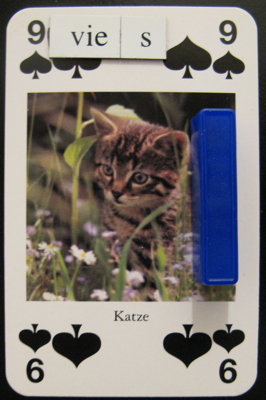 The first, I landed right-side up,
The next, I saved my skin.
The third, I won at cat and mouse,
The fourth, I dragged me in.
The fifth, I wasn’t curious.
The sixth, I wasn’t swung.
The seventh, I escaped the bag.
The eighth, I got your tongue.
So of my deaths, I’ve sidestepped eight
with guile and movements deft.
And while I’m in a quantum state,
I’ve still a half-life left.
I: Reflections in the imaginary axis
Posted by Angela Brett in Writing Cards and Letters on May 4, 2008
 I see ruthless enemy
The devil, I know,
The negative one.
I saw the root
of evil
Axis
of evil
I was the root
of the negative one.
The devil that I know:
Icy, truthless inner me
Eight of Spades: Fork and Tongs
Posted by Angela Brett in The Best of Switzerland, Writing Cards and Letters on April 27, 2008
 You’re not like all those other tools,
fond only of their wieners.
Yet even as your fire cools,
I see a snag between us.
Why won’t you be my Montague?
I’d be your Juliet.
I see you at the barbecue
embracing Andouillette.
That pig, I’d like to pierce her through,
and feed her to the cat.
She’s full of tripe, she smells of poo,
The wurst, a spoiled brat.
She sizzles near your tenderloins,
that visc’ral vivisection.
My tines vibrate as she purloins
the flames of your affection.
I come in closer, she’s dead meat.
I touch you with a tine.
You see my points, I feel your heat,
and briefly, we entwine.
And then I see the sausage roll
to ashes in disgrace.
It’s my turn now, I’ll take control,
I vow, I’ll take back space.
We’re stronger than the sausage link,
I’ve seen our stars align.
And later in the kitchen sink,
I know that you’ll be mine.
Seven of Spades: Happy, Ending
Posted by Angela Brett in Flowers and Animals, St James's Gate, Writing Cards and Letters on April 20, 2008
 This is the story of the happy ending,
where Mary and her little lamb play.
Of lamb, from human girl befriending,
to lessons in happiness stray.
Where Mary and her little lamb play
it’s tiring, so Mary would take it
to lessons, in happiness, stray.
A lamb, what a day it would make it!
It’s tiring, so Mary would take it
Said Father that very same night.
A lamb! What a day. It would make it?
That it would just wake, be alright!
Said Father that very same night
“You’ll bury what’s left.” No impression
that it would just wake, be alright,
its grave but a little depression.
You’ll bury what’s left no impression;
the sick one had not been her friend.
It’s grave, but a little depression
would not bring her world to an end.
The sick one had not been her friend,
she prayed in her panic that he
would not bring her world to an end.
He slaughtered the neighbours, not Mary.
She prayed in her panic that he
would not murder, hurt a loving soul mate.
He slaughtered the neighbours, not Mary.
The friends survive, rejoice, and ruminate.
Would not murder hurt a loving soul, mate?
No matter if a stranger, or a roast?
The friends survive, rejoice, and ruminate
why it’s okay to lose the farthermost.
No matter if a stranger or a roast
of lamb. From human girl befriending:
Why, it’s okay to lose the farthermost.
This is the story of the happy, ending.
Six of Spades: Three perspectives on CERN Open Days
Posted by Angela Brett in CERN, Writing Cards and Letters on April 13, 2008
 Strong: Did you miss the CERN Open Day? I did, in 2004. It wasn’t my last chance.
I planned my visit to CERN far in advance, and found out on my arrival that an open day was planned for a few weeks after my departure.
Thanks to an Englishman arranging a lift, I did manage to get to CERN’s 50th birthday party in Crozet. The speeches were enlightening… I had never realised that humans could make such bizarre sounds. What they were saying in French, I could only guess. My English companion had learnt enough French at school to understand some of it. From him I learnt one of my first words of French: Cernois, a person who works at CERN.
I wrote in my travel log:
After I’d looked at everything, I bought too much stuff at the souvenir shop, just like I did at the Apple Campus. The reason is the same — ‘when am I ever going to be here again?’ and so is the answer to that rhetorical question… when I work there.
A month before writing that, I had found out that my application for a CERN junior fellowship had been rejected. While still in Geneva, I found out that I had not been accepted into CERN’s Marie Curie fellowship programme either. So when I got home, I applied again.
My Marie Curie fellowship began in April 2005 and ended two years later. Before the end of the fellowship, I had been offered a position at ETH Zurich, based at CERN, so I continued going to work as usual, inasmuch as working at the world’s largest scientific facility can be considered usual.
That September, I got wind that CERN would be having open days the following April. I sent the news to everybody I knew, hoping that with enough notice, nobody with the slightest chance of making it to Geneva would miss out as narrowly as I had. I realised that as a Cernoise, I had the once-in-a-lifetime chance of not only going to a CERN open day, but being part of it. So I signed up as a volunteer for the Cernois-only open day on the Saturday.
Weak: I arrived at CERN at 8a.m, and was given a lift to the CMS pit in Cessy by a colleague and fellow volunteer. We all had our official T-shirts, windbreakers, and polar fleeces, several sizes too large. Guides had their hard hats, the people at the info point had their souvenirs to sell, physicists had brains brimming with answers, and I… I had tables, paper, coloured pencils, and pictures of CMS for colouring in. Kids’ corner.
After lunch I found myself alone at the art table, with two children approaching. Their mother asked in French if this was where they would be minded while she went underground, and would I like to take down her phone number? Would I? I had no idea. I looked around, only to have some guides confirm that it was indeed me in charge of the kids’ corner.
I mutely took the number, and finally the mother asked me in English whether I spoke French. Oui, oui, bien sûr… I like to pretend that I do. She explained to her kids that I didn’t. By this time the kids had the idea that I was a little odd, and sat there glumly staring. I asked in French if they wanted to draw something. They didn’t. The older one started halfheartedly colouring in. I tried to bribe them with promises of prizes for good drawing. They did not respond. Not sure of what else to do, I sat and dutifully watched them, feeling like some kind of psychopath. I started drawing, in an attempt to look less like one. Anyone who had seen my drawings would not have been convinced.
To my relief, a friend appeared with his young nephews, and I talked to him for a while, occasionally checking that my charges hadn’t exploded.
When the mother finally came to rescue her children from their ill-adapted babysitter, the younger one, who had barely touched his pencils, didn’t want to go. Perhaps, in the end, I am quite interesting to glumly stare at. I probably would have held the Cernois in awe too, if I’d been a member of the public at the 2004 open day.
Electric: Sunday was the open day for the general public, and the day when I, too, would be in the general public rather than a volunteer.
The bus to CERN was almost full at its first stop. It was great to see that I wasn’t the only one excited about the open day. At CERN, there were already crowds surrounding the Globe of Science and Innovation, near the entry to visit the ATLAS experiment. I’d already seen ATLAS, thanks to a friend who was trained as an ATLAS guide, so I headed into the rest of the site to see what else there was to see.
The whole place was eerily quiet. I saw a few signs, but no crowds to show me what might be interesting. I went to the café in bulding 40, knowing that there should be some events there, or at least some coffee. There were more volunteers than visitors, and no food yet. Still five minutes until the official start of the open day.
The restaurant was not crowded. I bumped into the friend from the day before, with his nephews and the rest of the family. Was it another day for the Cernois, after all? I checked the volunteers’ interface on the web. There was a few hours wait to visit ATLAS. The amateur radio club was still waiting for visitors. Shuttles supposed to take people from the Meyrin site to visit the ALICE experiment had still not arrived. At 9:30, I heard that some friends of mine who had come from Lausanne early that morning had already been underground to see CMS. What was going on?
What was going on was that 20 000 people were going underground to see the LHC and the detectors. 20 000 out of a previously stated maximum limit of 15 000.
The first visitors arrived at CMS at 7a.m. With queues filling the detector assembly hall and stretching hundreds of metres down the street, there was little choice but to start the underground visits half an hour early, at 8:30. The elevators ran at full capacity and full speed. At LHCb, tour sizes were kept smaller in order to allow more foreign language tours, but they still had a huge number of visitors. By 11a.m. the waiting time to see ATLAS was close to four hours.
Meanwhile, the rest of the 53 000 visitors were dispersed around the various sites, watching machines making machines, Nobel prizewinners making revelations, superconducting magnets making people and things fly, superfluids making their way up the walls of their containers, and actors making out they’d lost some protons.
By the end of the day, the forecast cold and rain had finally arrived. My friends drove me the short distance to the bus stop, where a busload of people were already waiting. One had come from London. One from Paris. One was an art student from Lausanne, who was more interested in the logo and other designs used for the event. One was a guide for CMS, who had volunteered to guide people in English and Portuguese, but ended up speaking French all day and getting a sore throat from it. When the bus arrived, the crowd surrounded it like a plague of zombies… but so much more alive.
Five of Spades: Calorimeter for Atlas (in the key of E)
Posted by Angela Brett in CERN, Writing Cards and Letters on April 6, 2008
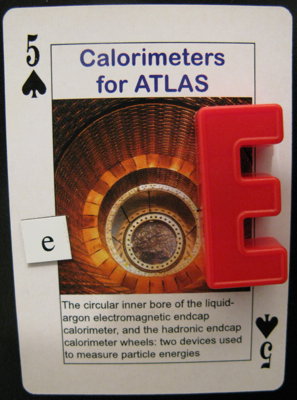 When Titans weren’t successful in a coup,
‘Twas Atlas who was made to hold up Heaven.
Now let’s assume the heavens weighed a tonne,
How much did Atlas burn to hold that weight?
Let’s say he lifts a metre, on genu,
For this way it’s a cinch to calculate.
Now, force times distance travelled’s called work done.
The pull of Gaia’s roughly nine point eight.
One metre times one thousand times her glue,
Is nine eight zero zero, at which rate?
That energy’s to lift it off the floor,
the trick from there on in’s to stay alive,
for if he doesn’t wobble the Divine,
then force times distance is exactly zero.
That’s not quite true, he still must sweat some more,
Beneath his skin he’s into overdrive.
We must consider muscle tension too,
to figure out the total energy.
But this, my simple physics can’t derive.
It’s something we must find empirically
by burning the Titanic sugar fix,
that’s eaten every second by our hero.
Four of Spades: Lake of many Rivers
Posted by Angela Brett in Discover Ontario, Writing Cards and Letters on March 30, 2008

C: Death of Consumption
Posted by Angela Brett in Writing Cards and Letters on March 23, 2008
 It seems to be true that the world is in debt.
If I take from you then I won’t see it yet.
By nature we crave to spend more than we earn;
we’ve money to save and we’ve forests to burn.
We’ll use up the rest, extradition’s deferred;
we’re draining our nest-egg and killing the bird.
Their species are dying, and so are our own,
but let’s just keep flying, it’s fine in our zone.
Let’s use all the oil and eat all the fish,
abuse all the soil and do as we wish,
ignore all the damage that we cannot see;
Perhaps it hurts you but it doesn’t hurt me.
In Earth’s final hour, we won’t fear the night;
if we have the power, we’ll turn on the light.
Three of Spades: Fire at will (a perfect match)
Posted by Angela Brett in Japanese art, Writing Cards and Letters on March 23, 2008
Join the few,
couple, two.
Give your life
to your wife.
Arms race
to embrace.
Open fire
warms desire.
Nuclear
family cheer,
firing range,
heat exchange,
Dead meat
fit to eat
No-fly zone
muslin cone.
Hate crimes,
love rhymes.
Two of Spades: Sleeping Giant
Posted by Angela Brett in Discover Ontario, Writing Cards and Letters on March 16, 2008

Gareth lay still for a minute listening to the music before reluctantly opening his eyes. He scrunched them closed again at the sight of his bedside lamp, still glaring since his insomnia of a few hours earlier. Gradually he coaxed his eyes to open again and focus on his laptop screen to check his mail. Nothing worthwhile. His eyes, at last awake enough to exercise their own free will, moved toward the small capsule resting on his bedside table. His brain, not awake enough to remember how much he wanted it, dismissed the idea of swallowing the pill. His body took him to the shower and turned on the water.
While the warm water meandered over his body, his cold mind meandered around the thoughts he didn’t want to think. Suddenly he was struck by a memory from his dream. He had lost her again.
In the dream she was blonde, and he couldn’t recall her face, but he knew that it was her, the feelings were the same. They were on a cliff overlooking their village on the black plains. He knew that it was forbidden, but there was no better place to propose to his sweetheart. He remembered how contented he felt, holding her hand and gazing down at all Creation. Until a freak wind blew her away, and left her motionless on the plains below. He remembered jumping down from the high cliff and landing unscathed, thinking nothing of the feat, and running to her. His dear Bea lay there, brunette again, her face returned, but bleeding and empty of expression.
The dream stayed with him all day. From time to time he would catch himself thinking that he really did live in that village on the black plains. It seemed like an age he had lived in that place. It seemed like only last night that he had lost her. Only last night he had gazed into those lifeless eyes, wishing he could forgive himself.
The day came and went without his paying much attention to it, and all too soon he was back in his bed, staring at the capsule, wondering whether a temporary sleep would claim him before he claimed a permanent one.
He couldn’t go back to the village after that. He couldn’t stand the thought of a hundred villagers obliged to act sympathetic while attempting to hide their ‘I told you so’s behind transparent corneas. He couldn’t stand the thought of living at all without her. He couldn’t stand the thought of the villagers aiming their phoney sympathy at his dead body. He stole a container of poison from the apothecary and stole back toward the cliff.
Sheets of bristled vegetation made the climb easy. Soon he was gazing back on the village again. This had been his favourite place in the world. The perfect place to die, were it not for the thought of villagers finding him. He turned toward the forbidden plateau. Beds of ground cover spread so far in front of him they made him tired. He began walking.
For hours he walked, as if in a dream. Distant hills appeared, and steadily grew in his field of view until it seemed he could easily reach them. How nice it would be to end his life high up, at a lookout spot like his own. He stopped to rest, and imagined he heard music.
Morning again. Gareth marvelled at the way even his favourite songs could become hated when given the task of waking him. Another day of emptiness, of working, of trying not to think. At midnight he fell reluctantly into his bed, for the nightly face-off with the pill. It had wandered from his night-table onto his mattress, as if trying to tempt him. Did it want him to swallow it? Did he want to swallow it? God knew he didn’t want to continue life like this. He held it a long time in his fingers, staring at it, mentally conversing with it, not quite gathering the courage to crush it between his teeth. Near morning, it fell from his grip as he lapsed into a troubled sleep.
When Gareth came out of his reverie, it seemed the hills were further away than before. Perhaps their nearness had just been wishful thinking. He continued on his way. As he approached the hills, he perceived a higher cliff atop them, nearly devoid of plants. The view from the hill was unimpressive, the monotonous plateau blocking the view of the plains. He started up the cliff face, grabbing the occasional stubbly brown stalk for support. Several times he fell.
Suddenly, he felt a great wind pressing him into the cliff. He turned his head sideways, his cheek pressed against the rock face, to see that the wind was followed by what resembled a giant stone hand.
He scrambled sideways to escape being crushed. The hand missed him by a whisker, but the force of it hitting the cliff caused such a quake that he fell back to the hill.
Dazed, Gareth wondered whether this was why the villagers told such tales of the plateau. Perhaps there was something to their superstitions. But he had never believed in such rubbish. The world was the way it was because of natural laws; there were no ghosts, no giants, no winds of God to punish the disobedient. It was all coincidence, it could all be explained.
Armed with this revived stubbornness and curiosity, Gareth resumed his climb. As he neared the top, he gripped one last ridge and pulled himself over it.
There was no solid ground beneath his torso. He found himself hanging headfirst from the lip of a chasm. Steam rose over his face and obscured his vision. His grip slipped on the slimy stone. He flailed blindly with his other arm, which found some thick vines further along the edge of the chasm. With all his strength he pulled himself across, and found a safe place to sit near the lip of the volcano.
Shaken, he looked back towards where he’d come. The hills, the plateau, the black plains, stretched out in front of him. And beyond… he could see that even the plain was a high plateau. He could just make out some strange figures strewn over the ground below it. He wondered if there were villages down there as well. What must they be like?
At last he remembered what he had come for. He had seen everything on Earth, but the most important piece was missing. What good was all this without her? He opened the flask of poison and brought it to his lips.
As he tipped the flask, he recalled the terror he had felt when falling into the volcano. How desperate he had been to escape. Why hadn’t he let himself fall? His survival instinct did not fail him. Somehow, deep down, he wanted to live. He wanted to explore all the lands he could see. He would never find Bea again, but perhaps he would find happiness.
Fearful of changing his mind, Gareth tipped the contents of the flask into the mouth of the volcano. For a few seconds, he was again at peace with the world, the way he had felt on his old lookout point on the cliff.
Suddenly the ground hiccoughed violently. He managed to remain in place only by gripping the vines. He had barely begun to feel safe again when the world seemed to melt, and the sky was lit with visions of Heaven, of Hell, of his parents, of Bea… nothing made sense. He became aware that as the visions faded, the sky faded as well, until all was black except for a shrinking circle of light around the Sun. An old science lesson came back to him… didn’t they say that if there were no atmosphere to diffuse the Sun’s rays, we would only see the sun surrounded by blackness, like a star?
At this thought, the air seemed to thin, and he could no longer breathe. Unconsciousness overtook him just as his dreamworld disappeared.
-
You are currently browsing the archives for the year 2008

This work is licensed under a Creative Commons Attribution-Noncommercial-Share Alike 3.0 Unported License.
Please tell me if you do something cool with it.

 Creative Output