Angela Brett
Mathematician and linguist by training, programmer by trade, physicist by association, writer by neglecting everything else.
Homepage: http://angelastic.com
Unintentional Haiku… of Mars
Posted in Haiku Detector on June 30, 2013
Kurukkan suggested using Haiku Detector to find the unintentional haiku in Edgar Rice Burroughs’ ‘A Princess of Mars’. This it seemed like a fine idea to me. I haven’t read it yet, but I’ve heard of it, and there was even another movie based on it (‘John Carter’) released recently. There are quite a few haiku which have a nice twist in the last line; one even has a rhyme. I’ve trimmed out some that really don’t work, but since they’re not much effort to read anyway, I’ve left in some that still sound picturesque even if they don’t break nicely into the lines. If you’re not into Mars fiction, there are some haiku about a real Mars mission, and an opportunity for you to send your own haiku to Mars, at the end.
On regaining the
plaza I had my third glimpse
of the captive girl.“Some day you shall know,
John Carter, if we live; but
I may not tell you.And now the signal
has been given to resume
the march, you must go.”“I am glad you came,”
she said; “Dejah Thoris sleeps
and I am lonely.I have twice wronged you
in my thoughts and again I
ask your forgiveness.Sola and I walked,
making Dejah Thoris ride,
much against her will.I have escaped from
worse plights than this,” and I tried
to smile as I lied. Read the rest of this entry »
Valet de cœur
Posted in St. Martin, Writing Cards and Letters on June 23, 2013
![Magnetic poetry giving HeartValet's rhyming slogan in French: 'simple, indolore, et plus encore. J'adore' which roughly translates to 'simple, painless, and more; I love [it].'](https://angelastic.com/wp-content/uploads/2013/06/valet-de-coeur.jpg?w=620 "HeartValet's rhyming slogan in French, which roughly translates to 'simple, painless, and more; I love [it].'")
Do you love your partner but wish you didn’t have to put up with their bad habits or allergy-provoking pets?
Are you sick of chasing love only to have your heart broken?
Do you prefer relaxing alone to dragging yourself out on dates, but wish you had someone to love once in a while?
Did the love of your life walk out on you after your father’s funeral last week, taking your cat and the last roll of toilet paper, and proclaiming he liked how generous you were to him and loved being invited to such family gatherings where he could see your smoking-hot mother, but the way you always scratched your ear when you were thinking was driving him nuts?
We have the solution. With the patented HeartValet system, you’ll always feel loved. HeartValet is a precisely controlled, individually tailored, automatic delivery system of your friends oxytocin, vasopressin, and the perfect blend of nineteen other natural love potions just like the ones your body makes in the best stages of love. We’ve taken the body’s unpredictable mess of love hormones and perfected them into the smooth sailing that you deserve. But that’s not all; HeartValet integrates with a HugVest that automatically stimulates your C-tactile network whenever you need it. Users of HeartValet are proven to be up to 42% happier, and live up to five years longer or more.
Pregnant women and chronically ill people are advised to find a partner who will assist them with their physical needs. HeartValet is not suitable as a complete source of affection for infants.
Toya self-consciously stopped scratching her ear, and mentally cursed targeted advertising. And she wondered why, with all the information it had about her, it still seemed to be consistently targeted at idiots. She knew what ‘up to’ meant, and she wasn’t desperate enough to buy their cheesy fake love. Toya had never been a fan of artificial emotions, injected into her mind with no external cause. Even alcohol freaked her out a little. Even the smoother-than-nature hormones from her contraceptive implant. HeartValet was just a blow-up doll for the soul. How dare they imply she needed it… how dare they…
Toya looked down to see her ice cream had cruelly melted while her attention was imprisoned by the dumb ad. The spoon made a goddamn irritating noise when she threw it into the bowl, then it bounced out and spattered melted ice cream all over her. She began to cry.
Are you crying into your Rocky Road after a recent breakup?
Do you wish there were an easier way to feel lov…
Toya swore and threw the terminal across the room. It had the gall to respond by breaking, trapping the irritatingly-cheerful voice in a loop and leaving Toya without a working terminal. She stomped out the door, more for somewhere to stomp and something to slam than anything else. The blasted lift wouldn’t come quickly enough, so she ran down the stairs until they made her tired and she had to lean against the wall to weep. The world was just a big ball of gravity bringing her down.
She managed to settle into a calmer state of self-pity, and mope down to the ground floor. Out into the bright sunlight, which made her sneeze. “Oh, go turn into a black hole!” she yelled at the Sun, and resumed her stomping.
She passed a group of creative anachronists cooking old-time foods with a fire. One of them accosted her. “Would you like to try this grilled bell pepper?” he demanded.
“God no. Don’t you realise what you’re doing to your bodies?! Sure, it tastes nice for now, but you’ll never have the proper balance of nutrients. Don’t you idiots even see the warnings on the packaging? All sorts of diseases are linked to poor nutrition. Everyone knows that. You’re going to die younger, you know.”
She muttered ‘ovary-eaters!’ under her breath, and took a swig of delicious, nutritionally-balanced fluid from the nearest Soylent fountain to prove her point. It hurt her on its way past the lump in her throat.
“Would you put yourself at the controls of your home’s nuclear plant? Would you leave your nutrition up to the whims of taste and circumstances? Would you leave your emotional state at the mercy of…”
Toya swatted the advertising drone out of the way.
It righted itself and hovered back to her.
“You seem to be in an emotionally agitated state. Studies have shown that emotionally balanced people live up to five years longer or more. HeartValet: balanced nutrition for the soul.”
She ran away from it. It chased her through unfamiliar streets, with its calm voice helpfully pointing out each preventable spike in her temper. After a particularly irritating stretch, she stopped and faced it.
“Would you shut up?! My dad died and I’ve just been through a breakup. I really do not need you pestering me!”
Do you need a hug?
Toya’s rage turned back to tears, and she momentarily forgot the drone wasn’t sentient. “Yeah.”
HugVest can give you all the hugs you need, when you need them! Studies have shown that people who get enough hugs are up to 32% happier…
Toya sighed. “Oh, alright. If I get HeartValet, will you stop bugging me?”
With HeartValet, nothing will ever bug you again!
The drone swung its spotlight onto the logo of the HeartValet building, which was, to Toya’s surprise, right next to them. The curvaceous V formed a softly pulsating heart, which hung from a sturdy H-shaped support.
The automatic doors opened, inviting her in.
The receptionist’s smile was disarmingly genuine. “You must be Toya,” he said.
“Yeah, I…”
“You want to be fitted with a HeartValet? Not a problem. Just authorise the payment here and the Cupid will be with you shortly. Feel free to use the time to peruse these brochures about HeartValet and our carnal pleasure add-on packages available for a small extra charge.”
“Oh, I… don’t think I need that…” Toya was sure the carnal pleasure package was just rebranded old technology with a hefty price tag.
“I assure you, you will. They’re 25% off when purchased with a HeartValet.”
Toya ignored the receptionist and tried to ignore the preliminary price tag as she authorised the payment.
Finding nothing else to do, she flicked on a brochure, which spoke in the familiar overly-cheerful voice.
Hi, and congratulations on choosing the sensible path to lifelong love! We love having you here. In just a few minutes, your expert Cupid will come and sweep you off your feet and into the clinic to implant your HeartValet device. The implantation is performed under local anaesthetic, and is quick and painless. Your cupid will then run a few quick tests to ensure all your HeartValet’s chemical channels are working properly, and you’ll be ready to be fitted for a HugVest. To perfectly tailor your HeartValet’s functionality to your personal physiology, we will monitor your moods and blood chemistry for seven days in our luxurious Honeymoon Village. Don’t worry, this is all included in the price range you’ve already preauthorised.
You will also benefit from fantastic deals on our carnal pleasure packages, so you don’t miss the other side of having a romantic partner. We have devices that do things your previous lovers never imagined…
Toya flicked it off in exasperation, and seconds later a woman in a soft pink lab coat entered the room from the door marked ‘Cupid’s Lab’.
“Ah, I see you’ve finished with the introduction. Come with me and we’ll get started.”
Toya followed her into the ‘Lab’, which was much like an ordinary clinic: scanner bed, chair, desk. The walls were adorned with the standard medical qualifications, plus a Doctorate of Cupidity issued by the company’s HappyVersity, and the framed quote, “Tampering with their happiness circuits will invalidate the warranty” in an old-fashioned script befitting its turn-of-the-century authorship.
“Alright, we’ve already accessed your medical and behavioral history, and you’re the perfect candidate. If you’d just hold out your arm, we can get the implant in.”
The HeartValet implant went in without problems, the same way her contraceptive implant had.
“Perfect. Now if you’d just get onto the scanner bed so I can test a few functions, that would be lovely.”
Toya did as she was told.
“Okay, I’m going to test the channels on your implant using this remote here while the scanner checks what’s happening in your brain. You may feel some pretty powerful emotions, and I urge you to remember that these feelings are not toward me but caused by your HeartValet. At some love implant companies you’d be told it was love for God, but we’re a little more open about what we’re doing. Just interpret it as love for yourself, or love of biology, if that’s what floats your boat. But if you do slip up and profess your love for me, don’t worry, I’ve heard it all before.”
Toya laughed. She’d never profess her love for someone she’d just met.
The Cupid pressed a button, and Toya was in love. The ‘Cupid’ being the only viable object of affection she could see, Toya reached out to her. The Cupid expertly dodged her, and pressed another button. Toya soon returned to normal, and blushed at the realization of what she’d just done.
“Okay, that one works. By the way, can I interest you in our carnal pleasure add-on packages?”
“No thanks, I already said…” The Cupid pressed a button and suddenly carnal pleasure was all Toya could think about. “Uhhhh…” she moaned. Nurse fantasies suddenly made sense. “Yeah… I think I’ll take that…”
Another button, and Toya had the strong feeling that the Cupid loved her back.
They went through a few more tests, a few more feelings that Toya enjoyed enough that she didn’t care about the lack of external cause. Then they tried out the HugVest, which successfully tightened around her when a virtual reality game induced feelings of loneliness.
“Okay, we’re done with the initial tests! It’s all working perfectly. Don’t worry, in normal operation you won’t feel anything as sudden or as strong as that. The emphasis is on balance, and maintaining a feeling of love to keep you enjoying life when life is not doing its part.”
Toya was still buzzing a little, and wasn’t sure if it was an afterglow from the experiments or the normal operation of the implant. She nodded.
“So to make sure we get the right balance for your body, as you know, you’ll spend a week in our Honeymoon Village. This should also allow you to adjust to your new feelings while surrounded by people who understand you. You should find it quite relaxing, but don’t be alarmed if our staff or other patients upset you occasionally; it’s all to test the responses of the unit and your body. You’re going to feel great. Amy here will show you to your room.”
Amy took her down a corridor, which became a high walkway overlooking an atrium with gift shops, a casino, a swimming pool, and various real and virtual sports courts, “I didn’t bring a change of clothes!” Toya realised aloud, and immediately felt like she was wanted anyway.
“Don’t worry about it. A lot of people come here unprepared. There are some clean jumpsuits and swimwear in your room. Here it is: 216.” Amy led her into one of the rooms beside the walkway, showed her the amenities, and left.
Toya lay on her bed for a while, at first enjoying the solitude, then enjoying the feeling of being with a loved one that naturally took over when the solitude outstayed its welcome. The HugVest tightened ever so slightly.
Eventually she got up and wandered along the walkway, watching the courts. She felt a little more lost than usual watching the virtual games; it was hard to tell from people’s demeanor whether they were winning or losing.
She was startled by the feeling of fur against her ankle. A cat. Her cat! What was Molpy doing there? She patted him happily, feeling a rush of love she was sure was natural.
“Hey there, little Molpy! You’re a kitty! Yeah, you’re a fuzzy wuzzy wittle kit…”
“Hey!”
Toya looked up. “Alex?!”
“Toya! It is you. What are you doing here?”
“Recovering from you,” she said. The HugVest tightened slightly. It was only when saying those words that she realised she didn’t feel like she needed to recover any more.
“Fair enough,” Alex said, laughing.
Toya felt a quickly-stifled spike of rage as she realised why Alex was there. “Did you leave me for this?!”
“Yeah, well… that ear-scratching thing was annoying… and their advertising was kind of… insistent… for good reason! This is so much better, isn’t it?”
“Yeah. Yeah, it sure is.” Toya fell in love with him again, then reminded herself she was in love with nothing in particular. “But why did you take Molpy? He’s mine… and you’re allergic!”
“Oh. They said I could get a discount if I stressed you into getting a HeartValet. I actually refused to go that far, but they sent a catnip-scented ad drone…”
“Wait, so… The story about having the hots for my mum, that was just to stress me?” She wasn’t sure whether to feel angry or relieved at the thought, so she felt loved. He had cared enough to give her everlasting love.
“No, that part’s true. Actually, I got my carnal pleasure package modeled on her.”
Toya’s gut reaction was anger and embarrassment. By the time she came to think about the reason for her reaction, the HeartValet had kicked in. “But… I love my mother, and she’s been alone for a week now. It’s not fair that she doesn’t benefit from your infatuation with her. You should really sleep with her.”
“Good point! I’ll go see her as soon as I leave the village this evening. It’ll be lovely! Hey, want to go swim?” he asked.
“Sure!” she said, wondering why the breakup had once seemed so important. It was just a thing that happened. She didn’t even need him.
She went back to her room and put on the provided swimsuit. The thin HugVest was barely visible underneath it, and she reckoned it gave her a smoother figure. Not that her appearance mattered.
Toya and Alex swam happily for a few hours. They even gave each other some real hugs, but eventually stopped bothering; the real thing was never in quite the right way at quite the right time.
“Hey, my week’s almost up; I have to go,” he said after a while. “I don’t actually have anywhere to stay lined up. Mind if I move back in?”
She felt a euphoric buzz at the opportunity to help someone out. “Not at all; your stuff’s there and there’s still enough room in the bed for both of us, and room for Mum this week if you want. Oh… I may have smashed some of your things; sorry about that. See you in a week!”
After just less than a week of socialising with eminently lovable HeartValet users, and contentedly losing at tennis, virtual wall ball, and roulette, Toya came across her mother in a Honeymoon Village gift shop. She’d turned to HeartValet for solace after the death of her husband and some disturbing passes made by her daughter’s ex. They reminisced about Toya’s father, imagining that the HeartValet allowed him to hug them and send them his love from beyond the grave.
And they all lived happily ever after.
Except Toya’s father, who was dead, due to a freak accident involving a HeartValet advertising drone.
∎
Ten of Hearts: Taken
Posted in NASA 50 Years, Writing Cards and Letters on June 10, 2013
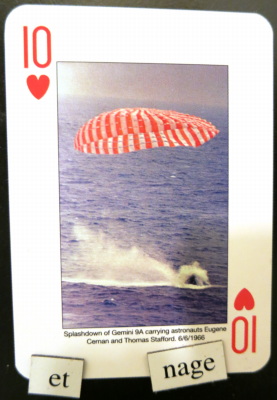 “My name is Finn, and I was abducted by aliens.”
“Tell us about your experience. We understand.” said Ray, the group leader.
“Thank you. My whole school laughed at me.”
“We understand.” repeated Ray.
“I was pulled up into space by an invisible force. I couldn’t breathe.”
The others stared, glassy-eyed, remembering their own trauma.
“They pulled me into their ship. Huge creatures, with… sort of tentacles… tentacles with tentacles… but stiffer, you know?”
Some knew.
“They moved strangely, floating in space, nothing holding them up. I could hardly move. They measured me, poked me, probed me… I can’t even…” He squirmed.
“And… this is going to sound crazy, but…”
“We’ve all been called crazy,” said Ray.
“I never believed anyone who said this. But I swear they implanted a tracking device!”
“Me too!” someone called out.
“And then… they dumped me, near my home. But I’m convinced they’re causing the disappearances. They keep some, take them to their own world, for… for… I don’t know.”
Muttered hypotheses bubbled through the group.
“They’re forcing them to breed alien hybrids!”
“…locking us up and studying us!”
“I bet they’re eating us!” The children always went for the most direct horror.
“Quiet! Finn’s speaking.”
“People say maybe their world’s a paradise, where everyone’s safe and well-fed. But I was terrified. I can’t believe they’re good. My mouth still hurts,” Finn blubbed. “I just… we can’t stop them. They’ll take us all. They’re a superior species. All we can do is wait for it.”
Finn swam through the wide-eyed audience, and into the coral to mope.
∎
As well as being part of the second cycle of my Writing Cards (and not really Letters) project, this story is an entry in Flash Mob 2013 International Flash Fiction Day blog carnival and competition. Edit: The rest of the mob is now lighting up the world with its pitchforks. By the contest rules it has to have fewer than 300 words; it’s either 293 or 263, or maybe about 500, depending on which word counting software you believe. I counted 263. Or something like that; I’ve changed it a bit since counting.
Nine of Hearts: ISS vs. LHC update
Posted in CERN, Space Shuttle, Writing Cards and Letters on June 4, 2013
 A while ago I made a somewhat whimsical but as accurate as I could manage too-much-infographic comparing many aspects of the International Space Station with the Large Hadron Collider, and jokingly asking which would win in a fight. I’ve given that a bit of an update and put an annotated text version below for those whose pdf readers don’t show annotations. More importantly, since then, I’ve seen the crew of the STS-134 mission to the space station give a talk at CERN, and wanted to ask them which was more awesome, but was in one of the few spots without a microphone, and I don’t speak as loudly as my friend Hugo, who asked a question from right next to me, does. But at a later talk at CERN, I did ask NASA’s Associate Administrator for Human Exploration and Operations, William H. Gerstenmaier. This was his response, which you can find at around 50:45 in the video:
Oh, man. This is a tough question; I don’t know. They’re both unique in their own way, right? Both pretty special research facilities, right? And I think that, again we often talk about, you know, human versus robotic, right, it’s really human all the time, right? Even in a robotic space, the data’s analyzed by a human somewhere, and so, I think again it’s that spirit of exploration that we’re all pushing on. We all want to understand something new, discover something that nobody’s seen before, so at CERN, damn sure, that spirit drives you every day, you’re looking for new things. I see it in your papers: what is this theory? Are we changing physics? It’s the same thing we’re doing. How can I look at a physical phenomenon that occurs in one gravity, remove the one gravity term, and now get a totally different perspective on that same physical phenomenon, that then allows me to advance in a different area. So I think it’s that same passion that drives people. But I don’t know which one’s best.
So there you go. I’ve added this comment to the notes in the TMIGraphic, and also updated data relating to the ISS’s orbit and a few other things, and added a ‘Getting to Orbit’ section, but the best thing is the update to that ‘when to see it’ bubble on the LHC. You can see it at the CERN open days at the end of September. Two full days. The LHC is shut down for upgrades at the moment, so I understand this will be another chance to actually go underground and see it, which probably won’t be possible for a while once it starts running again. And even if you don’t see the LHC or its detectors (there are only so many people that you can get up and down in a lift in two days; 23 000 people out of 53 000 visitors visited the tunnels in one day last time), there are many other things you can see at the open day. I know this because I was at the last one. Maybe I should look through whatever videos I took that day and see if I can make an interesting montage. I know I have footage from various other tours which I should put online.
The pdf version of the ISS vs. LHC comparison has a lot of links and extra notes in the margins detailing where I got the figures from, how I chose the sources, how I found myself gingerly plugging values into a relativistic equation at a demoparty at 1:30a.m, and so on. But I suspect not everyone who looked at the original downloaded the pdf, and those who did might not have been using pdf readers that showed the notes well. Besides that, the infographic is sort of messy (that’s why I call it a too-much-infographic), although I think it does add something to the raw text. So I’ll reproduce all of the text and notes in table format below, show a far-too-small preview of the TMIGraphic version, and encourage you to download the pdf if you like circles and crisscrossing dashed lines and things that can be read while offline.
Sorry if the line spacing is inconsistent in this table; WordPress changes the style for the second and later paragraphs in each cell no matter how I create the paragraph breaks, and it tends to delete newlines, paragraph and break tags if I ever open the page in the visual editor, so the best I can do is put blank lines before the first paragraph in each cell to give that the same style, and then try not to accidentally open the post in the visual editor.
| Aspect | ISS | LHC | Notes |
| Physical Characteristics | |||
| Size |
Solar array: 73m Truss: 109m Modules: 51m |
Dipole magnets: Cold mass diameter: 0.57m Vacuum vessel diameter: 0.91m Length: 15m See the ‘Orbit’ section for the size of the entire LHC. |
Source for ISS size |
| Mass | 419 455kg (but it depends what’s up there) | 37 600 000kg (cold mass) 35 200kg (detector mass, not counting MoEDAL) |
The ISS mass doesn’t include the contents of the station or any spacecraft docked to it. You’ll find different masses around the place depending on what they take into account.The LHC mass is much more than that (calculated from CERN FAQ – LHC the guide: “4700 tonnes of material in each of the eight sectors”.) The 1232 35-tonne dipole magnets alone weigh 43120 tonnes, and there are another 8468 smaller magnets, and many other things. But only 30 tonnes of each of those dipoles is cooled (by 120 tonnes of liquid helium and 10 080 tonnes of liquid nitrogen) As my friend Rob Lambert (who works on LHCb) says: It's difficult to define the mass of "the LHC", because you'd probably want to weigh the concrete in the tunnel walls […] I think the "cold mass" is the best comparison to make, since that is sort of like the LHC payload. The rest is sort of comparable to the shuttles/boosters used to get the materiel up to the space station, which weighs a lot more than the station itself, of course. |
| Weight |
368 730 000N (just the cold stuff, ignoring altitude) |
at least 3 614 899N (using the stated mass at 422km altitude, the point of the ISS’s current orbit where it weighs the least) |
For the LHC, this is just a simple matter of multiplying the mass above with standard gravity. The exact gravity where the LHC is wouldn’t be exactly that, due to the altitude, the distance below the surface, the mountains, the tides (which the LHC itself is sensitive can detect) and all sorts of other things that I don’t know how to calculate.As for the ISS, you might think the station is weightless, but it’s not; it’s in orbit. There’s still gravity up there, just a bit weaker than on the ground (where the station would weigh about 4 109 084N.) The station’s weight keeps it falling toward the Earth all the time. It’s just moving along fast enough that the Earth curves away beneath it, so it doesn’t get any closer to the ground. Things on the station seem weightless because they’re in free fall.Here’s a website which gives the formulas to calculate the force of gravity between two objects, and will calculate it for you. I used 5.97219e21 metric tons for the weight of the Earth, 419455kg for the weight of the station, and 6800km for the distance between them (the radius of the Earth, plus 422km.) I probably shouldn’t give the result that many significant figures. |
| Pressure | Inside: 760Torr (1 atm) Outside: 10-10 — 5×10⁻⁸ Torr |
For the ISS, this is actually the pressure at 500km; the closest altitude I could find authoritative-enough figures for. Outside the station, closer to Earth’s atmosphere, the value should be toward the high end of this range.I had a lot of trouble finding an answer to this seemingly-simple question; I found figures which varied by a factor of a billion. In fact it only varies by a factor of 20 depending on the space weather. | |
| Temperature | Inside: ~24°C Outside: -157—121°C |
Inside: -271.3°C Outside: ~20°C Lead collision point: 5.5 trillion °C |
When I first did this comparison, it was possible to check the inside temperature of the space station in real time here at the bottom right, but the temperature doesn’t show for me any more.The inside temperature of the LHC is the temperature of the cold mass of the magnets, given here.The ‘Outside’ temperature is actually the temperature of the LHCb cavern when the detector is turned off. I assume the LHC tunnel should be about the same temperature. 5.5 trillion degrees is an estimate from this Nature blog post. This CERN page says: When two beams of lead ions collide, they will generate temperatures more than 100 000 times hotter than the heart of the Sun, concentrated within a minuscule space. |
| Power | 84kW from solar arrays |
120MW from French and Swiss grid (including the base load for the whole site) |
Of the LHC total, LHC cryogenics uses 27.5 MW and the LHC experiments use 22 MW. It’s hard to say how much of the rest goes toward LHC-related computing, lighting, coffee-brewing etc, and how much goes to the many other experiments and activities at CERN. |
| Orbit and Altitude | |||
| Altitude | 408km — 422km (on 2 June 2013. Has been as low as 331.5km) |
175m — 50m below ground about 450m—380m above sea level |
Here is a nice graph of the ISS’s altitude from launch to 2009. Here’s the source for the LHC depth figures, and an explanation of why it was built underground. I estimated the altitude above sea level going by altitudes in Google Earth at roughly the points where the LHC is deepest and shallowest. I need to find better figures for this. |
| Orbit Diameter | 13 558—13 586km (on 2 June 2013) |
8485m | I used the mean Earth radius of 6371km to calculate the orbit diameter of the ISS, . I guess I should have calculated the diameter at the actual angle the ISS orbits at, but as a maths major I don’t trust my arithmetic. |
| Orbital Speed | 7 666.2m/s (on 2 June 2012) |
protons at 7TeV: 299 792 455m/s (3m/s slower than the speed of light) lead ions at 2.76 TeV per nucleon: 299 792 441m/s (17m/s slower than the speed of light) |
You can check the ISS orbital speed in real time. Protons haven’t circulated in the LHC at 7TeV yet, but they will. I got the 2.76TeV figure from the LHC FAQ document (which is very comprehensive and interesting, by the way. I recommend it.) A nucleon is just a proton or neutron. But I couldn’t find the actual speed, so I calculated it using this formula at 1:30a.m. I’m a maths major, so I can’t guarantee its correctness. Wolfram Alpha can calculate this by itself if you ask it ‘relativistic speed of 2.76 TeV proton’ but the answer is so near to the speed of light that it rounds it off to 1c. |
| Orbital Period | ~92 minutes |
88.928µs (11245 orbits per second) either protons or lead ions at full energy |
The ISS data used to be on the real-time tracking page listed previously, and the LHC figures were here. I’m going to need to find new sources for those. |
| Getting to Orbit | Zarya and Zvezda modules launched by Proton rockets Pirs and Poisk launched by Soyuz-U rockets Everything else launched by Space Shuttle with the help of its solid rocket boosters | Protons accelerated by Linac 2, then the Proton Synchrotron Booster, the Proton Synchrotron, Super Proton Synchrotron, and finally the LHC | It’s all about protons and boosters. I’m all about tenuous connections and dubious puns. |
| Particle Detectors | |||
| Detectors | AMS (Alpha Magnetic Spectrometer) Calibrated using proton beam Real data from cosmic rays |
CMS (Compact Muon Solenoid) Calibrated using cosmic rays Real data from proton beam |
AMS was designed at CERN, and one of those proton beams came from the Super Proton Synchrotron, which also accelerates protons to inject them into the Large Hadron Collider (see also the bottom half of the too-much-infographic.) The AMS control room is also at CERN.For a while the AMS was just across the road from my office. I took a few pictures of it just before it left, with my phone since my camera was broken at the time. One is shown below. The astronauts who installed it gave a talk at CERN a year after the installation, which you can watch online. |
| TOTEM In development |
|||
| LHCb (Large Hadron Collider beauty) Calibrated using cosmic rays Real data from proton beam |
|||
| MoEDAL (The Monopole & Exotics Detector at the LHC) In development |
|||
| ATLAS (A Toroidal LHC Apparatus) Calibrated using cosmic rays Real data from proton beam |
|||
| LHCf (Large Hadron Collider forward) Simulating cosmic rays using proton beam |
|||
| ALICE (A Large Ion Collider Experiment) Calibrated using cosmic rays Real data from proton beam |
|||
| Construction | |||
| Countries Involved | 16 | 111 | The International Space Station’s Facebook page and also the International Cooperation page say 15 nations. NASA’s Human Space Flight FAQ says 16. I went with the higher number, because people from other countries are probably involved anyway. I know that at CERN, it’s usually the countries of the institutions that are counted, when there might be people from many other countries working for those institutions. Here is a list of countries involved in CERN. As a maths major, I don’t trust my counting abilities, so I got the 111 figure from the LHC UK site. As explained above, the real number is probably higher. |
| Conceived |
1976 (Mir-2) 1984 (Freedom) 1986 (Columbus) 1993 (ISS) |
1984 | Here’s an interesting document on the conception of the ISS, which was essentially the coming together of several separate space station projects. The idea for the LHC (sometimes called the Juratron in early papers, after the Jura mountains) had been floating around since 1977 (see this talk by Lyn Evans for a nice history of the LHC) but 1984 was the date of the first conference about it. The idea was officially approved in 1994. |
| On-site Assembly | 1998—2013 | 1998—2008 | Of course, this depends what you count. The LHC date is from the start of civil engineering to the completion of the beam pipe around the entire circuit including the detectors. There was a huge repair effort after the cooling leak in 2008, and there’s work going on right now to upgrade the detectors and get the LHC itself up to the original design energy of 7TeV. |
| Operational Since | 2000 (first astronauts) |
2008 (first beam) 2009 (first collisions) |
|
| Operational Until | 2020 | 2022 (after which it will be upgraded) |
Some sources say the ISS could run till 2025 or 2028, but for now it’s officially funded until 2020. There are so many plans for upgrades and successors to the LHC that I’m a little confused as to when the LHC itself actually shuts off, but I’m going by the diagram in this article. |
| Estimated Budget |
$72.4billion in 2010 dollars unofficial calculation, not counting shuttle missions |
CHF6 billion | Having a real-life space station occupied continuously for nearly 13 years, and finding out what the universe is made of? Priceless! For the LHC, the figure of 4.6 billion is given here, but I chose the CERN FAQ/LHC Guide as the reference since it is newer and probably more carefully checked by more people. This was the booklet given out to volunteers at the 2008 open day. |
| Transport | |||
| To/From |
Shuttles driven by ISS personnel (Kennedy Space Center to/from ISS, 1998—2011) Soyuz driven by ISS personnel (Baikonur Cosmodrome to/from ISS, 2000—present) |
Powered flight (Geneva Airport to/from any airport on Earth) Shuttle driven by ISS personnel (Geneva Airport to/from CERN Meyrin site) |
Here is a picture of an ISS employee driving a CERN shuttle: |
| Around | Unpowered flight | Shuttles driven by ISS personnel between various CERN sites | |
| Unmanned cargo transport |
H-II Transfer Vehicle (Tanegashima Space Center to/from ISS) Progress (Baikonur Cosmodrome to/from ISS) Automated Transfer Vehicle (Guiana Space Center to/from ISS) |
ROCLA magnet transport robots Magnet alignment robots |
I saw an explanation of the CERN robots at an event in Microcosm years ago, but haven’t been able to find much information on them online. |
| Outcomes | |||
| Challenges Faced |
|
The bird escaped unharmed but lost its bread. | |
| Science | 121 “International Space Station” papers on arxiv.org |
more than 1000 “Large Hadron Collider” papers on arxiv.org | The paper count for ISS is from August 2012; when I checked again in June 2013, the count was 116, but I assume the other papers still exist. In any case, this is only a rough idea of how much science has been done with the help of the ISS. It shouldn’t be taken as a serious estimate of the benefits thereof. |
| Fiction | Only fictional space stations can destroy a planet with an energy beam. | Only fictional particle accelerators can destroy a planet with their energy beams. | I haven’t even seen Star Wars and I still managed to get a reference in. |
| Spinoffs |
|
|
You can see more about NASA technology spinoffs, search for NASA technology available for licensing, or find out about CERN technology transfer. |
| When to see it | As it passes overhead just before dawn or just after sunset | When it’s not running; ideally the 2013 Open Days. | If you set your location and follow @twisst on Twitter, you can be notified whenever there will be a visible ISS pass in your area.You can see CERN’s other exhibitions, or book guided tours at any time. |
| Overall | |||
| Awesomeness |
★★★★★ Most awesome man-made thing in Earth orbit. Don’t make me compare it with Mars rovers. |
★★★★★ Most awesome man-made thing on Earth. |
They’re both unique in their own way, right? Both pretty special research facilities, right? […] I think again it’s that spirit of exploration that we’re all pushing on. We all want to understand something new, discover something that nobody’s seen before, so at CERN, damn sure, that spirit drives you every day, you’re looking for new things. I see it in your papers: what is this theory? Are we changing physics? It’s the same thing we’re doing. How can I look at a physical phenomenon that occurs in one gravity, remove the one gravity term, and now get a totally different perspective on that same physical phenomenon, that then allows me to advance in a different area. So I think it’s that same passion that drives people. But I don’t know which one’s best. — William H. Gerstenmaier at CERN on 6 November 2012 |
Unintentional Haiku in the works of Lewis Carroll
Posted in Haiku Detector on May 28, 2013
The other day I decided to run Haiku Detector over the works of Lewis Carroll, as found on Project Gutenberg. This is what I found. It’s a bit of a mixed bag in terms of how well they work as haiku, to the extent that I can still measure that after reading so many (I will have to try out linguistic tagging and work out some heuristic based on parts of speech beginning and ending lines), but simply as bite-sized samples they give a nice sense of the work. I can’t tell whether they’re made more or less whimsical by being stripped of their context.
From Alice’s Adventures in Wonderland:
‘But it’s no use now,’
thought poor Alice, ‘to pretend
to be two people!But if I’m not the
same, the next question is, Who
in the world am I?They all sat down at
once, in a large ring, with the
Mouse in the middle.But I’d better take
him his fan and gloves—that is,
if I can find them.’‘I haven’t the least
idea what you’re talking
about,’ said Alice.
Eight of Hearts: Ten Minutes a Day
Posted in Alcatraz Rules and Regulations, Writing Cards and Letters on May 26, 2013
Ten minutes a day,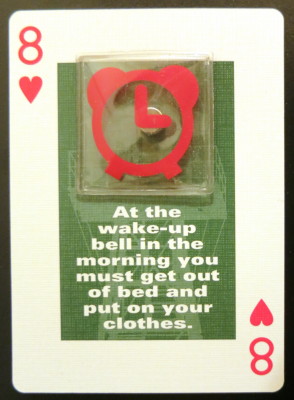
that’s all you need
to realise your dreams —
not as hard as it seems.
Ten minutes can always be freed.
Ten minutes a day,
a sixth of a clock,
to keep up your writing,
its forced march providing
a force to march through writer’s block.
Ten minutes a day
can’t be denied,
to read through your bookshelf
and castle your rook self
with culture of kings by your side.
Ten minutes a day,
one day at a time,
to inch past the worst of it,
combat inertia that
nothing excuses; must try if it uses just
ten minutes a day,
don’t you forget,
to learn a new language:
word spread, grammar sandwich.
Ten minutes to keep your tongue wet.
Ten minutes a day
(if you’ve spread spores)
to teach well your baby;
remember that maybe
its life will be bigger than yours.
Ten minutes a day,
on- or offline,
to maintain your friendships,
accept rain and send drips;
as long as it’s something it’s fine.
Ten minutes a day —
find it somehow.
Forego social network fun,
finally get work done.
You’ve got all these things to make, it’s really not hard to take
ten minutes a day.
That’s all you do
to try meditation
and self re-creation;
you have to take some time for you.
Ten minutes a day —
it doesn’t take long
to tidy a tight space,
put junk in the right place;
and live with things where they belong.
Ten minutes a day,
not big amounts
to work on your fitness;
don’t tire yourself witless,
but even a small workout counts.
Ten minutes a day?
I can do that!
Grab life while I’m alive,
did all the things and I’ve
got what I’m leaping for now, and I’m sleeping for
ten minutes a day.
That’s all I need. [yawn]
Night dreams are boring;
my real dreams are [sound of snoring]
[snoring continues]
This is another one of those poems which has a tune in my head, and I had a hard time reading it without the tune to see if there were any lapses in rhythm the tune was forgiving. I fear I this may have caused me to write a terrible song and mediocre poem instead of a good poem. But I like it anyway. I might have to make a robot choir recording of it. It even has guitar bits after the second line of each stanza, which will be a fun challenge to record using only my MIDI keyboard and my vague suspicion that things called chords are involved.
I’ve been thinking about this one for several weeks, every so often adding something to the list of things that people say we should spend some negligible and underestimated amount of time on every day. It wasn’t really inspired by that card, and I still haven’t even tidied up my cards since the cruise. On the subject of the cruise, and people telling us to write every day, here’s my video recording of the live episode of the Nerdist Writers Panel recorded on JoCo Cruise Crazy 3.
It might be nice if I changed ‘ten minutes’ to either ‘five minutes’ or ‘one hour’ (‘hour’ pronounced as two syllables) so that I could arrange the first twelve stanzas around a clock and put the last one somewhere where there isn’t time for it, but I prefer the sound of ‘ten minutes’. I was thinking of making it zigzag across the page, three stanzas wide, but that would be pretty gratuitous.
I can consistently introduce and read this one in under three minutes, so I might read or recite it at the poetry open mic at ICV Arcade on the 31st. Let’s see if I can memorise it. My goal will be to make the audience yawn, and with that as a goal I don’t think it’s possible to fail. I bet you’re yawning already, so I’ll stop this now.
Addendum:
I changed some of the words. It originally went:
to try social network fun,
or you could get work done.
but who ever advises people to use social networks more? Apart from to maintain your friendships, of course, but conflicting interests is what this poem is about. Also, I used to have ‘for’ instead of ‘but’ about the small workout counting. I’m thinking about ‘a’ to ‘the’ in the fourth line of the second stanza.
Further Addendum: I recited this at open mic, and lots of people said they liked it, and I wish I could have said the same to the other poets there but I am not good enough at absorbing poetry and memorising faces and attaching the two all at the same time. I have some ideas for illustrations which could turn this poem into a small picture book or large comic strip for people who are told they’re too old for Dr. Seuss, and maybe aren’t yet old enough to realise they’re not. It would also be used for a halfhearted slide-show-style music video when I eventually teach my robot choir to sing this. I’m not sure whether I should attempt to draw it myself using stick figures, or commission someone else to do it. I’m starting to think it would be fun to have merch to shill, even if it the profit would be inevitably approaching zero from one side or the other. I have a day job so I can do that if I want. I enjoyed the ego boost when the occasional person would buy my shareware in the late 90s, and I still have the T-shirts and most of the cheques (the payments were processed by a US company, so they actually used cheques, even though it was almost the 21st Century.) But I won’t start on any of that until I’ve finished the King of Hearts.
Seven of Hearts: mp<3 (Half-Assed Rapper Version)
Posted in Shakespearean Insults, Writing Cards and Letters on May 20, 2013
 Remember that poem I wrote about heart-drive based music players, which I said I imagined as a rap? Well, here’s a recording of me ‘rapping’ it (now with new cover art.)
I wore my MC Frontalot glasses while recording it in case they would imbue me with talent. It’s probably still terrible, but I don’t care if you laugh at me or with me, as long as you laugh.
According to The Burning Hell, apart from all the rabbit, chicken, worm or artificial hearts, inside every one of us there also beats the hearts of a mother, a father, a trapper, a cult leader, a comedian, and an amateur rapper. The hearts of a mother and father in me went into cardiac arrest when they saw what parenthood was like (to quote the same song again, where would I find the time to build my compound, my comedy career, my empire of rhyme?) but maybe the hearts of a trapper, cult leader, comedian and amateur rapper still beat in me. In fact, they’re probably quite easy to beat.
It’s pretty light on instrumental stuff, because every time I tried to add something I realised that I’m not very good at making things line up with beats properly, and I was probably making things worse. This is a clear sign that I am a half-assed rapper and should stick to normal poetry, but I’m not going to cudgel my brains about it. Edit, one day later: You know what? I bet you could do better than I could. Here, have a remix kit consisting of all of the parts not already linked from this post or easy to find on the internet, plus a different version of ‘Copy Protected!’. Most of the backing tracks I did use are there more for pun value than anything else: some heart beats, the omnichord track (cheesy panning added by me) and artificial heartbeat sampler track from Jonathan Coulton’s Artificial Heart, the start of Worm Quartet’s I Want To Be Taken Seriously As An Artist (when I start talking about worms) and of course, Devo Spice’s Earworm at the end. My robot choir sang the ‘copy protected!’ part in the Trinoids voice. I would apologise to the artists whose sounds I used in this monstrosity, but when you release music under a Creative Commons license, you have to be prepared to face the consequences. This is also my second song-like-thing in a row containing a Wilhelm scream. Perhaps I should include one in every song; my terrible music screams, so you don’t have to! If Possible Oscar can include Wilhelm screams in songs, so can I.
 Am I being too self-deprecating? The ad at the beginning just happened to come out at 30 seconds, which I think is a standard length for an ad, so that was nice. Also, I quite like the ending; the intro of that song happens to loop quite nicely at the right length for my words. I hope you get it stuck in your head.
I set the artist name to Angelastic, because rappers never seem to go by their real names, and the song is quite gelastic. I’ll probably submit it to The FuMP sideshow, because I’ve always wanted to submit something to that, but it was difficult because I don’t normally sing when people can hear me, and most of what my robot choir has sung so far isn’t really suitable. Edit: I submitted it.
One thing I discovered while recording this was that I have great difficulty pronouncing the word ‘earthworm’ quickly without making some kind of weird flap or trill sound between the r and the th. That’ll teach me for pitying the unpronounced r’s enough as a kid to adopt a rhotic accent.
Synaesthete’s Blues, Immersive Edition
Posted in Publishing on May 19, 2013
On Thursday I was thinking about interesting things I could do if I made a book of some of my writing and typeset it myself, and one of the things I thought of was running Synaesthete’s Blues (a poem about discovering my ‘S’ fridge magnet was blue, when according to my grapheme → colour synaesthesia it should be orange) through Synaesthetist (an app I wrote to display text in a given synaesthetist’s colours) so that it would be displayed in my colours. This would annoy other grapheme → colour synaesthetes in exactly the manner described in the poem (since their colours are almost certainly different from mine) and would probably be jarring for non-synaesthetes too.
If I did make such a book, it would probably be very expensive and time-consuming to produce, so for now, I will just put a coloured version of Synaesthete’s Blues here. The letters are coloured with the colours I associate with them, and outlined with the colour of the first letter of the word they’re in, because the first letter of a word tends to dominate, and the outline makes it clearer what’s going on and easier to read than simply mixing the colours would — see the post about Synaesthetist for more about that. It’s in bold text, which means the outline is thinner than usual relative to the letters, and makes its effect less true to how I see the words, but it makes the text easier to read, and should make it easier for you to see the colours of the individual letters without them being so dominated by the first letters. The title, URL and my name at the bottom are all done by blending the first letter’s colour in with the others in a fraction that looks just right to me.

Coincidentally, Friday’s xkcd comic was about grapheme → colour synaesthesia. Neat as a tree. In case you’re wondering, I couldn’t see either big number (though they are there.) I have to look at a few graphemes at a time to get colours from them; I can’t see a colour picture just by glancing at it.
A couple of dictionaries tell me that ‘immersive’ applies to electronics which engage several senses apart from sound and vision, whereas ‘immersion’ does have the meaning I’m after but isn’t an adjective. I’m going to stick with calling this immersive until I think of a better idea. You’re immersed (but not embedded) in synaesthesia and the frustration of seeing graphemes in the wrong colours.
Unintentional Haiku in the Princeton Companion to Mathematics
Posted in Haiku Detector on May 18, 2013
I’ve had a copy of the Princeton Companion to Mathematics for a while, and intended to start a series called ‘forms and formulae’, where I’d write about some of the articles using poetic forms from the Princeton Encyclopaedia of Poetry and Poetics (addendum: I have since started a series called Forms and Formulae doing just that.) However, both books are huge and difficult to read on the bus, and the articles are long, so so far all I’ve managed to do in that vein is write a poem about platonic solids in a duel, and procrastinate my way out of writing about the entries whose names were alphabetically closest to Emmental. So I was excited to discover this morning that there is a pdf of the Princeton Companion to Mathematics available for free, apparently legally. Finally I can carry it around with me on my iPad and write poems about it whereever I want. But I don’t even need to do that, now; thanks to Haiku Detector, I can easily find the poems that are already in it. And boy are there some nice ones. Some were missed because Haiku Detector doesn’t know how to pronounce Greek letters and a lot of other mathematical notation, and the book sometimes hyphenates at the ends of lines so it looks like they’re good places for line breaks when they’re not. But these are the best ones I found. First off, some which don’t even sound like they’re about mathematics:
Watch your hand as it
reaches out gracefully to
pick up an object.The difference between
the two definitions of
a secret is huge.These ideas will
occupy us for the rest
of the article.This opens you up
to new influences and
opportunities.In our case, there are
two natural properties
that one should ask for.Suppose that households
are able to observe one
another’s outputs.Everything is now
a martingale and there can
be no arbitrage.The magician can
at once identify which
digit has been changed.This definition
has the advantage of great
flexibility.Let us briefly sketch
the argument, since it is
an instructive one.Moreover, it was
a thought that took many years
to be clarified.The blocks are the sets
of seed varieties used
on the seven farms.
If you didn’t know where it came from, this could be about anything, but it also sums up the appeal of mathematics:
But then again, who
can deny the power of
a glimpse at the truth?
And a more transparent statement about the nature of mathematics:
“All roads lead to Rome,”
and the mathematical
world is “connected.”
But I really love it when you can’t tell it’s about mathematics until the last line:
The answer turns out
to be that we should weaken
our hypotheses.It is important
to have a broad awareness
of mathematics.We will focus on
the most important special
case: vector bundles.Sometimes relations
are defined with reference to
two sets A and B.This remains as an
outstanding open problem
of mathematics.Church’s thesis is
therefore often known as the
Church–Turing thesis.How, though, can we be
sure that this process really
does converge to x?It turns out that both
choices are possible: one
automorphismWe shall now describe
the most important of these
extra assumptions.Several themes balance
in Hilbert’s career as a
mathematician.Indeed, the study
of such designs predates their
use in statistics.This turns out to be
a general fact, valid
for all manifolds.However, it is
a well-understood kind of
singularity.In particular,
we can define the notion
of winding numbers.This is exactly
the task undertaken in
proof complexity.
Questions mathematicians ask themselves:
How much better would
you do if you could compound
this interest monthly?Why are spherical
harmonics natural, and
why are they useful?What consequence should
this have for the dimension
of the Cantor set?Can we reduce this
computational problem
to a smaller one?How about checking
small numbers a, in order,
until one is found?For what values of
the edge-probability
p is this likely?Is every even
number greater than 4 the
sum of two odd primes?Can one make sense of
the notion of a random
continuous path?
Perhaps this is the answer:
In mathematical
research now, there’s a very
clear path of that kind.
This one sounds like some kind of ‘how many roads must a man walk down’ question:
How many walks of
length 2n are there that start
and end at 0?
And while this isn’t actually a haiku, I can imagine it being sung in response to that song, with ‘the number of such walks’ to the tune of ‘the answer my friend’:
The number of such
walks is clearly the same as
W (k − 1).
Mathematicians don’t always answer questions in ways that other people find useful:
If instead we were
to ask each person “How big
is your family?”In particular,
the average family size
becomes infiniteIt follows that at
some intermediate r
the answer changes.
Things only a mathematician would feel the need to state explicitly:
This is a sum of
exponentials — hence the phrase
“exponential sums.”What makes them boring
is that they do not surprise
us in any way.
Proof is left as an exercise for the reader; it probably takes several pages, but:
If you do know it,
then the problem becomes a
simple exercise.Once this relative
primality is noticed,
the proof is easy.All we have to do
is use one more term in the
Taylor expansion.Doing things this way
seems ungainly to us, but
it worked very well.It is not hard to
see that the two approaches
are equivalent.(Of course, one needs to
check that those two expressions
really are equal!)But this subtlety
is not too important in
most applications.
Some interesting statements:
For every person
P there exists a drink D
such that P likes D.That is exactly
what a sphere is: two disks (or
cups) glued together!Thus, recursion is
a bit like iteration
but thought of “backwards.”Nevertheless, it
turns out that there are games that
are not determined.(It can be shown that
there is exactly one map
with this property.)The remainders get
smaller each time but cannot
go below zero.There are other ways
to establish that numbers
are transcendental.(The term “Cartesian
plane” for R2 is therefore
anachronistic.)As usual, we
identify R2 with
the complex plane C.Note that a block of
size 1 simply consists of
an eigenvector.The upshot is that
we should always use a prime
number as our base.Among the other
important number fields are
the cyclotomic fields.Thus we obtain a
number that is less than the
quantity we seek.So we might define
the “points” of a ring R to
be its prime ideals.(For both halves, the pinched
equator is playing the
part of the point s.)Thus, we have deduced
that length-minimizing curves
are geodesics.For example, the
geodesics on the sphere
are the great circles.The generators
correspond to loops around each
of the two circles.The image of this
map will be a closed loop C
(which may cross itself).We consider what
happens to C if we add
a small ball to it.It is not hard to
show that the orbits form a
partition of X.There are many ways
of combining groups that I
have not mentioned here.I have thrown classes
of groups at you thick and fast
in this last section.To apply Newton’s
method, one iterates this
rational function.A quick overview
of physics will be useful
for the discussion.can get away with
not understanding quantum
mechanics at all.The quantum version
of Hamilton’s principle
is due to Feynman.These encapsulate
the idea of a proof
by contradiction.(A graph is simple
if it has neither loops nor
multiple edges.)It is really an
algorithm that inputs
n and outputs an.(An involution
is a permutation that
equals its inverse.)If the tree has 2
vertices, then its code is
the empty sequence.But the number of
possible orders of A,
B, and C is 6.Number theory is
one of the oldest branches
of mathematics.The percolation
and Ising models appear
to be quite different.First, Albert shouts out
a large integer n and
an integer u.
This one is interesting if you imagine it’s about lines of poetry:
Another affine
concept is that of two lines
being parallel.
A mathematical protest slogan:
equality if
and only if x and y
are proportional.
A title of the mathematician’s equivalent of a song about unrequited love:
5.1.5
Why Is It so Difficult
to Prove Lower Bounds?
A series of short films:
10 Differences in
Economic Life among
Similar People
And something said in a soothing tone after a litany during a maths/mass:
Now let us return
to polynomials with
n variables.
The probability of finding a good haiku in the end matter is low, but I think this one’s pretty neat, even if it only has the right syllable counts if you say the ‘and’ in 906 but not 753:
law of large numbers,
753,
906
VI of Hearts: The Cantor Ternary Set Cantor Ternary Set
Posted in Deal me out I'm Crabby (plain Maryland cards), Writing Cards and Letters on May 5, 2013
It’s self-referential! It’s self-similar! It would give Jonathan Coulton nightmares! It’s the Cantor Ternary Set Cantor Ternary Set: a representation of six steps in the construction of the Cantor ternary set using sped-up and slowed-down samples of Jonathan Coulton singing ‘Cantor ternary set’ in his song Mandelbrot Set, in which he professes to fear said set. I suppose you could say Jonathan Coulton is the cantor, but would it make him turn a reset?
 I added a Wilhelm scream to the end, because that seemed appropriate. Here’s the audio-only version.
The Cantor ternary set is what you get if you take a line (technically a line segment, but we’ll call it a line), cut out the middle third, then cut out the middle third of the lines that remain, then cut out the middle thirds of those, and so on. If you continue doing this forever, you end up with just as many points as you started with (isn’t infinity grand?) but they’re nowhere near each other. I made the ‘lines’ at each stage out of clips of Jonathan singing ‘Cantor ternary set’ at different speeds; first at one 27th normal speed, then at one ninth, then one third, then normal speed, then three, nine, and 27 times normal speed. Then I put all the lines (i.e. audio clips) from the different steps on top of each other, positioned according to where each line came from in the original line, to make the full canticle (cantorcle?) You can see how it works in the video. To make it easier to differentiate the different layers, I put the second and fifth layers (counting from the slowest one at the bottom) toward the left ear and the third and sixth toward the right, leaving the other three (1/27-speed, original-speed, and 27-times speed) in the centre.
This didn’t take very long to make, in the end, but there were a lot of false starts. A long time ago I decided to make some kind of song about mathemusician Vi Hart using snippets of the various source tracks I have of Jonathan Coulton songs — a Hart-shaped box, on the table, and far too late you see the one inside the box is Vi Hart, who’s not a real heart but is a real bad-ass mathematician… that kind of thing. I realised some time ago that it would have to be the six of hearts, because in Roman numerals that’s the vi of Hearts. But that didn’t stop me from putting off starting it till about a week after the last minute. It’s a good thing I set my own deadlines.
A couple of days ago I finally started to actually work on this. I cut some sounds together (‘my heart’ and a ‘v’ sound from When You Go) to make Jonathan sing Vi Hart’s name, and collected relevant phrases from other songs. But I needed some kind of musical background track to tie it all together (like the Mr. Fancy Pants choir I used in my ‘Code Monkey Like…’ thingy.) I had considered using Vi’s piano music that she played on JoCo Cruise Crazy 2, but in the moment I didn’t feel like looking for it, and also didn’t feel like I could do it justice; I’ve just recently started listening to a basic and hilariously over-dramatic audio course on music theory, but most of what little I know about music, I learnt from Douglas Hofstadter, Leonhard Euler, Leon Harkleroad, and Vi Hart herself. While I’m okay with the mathematical side of things, I don’t think I remember enough to make a fitting musical tribute. So I asked myself, as I often do, what would Vi Hart do? Probably something symmetrical, mathematical, brilliant. So I hit on the idea of making a Cantor ternary set of Jonathan Coulton singing Vi Hart’s name, and using that as a backing track for the song.
Well, that was interesting, but it sounded terrible. The gap in the middle (the middle middle, not all the other gaps in middles which make the Cantor set what it is) sounded like a lawnmower, most of the rest sounded like a bad choir being massacred by a possessed lawnmower, and the 3x-speed ‘Vi Harts’ were more prominent and understandable than the ones at the original speed. I fiddled with levels for a while, and tried to make the lawnmower sound better by adding more words from other songs, but no dice. The fact was, using a Cantor ternary set of Vi Hart’s name (sung in that particular way) as a backing track was a terrible idea. And now that I think of it, I seem to recall that Hofstadter mentioned experimenting with fractal music and finding it didn’t work very well. That’s fine, though; I’m no musician, so I figured I could make it work to my low standards eventually. But just to take a break, on a whim I decided to try making a Cantor ternary set out of Jonathan singing ‘Cantor ternary set’.
Five minutes later, I discovered that the greater variety in syllables and pitches makes this sound quite interesting even without added lyrics, and you can fairly easily hear the words at several different speeds, so you can tell what’s happening well enough for it to be a demonstration of the Cantor ternary set in itself rather than just a backing track. Plus it’s a Cantor ternary set made up of the words ‘Cantor ternary set’. Why on Earth did I not think of that in the first place? Sorry Vi Hart; you’ll get your tribute song some day, and hopefully from someone better at music than I am.
On the subject of Vi Hart, last weekend I was at my physicist friend Aidan‘s place and noticed he had made some pretty neat things with Geomag, so I asked him to explain it all on video. He did mention Vi at one point. Here’s the video, in which we talk about RF cavities, conservation of angular momentum, triangles, and various kinds of pole, among other things:
Aidan also makes a lot of videos explaining particle physics; you should check them out.
Also on the subject of physics, and cool people I’ve met on JoCo Cruise Crazy (Vi Hart being one of them) here’s an LHC-related comic that Randall Munroe from xkcd drew for me on JoCo Cruise Crazy 3.

This work is licensed under a Creative Commons Attribution-Noncommercial-Share Alike 3.0 Unported License.
Please tell me if you do something cool with it.

 Creative Output
.png)