Posts Tagged math
Arithmancy Pants for macOS and iOS: Because everything’s a magic number if you’re brave enough
Posted by Angela Brett in My Software on October 31, 2025
TL;DR: I made an app to derive a lot of ‘lucky’ numbers from any text. You can get it on the App Store now, for iOS and macOS.
Many years ago I came across Uri Geller’s page about how he notices the number 11 a lot and it’s somehow a magic number. I didn’t read all of it, because it’s nonsense, but I was intrigued by the list of ‘Names, events and places that add up to 11 letters.’ It contains:

- Many words, names, and phrases that happen to have 11 letters
- The words ‘hell heaven’ that sound a bit like 11
- Events that happened on the 11th of some month, or in November, or at 11:11
- The fact that Queen Elizabeth II is often written EIIR, which looks like E11R (of course, if you know Roman numerals, it clearly means E2R, but when I was a little kid I thought the Commodore 64 game Saboteur II was Saboteur 11, so I shouldn’t judge)
- Numbers whose digits add up to 11, if you keep adding the digits of the result until you get to 11
- Dates whose digits add up to 22, if you keep adding the digits of the result until you get to 22
- Phrases that have two consecutive As in them (because A is the first letter of the alphabet)
- Numbers that have two or more consecutive 1s in them
- Numbers that have two or more non-consecutive 1s in them, separated by zeroes
- Numbers that have 2 in them
It was clear to me that if you look hard enough, you can find 11s anywhere. Not only that, but you could find whatever other smallish (under 1000 or so) numbers you’re looking for. So I wrote code to look for a lot of these things automatically, and put it in an iOS and macOS app called Arithmancy Pants. It’s called that because ‘Numerologist’ was taken, arithmancy is an older word for numerology, and I’m a two-time Fancy Pants Parade winner.
I broke down everything into independent steps, so that we can find as many numbers as possible without doing the same thing twice — for instance, instead of converting AA to 11, we first convert it to 1, 1, and then concatenate them in a separate step to make 11.
Here are the things Arithmancy Pants can do in its quest to find numbers:
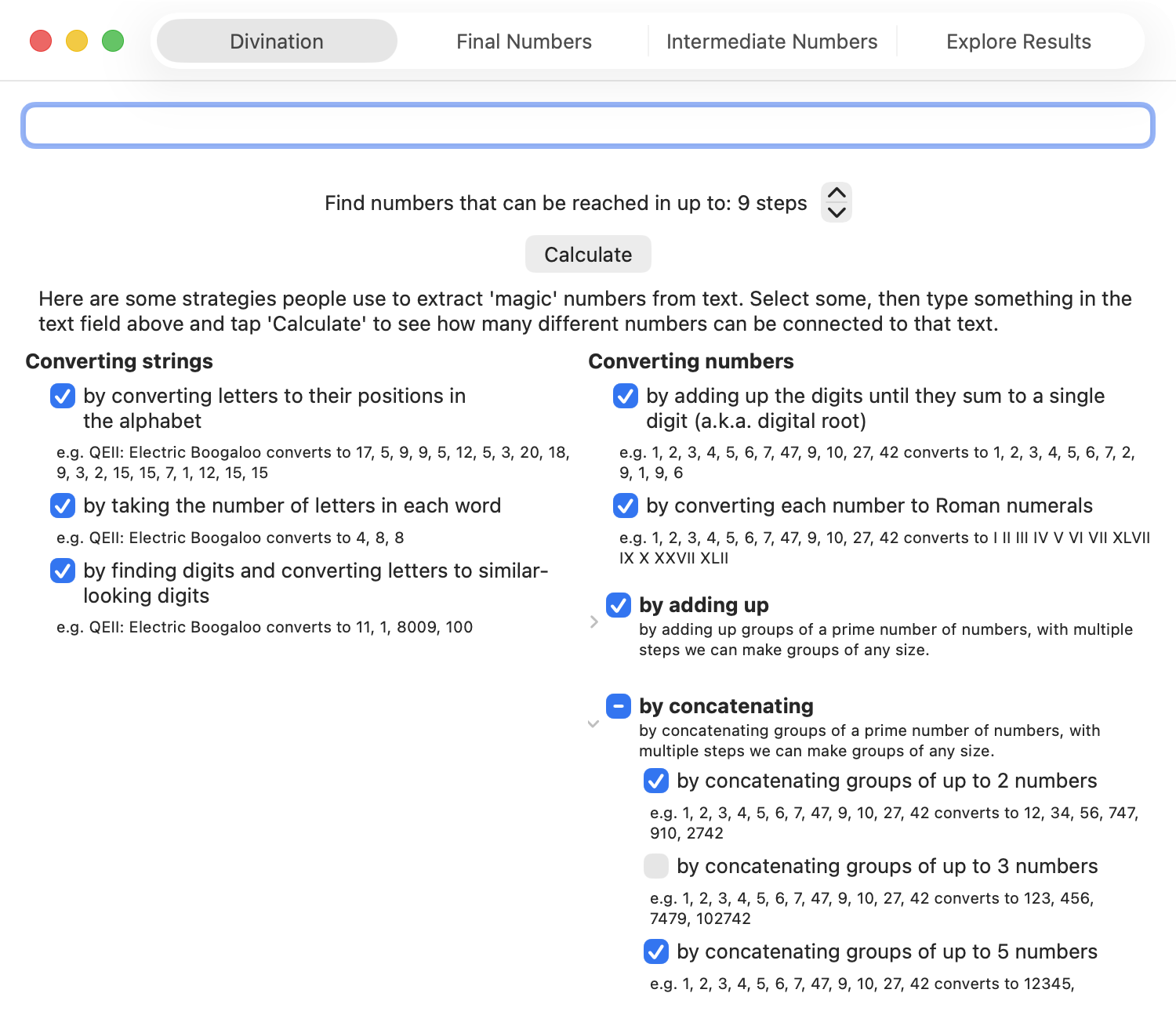
- Convert text into numbers
- by converting letters to their positions in the alphabet — Uri only uses this one for converting A to 1, but I’ve seen it quite often elsewhere
- by taking the number of letters in each word — this covers all the 11-letter words, and when combined with ‘adding up all the numbers’, covers other names and phrases with 11 total letters.
- by finding numbers that are already in the text, and letters that look like numbers — this covers the EIIR example.
- Convert numbers into other numbers
- By adding up the digits until they sum to a single digit (also known as digital root, this is equivalent to finding the remainder when dividing the number by 9, except using 9 instead of 0 unless we started at 0.)
- By converting each number into Roman Numerals — I think I only added this because I’d already written code to do that for something else. However, this covers the ‘numbers that have 2 in them’ case, as we can convert 2 to 11 by converting it first to II, and then to 11 by converting letters that look like numbers. This is a much more manageable way of turning 2 to 11 than adding a generic ‘convert each number into every possible combination of numbers that add to that number’ step.
- By adding up numbers
- Adding up all the numbers — this covers most of the adding-up cases on Uri’s page
- Adding up numbers in groups of up to 2, 3, 5, 7, and 11 numbers. By using prime-sized groups, in multiple steps we can add the numbers in groups of any size — e.g., we can add up groups of 6 numbers by first adding groups of 3 numbers, then adding those results in groups of 2.
- By concatenating numbers — combined with converting letters to their positions in the alphabet, this covers converting AA to 11
- Concatenating all the numbers
- Concatenating numbers in groups of up to 2, 3, 5, 7, and 11 numbers.
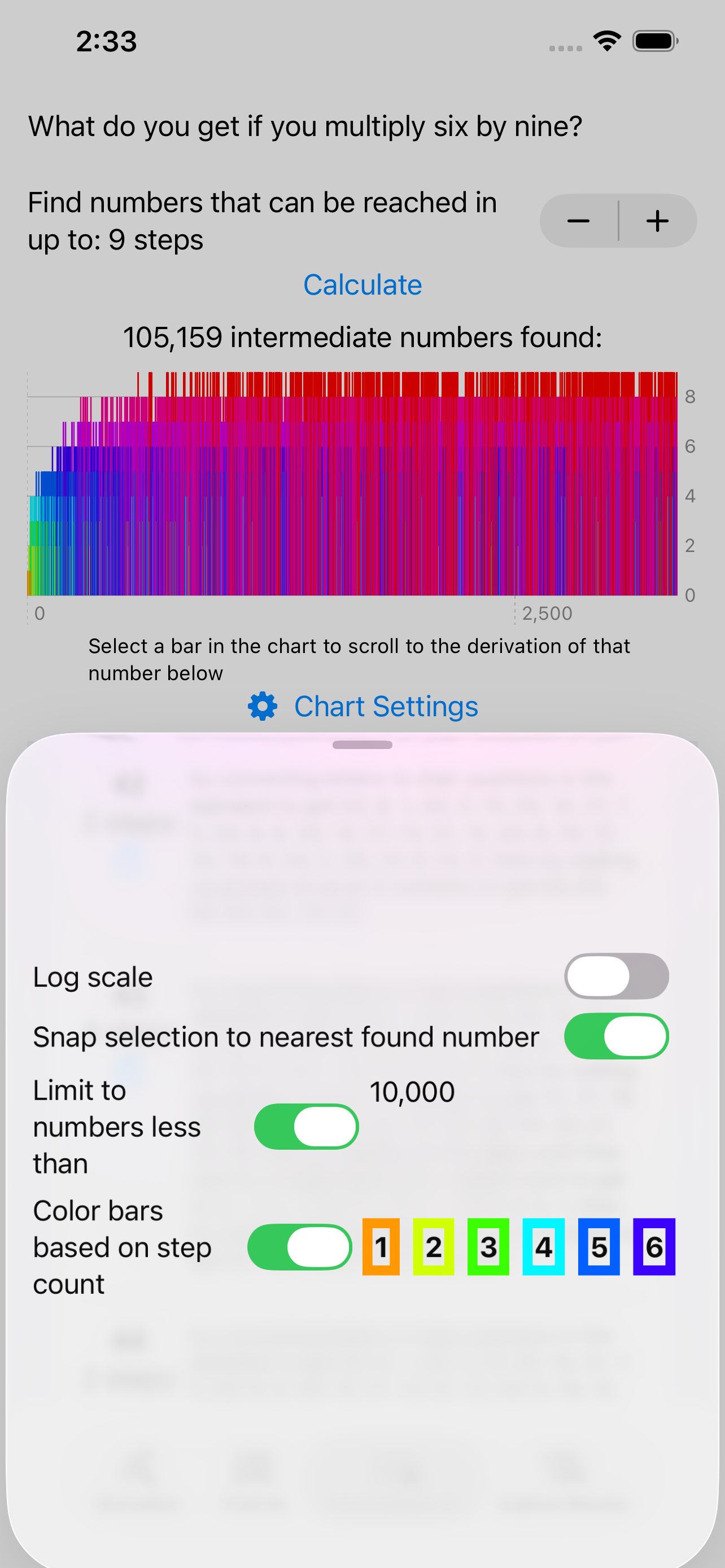
I stop at combining groups of 11, because while I could handle even larger numbers internally by using a different data type:
- I’ve got to stop somewhere, and not many people’s supposed lucky numbers have enough digits for concatenations or sums of multiples of 13 numbers to matter.
- I show charts of the numbers found, and there seems to be a bug (FB20491693, if you’re at Apple) in Swift Charts when I include more than one result that would convert to the same
Doublevalue. So I’m limited to final numbers under 253. - 13 is an supposedly an unlucky number anyway.
The app shows the final numbers you get when you complete enough of these steps to get down to a single number. On another tab it shows the intermediate numbers found alongside other numbers partway through the process. You can also explore the results yourself by expanding each intermediate result to see what was derived from it in the next step.
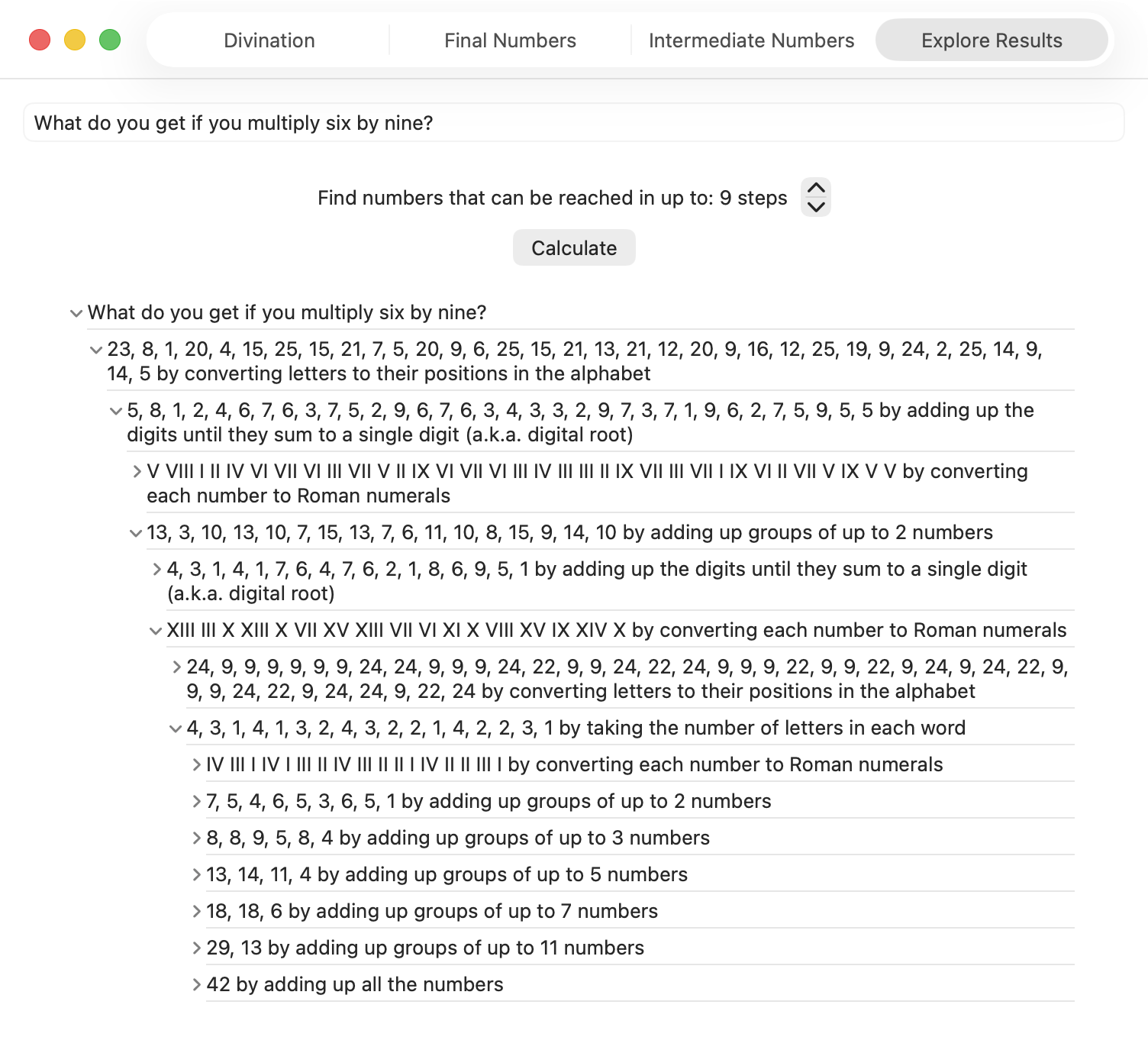
Note, there were many years between when I saw that page and when I actually wrote the app. So I don’t cover:
- Words that sound like numbers. I could have easily done something like this, at least on macOS, as I have a lot of experience with the text-to-speech APIs, but I simply forgot that was one of the tactics. Actually, I would probably just have a list of known words (too, to, for, non-rhotic Severn, etc.) that sound like numbers, or perhaps I would derive such a list by searching through a lot of text using the text-to-speech API. Uri’s suggestion of ‘hellheaven’ would not have come up though, since it doesn’t actually sound like eleven.
- Numbers that have consecutive or non-consecutive ones in them… although, this depends on how we got the numbers. If we obtained 10001 by concatenating 10, 0, 0, and 1, we would also have added those numbers to get 11.
- Stopping halfway when calculating the digital root — e.g., adding up the digits of 254 to get 11, but not continuing to add up the digits in 11 to get 2. I just take the remainder when dividing by nine to do the whole thing in a single step, so this won’t even be shown in the intermediate values.
I think that’s all I have to say about that… as I mentioned in my last post, this could also be a MathsJam talk some day. You can download the app for free on any device running macOS 26 or iOS 26. You could use it to debunk the claims of numerologists, or to make your own claims for fun — but please don’t use it to take advantage of gullible people.
Holiday Inn Express Geometry
Posted by Angela Brett in News on October 26, 2025
On our road trip across the USA, Joey Marianer and I stayed at many Holiday Inn Express hotels. I noticed that (at least for the Eastern side of the country) they had a lot of geometrical decor. In particular, some intriguing wallpaper, which I will analyse in the second hald of the post.
But first, some other geometrical art. For instance, this art made of triangles, shown here with a copy of the book I read on the trip, Matt Parker’s ‘Love Triangle‘:

This art featuring hexagons, and occasional quadrilateral half-hexagons:

And this art with triangles inside hexagons!
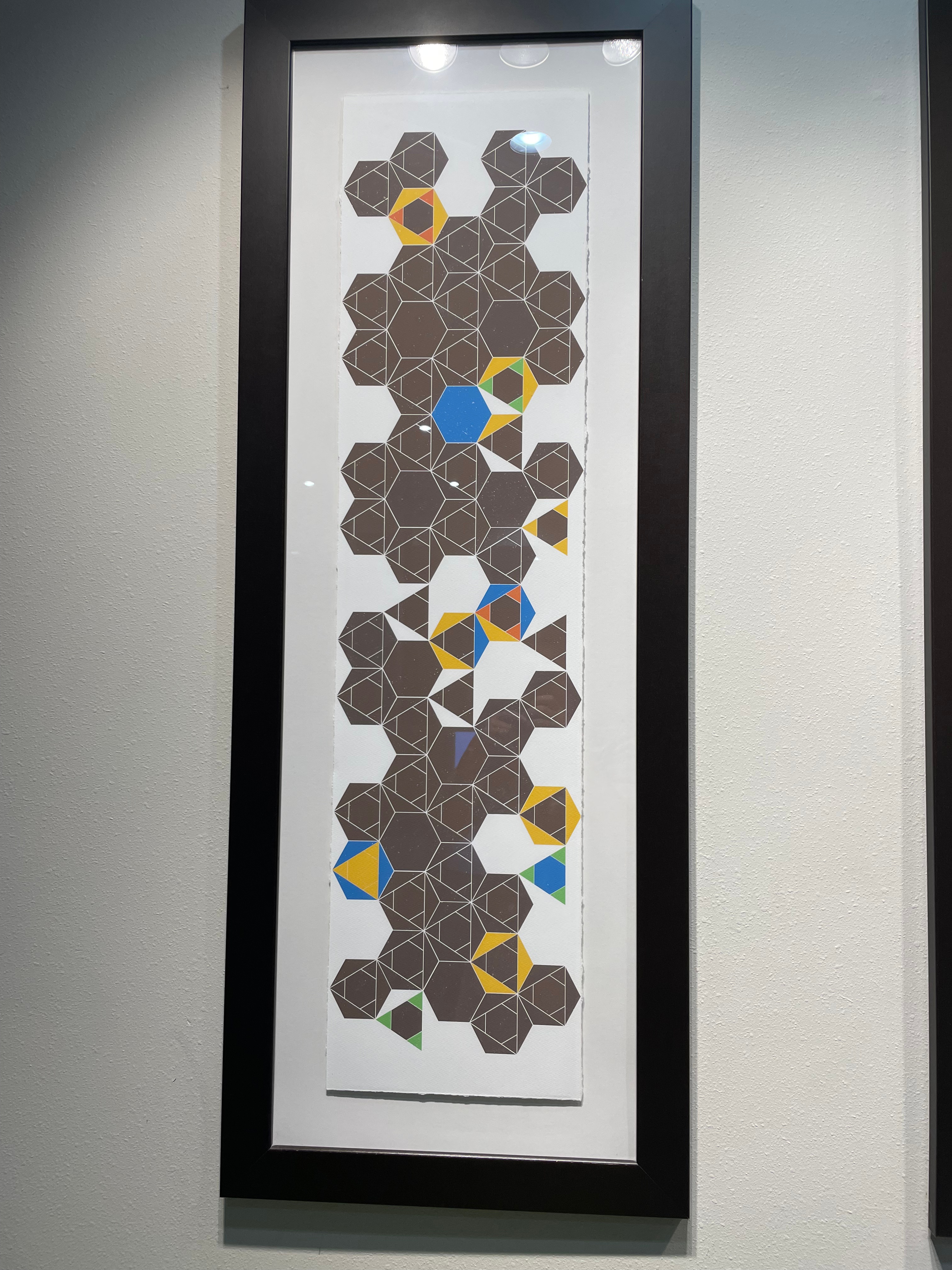
This door decorated in triangles, diamonds, and parallelograms:

This more abstract collection of overlapping quadrilaterals making the occasional triangle:

Then there are perhaps less-artistic tesselations which I might not have noticed if not for the other decor. For instance, this couch featuring two different kinds of triangle:

This floor which seems to have at least two different lengths of floorboard:

This bedspread tesselation of diamonds and parallelograms:
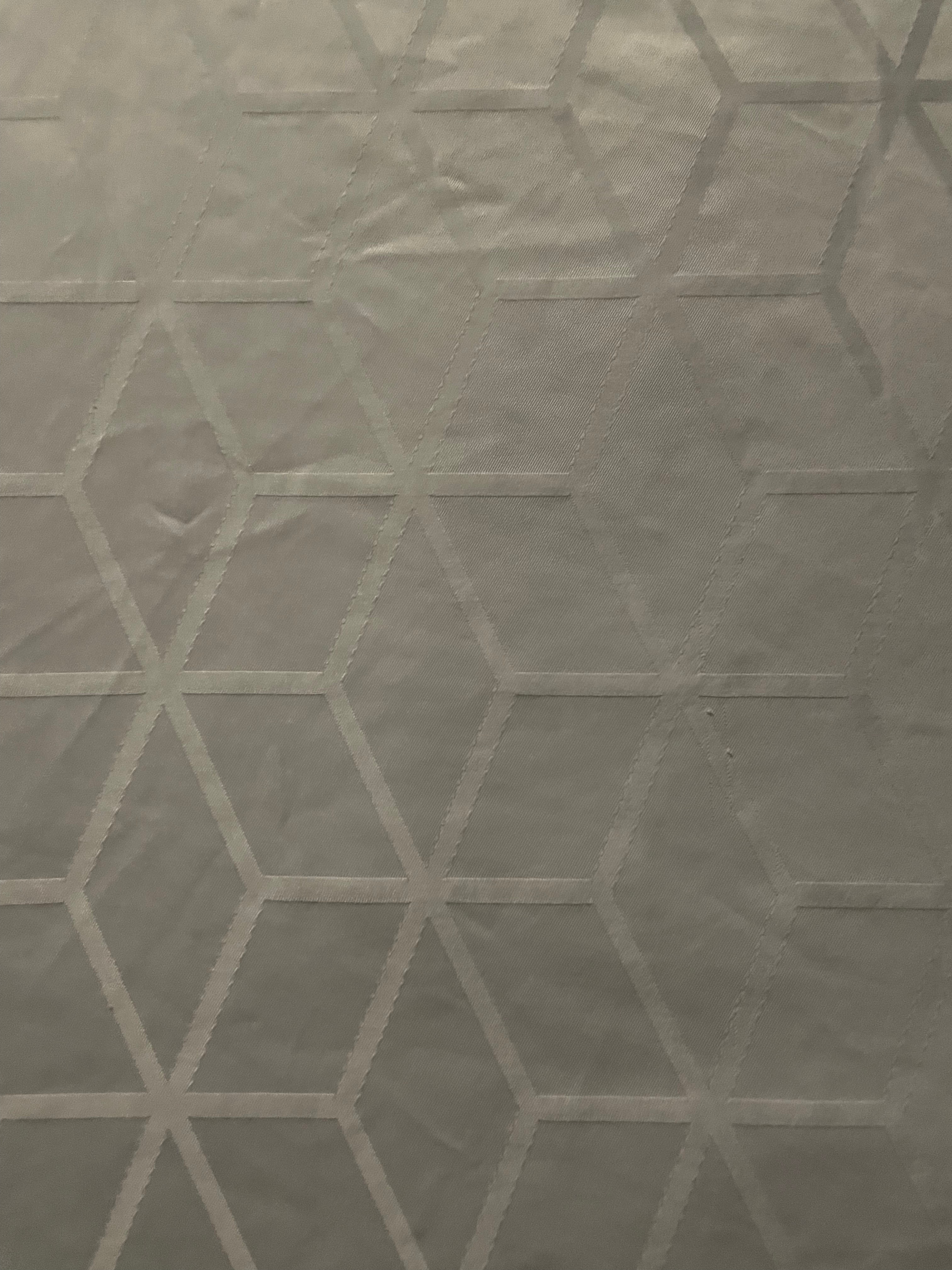
Now, onto the wallpaper. This was present in many different Holliday Inn Express hotels. Here’s the photo I took:

Here it is after I unskewed, cropped, and lightened it in GraphicConverter:
This raises a lot of questions:
- What is the repeating unit here?
- Which wallpaper group is it?
- What’s with all those lines that don’t meet the other side? Would the pattern make any more sense if I completed them?
- Is there some kind of pattern to the way the rectangles, the rectangles divided into triangles, and the rectangles with unfinished lines in them are arranged?
Okay, to answer the first question, here I’ve cropped it to show enough of the repeating units to recreate the whole thing, and converted it to black and white so we’re not distracted by the lighting:

At this point I switched from GraphicConverter to OmniGraffle. Here I’ve drawn in the repeating tiles:
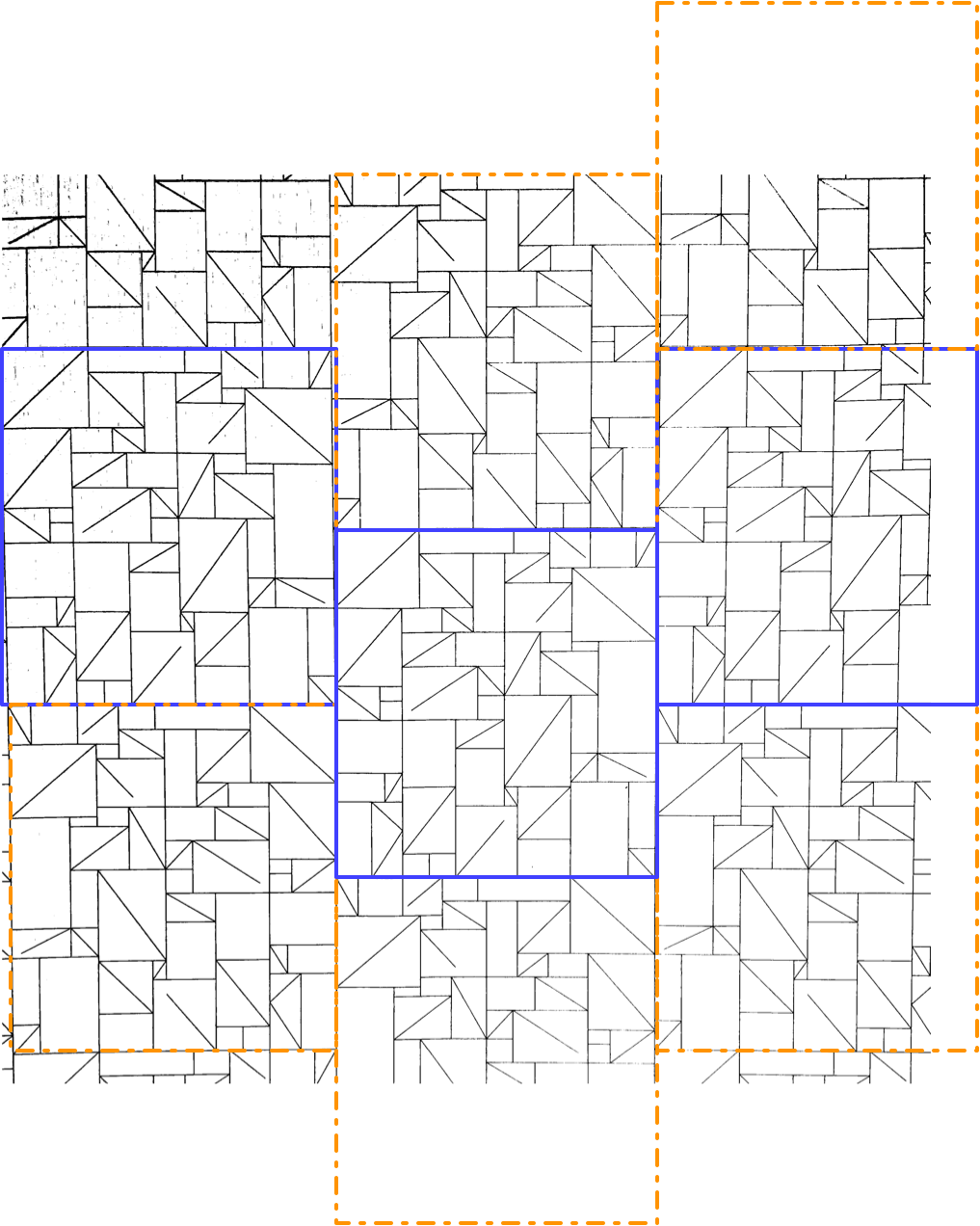
There are two kinds of tile, which I’ve outlined in solid purple and dashed orange. Vertically, the two kinds of tile alternate. Each column of tiles is offset vertically by half a tile from the ones next to it, so if you follow across the wallpaper, you’ll be alternating between top and bottom halves of tiles, and they might all be the same kind of tile, or they might be alternating kinds of tile, depending on where you start.
It took me a while to realise (actually, I think Joey pointed it out), but the orange tile is in fact the same as the purple tile, just flipped horizontally. That means we have what’s called a glide symmetry, or glide reflection — it’s like a reflection, but the reflection is moved along. The classic example of a glide symmetry is a trail of footprints — the two feet are mirror images of each other, but since they were walking when they made the footprints, they are never exactly next to each other.
So that means we can answer the question about wallpaper groups. It’s a rectangular lattice with only glide symmetries, no rotations or reflections. That’s called pg, and you can see other examples of it on wikipedia.
Here’s a single tile of it, from which we can construct the whole wallpaper:
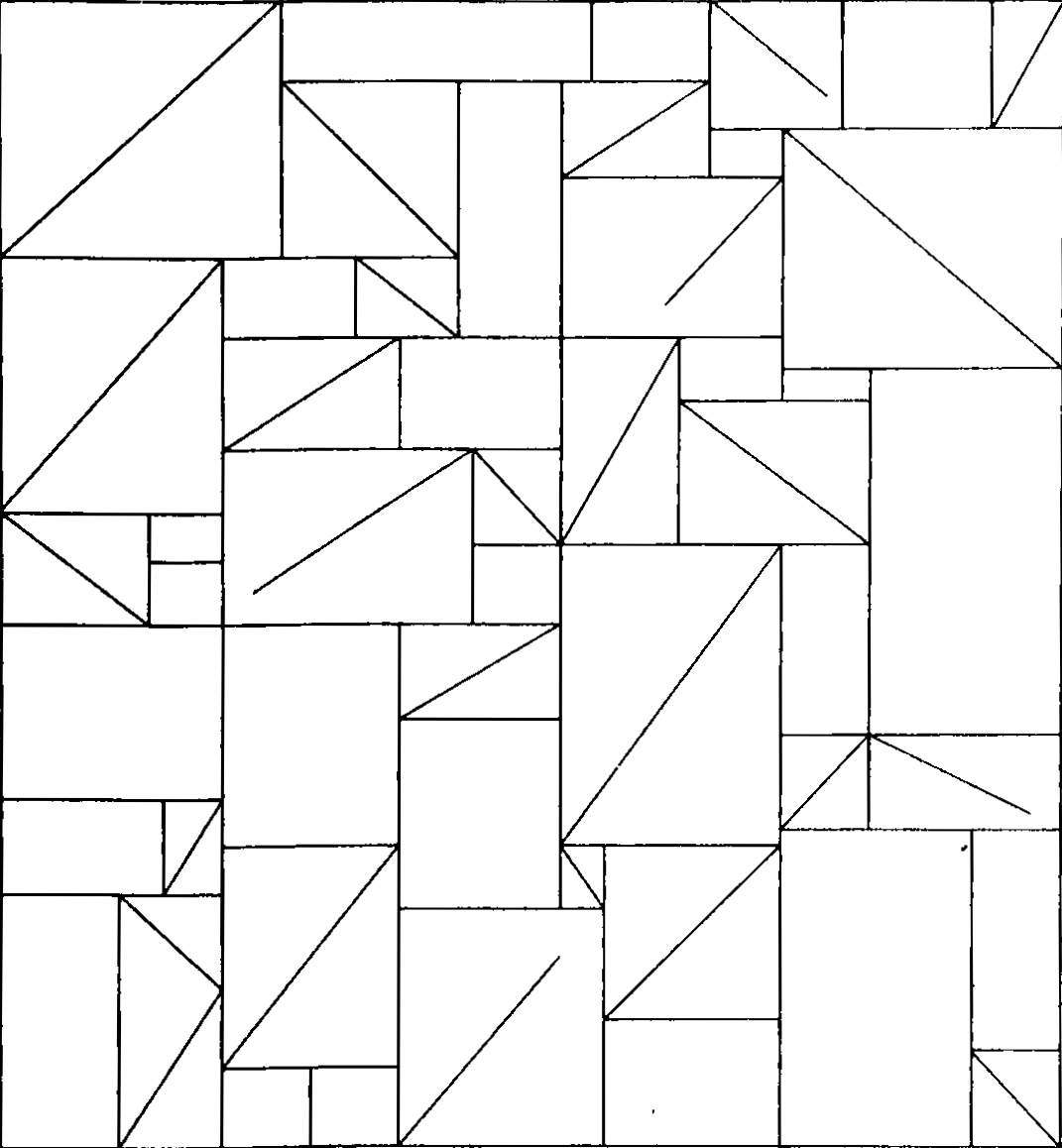
It has 43 triangles (mostly in rectangles divided into two triangles, but there’s one divided into three triangles on the bottom left), 24 plain rectangles, and 5 rectangles that have a diagonal line going partway across them.
Okay, so onto question three. What’s with those lines that don’t quite reach the other side? Here, I completed them, and approximately measured the angles using the arc tool in OmniGraffle (I use OmniGraffle for a lot of things that aren’t graphs. For instance, this quark explainer, and the icon of my next app.)

There. Is that enlightening? No. Is that satisfying? Also, no. Two of the lines pretty much reach the other corner, if you squint, and three of them don’t. But perhaps knowing that you can give up on making any sense of this will give some relief.
Ah, but what about the arrangements of the three kinds of rectangle? Surely there’s something interesting about that. I haven’t found it, but maybe you could. Here’s a single tile, with a purple rectangle pattern for the plain rectangles, a pink zigzag pattern for rectangles divided into triangles, and a green pattern of short lines for rectangles with maddening partial lines in them. I’m not sure how useful the redundant coding is here, but it can’t hurt.
I’m not sure why I didn’t colour the three-triangle rectangle near the bottom left in a different colour from the two-triangle rectangles. I made these a while ago. [Next day edit: This bothered me too much to ignore. See below for a version with a different colour for that rectangle.]
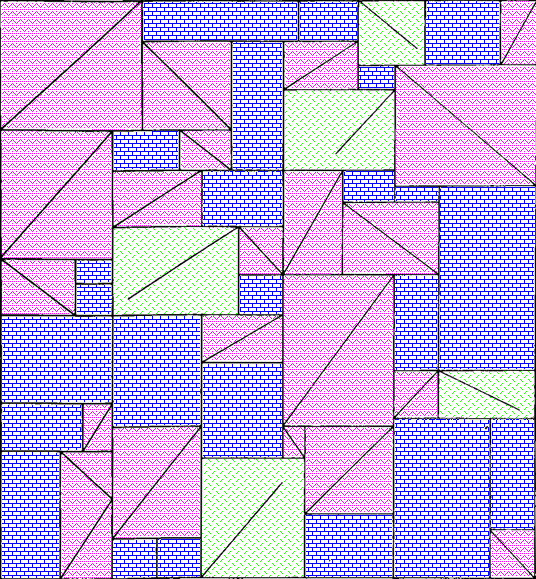
I can imagine the letter P and a dog standing on its hind legs in pink, but I don’t think there’s any kind of hidden message here. Just to be sure, here’s the colourised version extended to show more of the wallpaper:

Well now perhaps there are a bunch of dogs walking past each other doing the can-can. Do you see any interesting geometry or other mathematics that I missed in any of these images?
Next-day edit: Here’s a version with the three-triangle rectangle in checkered orange. I accidentally used a different shade of pink, but the shade of pink had no mathematical value, so it’ll do:
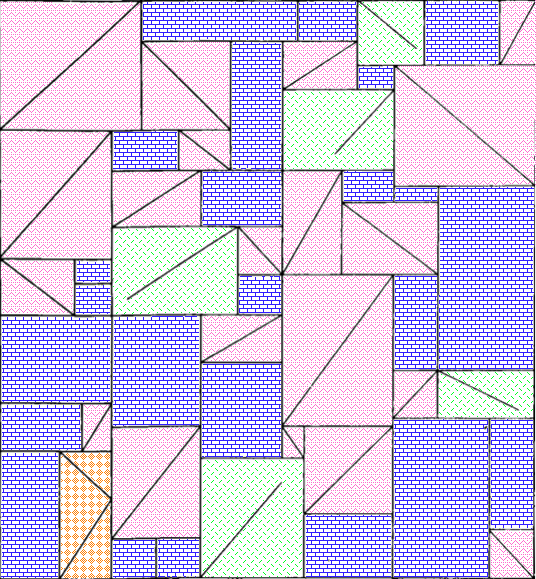
And here’s a larger section of wallpaper using that version:

When I took these photos, I thought they might make a good talk at the MathsJam Annual Gathering. We ended up deciding not to go this year (though we’ll probably join virtually) so I won’t be giving that talk. I have also made a new app which could be the focus of a MathsJam talk. I have submitted it to the App Store, so I hope it will be out very soon.
On the subject of apps, I got a job offer, though I haven’t started work yet. That means I’ve released a new version of Seddit, my text-to-speech-focused Reddit reader, where the only update is that it no longer says I’m looking for work on the ‘Support Seddit’ tab of the settings.
Sailing off into the sunset toward America
Posted by Angela Brett in Moving to the USA, video on July 27, 2025
As mentioned previously, I have an idea for a music video I’d like to make about my move to the US. But before I make that, I wanted to publish some of the video I took on the trip, in a fairly raw and unedited way, just to get it out there. I already published hours of 4K video from the ship leaving Hamburg, leaving Southampton, and arriving in New York City, recorded with my Sony ZV1 camera on a tripod.
Well, it was time to put together whatever random video I took with my iPhone. And I was just going to stick it all in a video with fades between clips, but there really wasn’t much going on in terms of sound — it needed music. And of course if there was going to be music, I’d better edit the footage a bit more to fit in with the music. So I ended up making something of an impromptu music video. Probably the coolest part (other than the music) is the sunset I recorded from the front of the ship one evening.
The song is ‘America’ by K’s Choice, as covered by my friend Joseph Camann when I requested it on his Patreon. Joseph is a multifaceted and multitalented individual who is also known as Chromatic Verse (mostly for visual art) CamannWordsmith (mostly for writing) and Joseph and the Bear Hat (for song covers.) It is unclear which parts the bear hat played in this cover.
I initially thought that the song ‘America’ would work better for the road trip across America than the trip across the pond, so I spent some time trying to find something else for this one… but come on, ‘America’ has a line about the sun rising and falling, and most of the video is a sunset. How could I not? Also there’s the double bonus of publicising both my friend Joseph and also one of my favourite bands, K’s Choice.
A day or so after we got to NYC, we visited MoMath, and I recently realised that while I’d put up video of Joey Marianer riding a square-wheeled tricycle there, I had forgotten to edit the other video I took of Joey at MoMath. Here’s Joey changing some benches from a triangle shape to a square and back, set to one of the free jingles that comes with Final Cut Pro:
That’s it for now. Stay tuned for a video of whatever I recorded on my phone during our ensuing road trip across the US, which I will inevitably spend more than the expected amount of effort on!
Circles (Soul Coughing parody lyrics)
Posted by Angela Brett in Moving to the USA on February 6, 2025
These lyrics are to be sung to the tune of ‘Circles’ by Soul Coughing. They refer to the proposition that we use tau (τ) defined as 2π, instead of pi (π), counterarguments to that, and neverending friendly rivalries about it.
When you were younger you were taught a circle formula
That its perimeter is πd, that is, 2πr
πd gets you all round the circle
All around the circle, all around the circle
All around it
πr’s just halfway round the circle
Halfway round the circle, halfway round the circle
Halfway round it
And now you’re older, there are folks attempting to convince
That 2π’s τ and you should use it for circumference
τr gets you all around the circle
All around the circle, all around the circle
All around it
πr’s just halfway round the circle
Halfway round the circle, halfway round the circle
Halfway round it
Pi-tau-pi-tau-pi
Am I coming or going?
Tau-pi-tau-pi-tau
Am I halving or doubling?
Pi-tau-pi-tau-pi
Am I coming or going?
Tau-pi-tau-pi-tau
Am I halving or doubling?
But I can’t find out what’s the area
It was πr-squared, and now, τr squared on two
τ is now twice, π can do everything
Change it to τr, and complicate the formula
πr-squared is all around the circle
All around the circle, all around the circle
All around it
τr-squared’s twice around the circle
Twice around the circle, twice around the circle
Twice around it.
This row*’s just going round in circles (*with ‘row’ rhyming with ‘cow’, meaning ‘fight’)
Going round in circles, going round in circles
Round and round them…
(repeat entire song indefinitely)
I was not familiar with the original song, but we saw Holy Bongwater perform Nurples at FuMPFest 2024, and when I found out it was a parody of a song about circles, I knew what I had to do. I was motivated to finally finish it by a deadline for a maths music feedback group with a group of people I know from MathsJam. There were a few suggestions, but nothing that stood out as being a definite improvement — it was π of one, half a τ of the other, really. So I’ll put the lyrics here, and you’re welcome to sing them or change them as you see fit. They’ll likely be sung at MathsJamJam this year, perhaps along with This Tiling Never Repeats, which wasn’t sung last year because not enough people were familiar with the tune (and it’s a little harder to get the hang of than this one.)
In other news, after watching Star Trek: The Next Generation, Joey and I watched all of Lower Decks, and have got several seasons through Deep Space Nine. I now know that the combadge I put on my Star-Trek-like dress (which most closely resembles Starfleet cadet uniforms and Deep Space Nine uniforms) is only used for the first two seasons of Deep Space Nine, so the person who told me I had the wrong combadge for the dress was probably thinking of later seasons of DS9.
Since my last post I finished Advent of Code 2024 (which it turns out does not necessarily get more difficult each day, but does continue to be fun and somewhat nerdsnipy), did some more LeetCode exercises, did the final round of interviews for the job that had recommended practising with LeetCode, and did not get the job. So, I’m still looking, but now I feel pretty well prepared for most kinds of interview that could come my way. Meanwhile, I’ve started making a new multiplatform (iOS/macOS) app that a friend of mine always wanted to exist. A very rough, but functional, version of it is on TestFlight already. If you are a big Reddit user, and especially if you are also blind or visually impaired, you might want to try it, but please be aware it is in the early stages and there are many things I already plan to improve.
I have also uploaded a video from when we arrived in New York on the Queen Mary 2. I’m currently doing some light editing on a video from when we left Southampton, which I had forgotten I filmed. As mentioned previously, I still have more videos of my move to edit. On the more practical side, I’ve finished unpacking all my boxes, and filled my shiny new bookcases with books, and my new CD/DVD racks with CDs, DVDs, and also books.
A few mathematical numbers
Posted by Angela Brett in News on August 14, 2023
My last post had Joey Marianer (to whom I was flabbergasted to be married) singing some lyrics I wrote, and mentioned that we would soon be at the MathsJam Annual Gathering, and that I’d uploaded all my JoCo Cruise footage for that year. Well, in my aperiodic compiling of blog entries, I have reached a familiar local pattern. Joey (to whom I am still gobsmacked to be married) has sung more lyrics I wrote, we are once again planning to go to the MathsJam Annual Gathering, and I have uploaded all my JoCo Cruise footage for 2023.
A Cake of Sets
At my first MathsJam Annual Gathering, I gave a talk involving one poem I wrote and several that I found. At the 2019 Gathering, Joey and I participated in the competition competition with a Hallelujah competition. At last year’s Gathering, we added some set theory to the Bakeoff with this (cheese(cheesecake)cake) Venn diagram:

It was mentioned in this excellent summary TikTok by Ayliean!
We assembled it on-site from store-bought cheese, cake, and cheesecake. What with travelling internationally to MathsJam, it would have been impractical to (cheesemake(cheesebake)bake) it ourselves.
A Set of Songs
At this year’s MathsJam, we will add to the set list of the MathsJam Jam.
Symmetry
To start with, we noted an existing theme of symmetric relations in the lyrics of The Beatles’ song ‘All You Need is Love’ and made it explicit. Here’s Joey singing our parody, Symmetry:
Here are the lyrics:
Symmetry!
Symmetry!
Symmetry!There’s nothing that is x that x is not
No ex where you’re not an ex they’ve got
The symmetry says that the relation goes both ways
It’s easy!If you’re my sibling, I’m your sibling too
You’re married to me and I to you
Each of these relations is the same as its converse
It’s easy!x relates to y
x relates to y
x relates to y, why? ’cause y relates to xIf one real number’s greater than the other
Or maybe I’m your son and you’re my mother
Such relations exist, but symmetric ones top our list
They’re easierWhen x relates to y
x relates to y
x relates to y and y relates to xx relates to y
x relates to y
x relates to y, why? ’cause y relates to x
Seven Bridges (of Königsberg) Road
I’ve also written a first draft of a parody of the Steve Young song ‘Seven Bridges Road‘ about the Seven Bridges of Königsberg. Joey hasn’t sung this one, but I intend to enter it into the MathsJam Jam songbook (where there is already a parody of ‘Lola’ about the same topic.) Here are the lyrics:
There are rivers in Königsberg
Cross them as you go
Don’t forget one and don’t you repeat
On the Seven Bridges Road
Now each land mass must have odd or even
Bridges to and fro
Arrive but don’t leave in the same way
And Euler’s work did show
Sometimes there’s an odd one out
How to turn from there and go?
No way for a path with these few rules
Down the Seven Bridges Road
There are rivers in Königsberg
And if ever you decide you should go
There is a way by backtracking only
Down the Seven Bridges Road
Note, this is purely based on the way Jonathan Coulton and Paul and Storm sing Seven Bridges Road when they’re not pretending to be tone-deaf. If other artists sing it differently, the prosody might not work out as well.
This Tiling Never Repeats (in progress)
I’m also working on a parody of History Never Repeats by Split Enz called This Tiling Never Repeats, about the recently discovered aperiodic monotiles, which I am sure will be a big feature of this year’s MathsJam. I expect there to be at least three sets of aperiodic monotile cookies entered in the Bakeoff. I’ve only just started with this parody, but figured I’d mention it in case anyone wants to give me ideas for it, encourage me to finish it, or even write their own. I don’t mind who writes it as long as it exists and is sung at MathsJam.
A Song of Cakes
This section title is just for completeness, and because I needed something to separate the last song from the outro. I know too many songs about cakes to pick one.
As many people contemplate the value of X, I’ve created an account at what is obviously the best-named Mastodon server, Mathstodon. Feel free to follow me there! I don’t know yet how frequently I will post on it and/or my Twitter profile, but at least now you know where to find me if you’re on those networks.
∎
GloPoWriMo 2019
Posted by Angela Brett in NaPoWriMo on May 30, 2019
Last November, instead of NaNoWriMo (National Novel Writing Month) I created NanoRhymo, where I wrote a tiny poem every day inspired by a random rhyme from my rhyming dictionary, rhyme.science. April was GloPoWriMo (Global Poetry Writing Month — NaPoWriMo/National Poetry Writing Month to people from unknown nations who think ‘national’ gives their invented holidays a more realistic sheen) so I decided to do the same thing. Here are the poems I wrote.
Day 1, inspired by the rhyme propounds and zounds:
I see the news, and holler ‘Zounds!
That’s downright nuts! That is not cool!’
To see the thoughts that he propounds
I *hope* it’s all an April fool.
Day 2, inspired by the rhyme shenanigan and Flanagan:
There once was a rascal named Flanagan
who magnified ev’ry shenanigan
and when they were caught
repented, quite fraught,
then made their escape and and began again.
Day 3, inspired by the rhyme excavations and replication’s, and also a line from Jurassic Park:
After careful excavations,
came some reckless replications,
running rife, now run away!
Cunning life, uh, finds a way.
Day 4, inspired by the rhyme mutuality’s and theatricality’s, and the idea that the then-imminent Brexit needs to be summarised as a comic opera:
As now we face with Brexit
an end of mutuality,
I need theatricality
to show what’s going on.
It’s really quite complex, it
must be faced with joviality;
I can’t take the formality
or show-stopping fatality…
Before my poor brain wrecks it
by facing the reality
I need some musicality —
the show’s still going on!
Day 5, inspired by the rhyme asylum and subphylum:
This spineless chipolata
brings disgrace to Vertebrata!
I wish to seek asylum
in a different subphylum.
Day 6, inspired by the rhyme while I and styli:
Some scoff at using styli.
I’m not so highfalutin’,
so please excuse me while I
tweet from my Apple Newton.
Day 7, inspired by the rhyme lawmen and for men:
There’s no need to call the lawmen
and exclaim “Oh no! Us poor men!”
when things aren’t tailored for men.
Cast aside “misandrist” strawmen.
Watch how much you hold the floor, men.
Day 8, inspired by the rhyme airway’s and their ways:
I don’t agree with their ways!
Why can’t they learn new skills?
Their ‘breathing’ thing is hokum!
I won’t pay for their airways!
Why can’t they just use gills?
They’ll learn to if I choke ‘em!
Day 9, inspired by the rhymes ineffectually and intellectually, deficiency and inefficiency, and ineffaceable and untraceable:
If you’re ineffectual, although you’re intellectual,
then your inefficiency might stem from some deficiency —
memories ineffaceable which should be made untraceable,
ineffable reverberations crowding useful thought.
Day 10 (a day late), inspired by the rhyme detectable and connectible, and of course the Event Horizon Telescope Collaboration’s announcement of the first image of a black hole:
Eight radio telescopes, made connectible,
made a black hole’s light detectable.
Day 11, inspired by the rhyme mending’s and endings, and of course the Beresheet lunar landing:
One small stop, and mission’s ending.
One giant lapse, no lunar mending.
Look at what you learn and hail your
huge success you earn through failure.
Day 12, inspired by the rhyme unlabelled and disabled:
While some propound that we transcend
ignore the boundaries to end
discrimination: life unlabelled
as woman, Asian, bi, disabled,
how you see me, and I myself,
still have myths attached we fell for,
still affect what we expect
to be, or see, and left unchecked
this blinding to the groups we see just
lets those stealthy fictions lead us.
Day 13, inspired by the rhyme reupholstering and bolstering and definitely referring to gunshot rather than immunisations:
If the shot in your arms is a killer,
you’ll find yourself bolstering the holster,
but if what’s in your arms is a pillow
you’d best be reupholstering the bolster.
Day 14, inspired by the rhyme planetesimals and hexadecimals (best read in a non-rhotic accent):
Previous dates say you’re lesser? Miladies,
we all start out infinitesimal.
Growing from dust we become planetesimals;
now you’re sixteen out of ten, hexadecimal.
Day 15, inspired by the rhyme deSitter and bitter:
I’m just very old; I’m not bitter.
I don’t care I can no more transmit a
request that will pass the de Sitter
horizon and get to your Twitter.
Day 16, inspired by the rhyme cassava’s and guavas, and a true story involving Joey Marianer and I hearing Beth Kinderman’s ‘Stop Covering “Hallelujah”‘ at MarsCon, visiting a ball of twine but not a furniture shop, noticing many other phrases that could scan to Hallelujah, and later writing a song to that tune about the ‘purple guava’ meme on JoCo Cruise. This poem is, of course, to be sung to the tune of Leonard Cohen’s Hallelujah:
At MarsCon just before the cruise,
we heard some Hallelujah blues,
saw Minnesotan places, but not Marva’s.
Beth Kinderman was in our head,
but thanks to Paul we wrote instead
A song like Hallelujah about guavas.
Purple guavas, not cassavas, purple guavas, not cassavas.
We ended up writing and rewriting many songs to that tune, and Joey has been going through our growing list of Hallelujah parodies and singing them on YouTube.
Day 17, inspired by the fact that it was National Haiku Day in some nation or other, and I indeed wrote a Haiku Detector app for macOS a while ago:
Haiku detector
is an app that finds haiku.
I wrote it myself.
Day 18, in reply to a friend who was surprised to have missed that I wrote a haiku detector:
And a robot choir,
a rhyming dictionary,
and an insult app.
Day 19, inspired by the rhyme surviving and depriving:
Let us watch the rich contriving
ways they can continue thriving,
cunning tricks to keep deriving
profits from their deeds depriving
others of the means of striving
for a life above surviving.
On day 20, I considered my post on unintentional haiku in the Mueller report to be my poem for the day.
Day 21, inspired by the rhyme nonvital and recital:
Some may say that art’s nonvital —
mere indulgence for the idle.
But while we breathe with no recital,
without reprieve, we’re suicidal.
Day 22, inspired by the rhymes (in non-rhotic accents) Larousse’s, nooses, and seducer’s, and some of the dictionary brands in my language bookcase:
In my bookcase of seducers:
Collins, Van Dales, and Larousses.
Some who judge not right from wrong,
Some who tighten grammar’s nooses.
Come to my Chambers, Roberts, Pons,
and I will Reed you all night long.
Day 23, inspired by the non-rhotic rhyme PDA to and cater:
Avoiding PDA to
abstemiously cater
to those who’d subjugate a
self you’ve not revealed
may further make the straighter
subconsciously equate a
same-sex love display to
a sin that’s best concealed.
Day 24, inspired by the rhyme dipterocarpaceous and veracious, to be sung to the tune of Supercalifragilisticexpialidocious:
My dictionary says some plants are dipterocarpaceous,
even though it sounds like that is doubtfully veracious.
Lots of plant clades sound like this; it’s really not fallacious!
Caryophyll- amaryllid- hamamelidaceous!
I then got distracted by life for a while and wrote more poems in May, but let’s pretend they correspond to days in April.
Day 25, inspired by the non-rhotic rhymes intersected, unexpected, and sectored:
In a culture split and sectored
sometimes came the unexpected
when two groups who both were hectored
saw their interests intersected.
Day 26, inspired by the rhyme anaphylactic and intergalactic:
In an immune system intergalactic
dark energy swells in repulsive analogy
for self-versus-self, a matter of allergy,
and the Big Rip apocalypse anaphylactic.
Day 27, inspired by the rhyme subsistence and coexistence:
Species risk extinction and your
stocks deplete if you seek grandeur.
If instead you seek subsistence,
you might sustain that coexistence.
Day 28, inspired by hearing about someone being asked this question, to be sung to the tune of Tom Lehrer’s song L-Y:
You love with your minds and hearts
but also have matching parts.
“How do you two have sex?” acquaintances pry.
Consensually, consensually, consensual-L-Y.
Day 29, inspired by the fact that May 12 was both Mother’s Day in America and the first Women in Mathematics Day:
Today’s the day we stand beside
the women who have multiplied,
divided, added, and subtracted,
extrapolated, and abstracted
such that all of us were raised
to heights and powers that amazed.
Day 30, written as I was compiling this post, inspired by the rhyme mallets and ballots:
Some pound pavement swaying ballots,
Some pound foes, build walls with mallets
Some pound notes are worth less… well it’s
some pound of flesh to buy and sell us.
∎
NanoRhymo
Posted by Angela Brett in NanoRhymo on December 2, 2018
November was National Novel Writing Month, which is a global event (‘National’ in this context means ‘More Official Than Other Made-Up Events, I Swear! Also, I Forgot There’s More Than One Nation’) in which people attempt to write 50000 words in a month. This is often abbreviated NaNoWriMo. I decided to go for an easier homophone, NanoRhymo.
Every day, I tweeted a short poem inspired by a rhyme I’d found using the ‘Random‘ button on the rhyming dictionary I made, rhyme.science. I’ve been tweeting interesting rhymes from this for a while, so some days I generated a new random rhyme, other days I looked through the @RhymeScience Twitter feed to find one that inspired me. Try it yourself! You might need to click a few times to get an accurate, interesting rhyme; I’m working on a new version that has fewer incorrect words or pronunciations in it, but don’t have enough spare time right now to get that up and running.
Some of them were fun little ditties, others were more inspired by current events or politics than my writing usually is. I’m not informed enough on most such issues to write on them, but that’s where the rhymes led me, and I have just enough of an informed opinion for a rhyming tweet. There are a few references to sexual assault and one to the Holocaust, so proceed with caution if reading such things is likely to be traumatic for you.
You can see all the NanoRhymos by clicking on the tweet above and reading the whole thread. But for those who prefer reading a blog, here they are. I’m considering continuing to write a NanoRhymo every day until I get bored of it, or until I have enough to publish a poem-a-day calendar. What do you think?
Day 1, inspired by the rhyme cloned and unowned:
It didn’t seem so wrong —
you wanted to prolong
the perfection of their hearts.
A collection of spare parts
was made when they were cloned.
They’re fêted and unowned,
but I’m a pair, impaired them-prime;
what’s mine is theirs, and theirs to mine.
Day 2, inspired by the rhyme no sin and close in:
A Jewish saviour way back
was questioned about payback,
and bade that those with no sin
grab stones and gather close in
to pelt a sinful other,
but then, the saviour’s mother
(whose immaculate conception
had made her an exception)
came forward — oh, Lord!
I would have ended that with ‘came forward, and Lord guffawed’, but I wanted to keep it in one tweet. The short version is probably better.
Day 3, inspired by the rhyme disguise and FBI’s:
This guy’s disguise will fool your eyes, but not the FBI’s.
They prize the wise who recognise through lies, despise the spies.
Day 4, inspired by the rhyme DVD on and neon:
Noise and darkness, stink and heat
Senses strained to find a beat
Shout to strangers lit by neon
…
Go home, put a DVD on.
Day 5, inspired by the rhyme young can and drunken:
Drunken groping long ago
Young can learn it’s wrong, and grow
Admit mistakes and make amends
Ensure the waking nightmare ends
Day 6, inspired by the rhyme enlighten’d and bite and, the election in the USA happening that day, and apparently also dogs:
Frantic voters running frightened,
Heavy hearts, but heads enlightened,
Two years on, they’ve seen his bite and
barking mad demeanour heightened.
Doggedly, they’ll put things right and
chase a future slowly brightened.
Day 7 (actually posted on November 10, because I missed a few days and made up for them by posting a few rhymes in quick succession) inspired by the rhyme promise’s and Thomas’s:
Don’t believe every Tom, Dick, and Harry;
Thomas’s promises won’t hold true;
Richard’s switch’d leave you hanging;
Trust Henry? Then regret that too.
Day 8, inspired by the rhymes rushes, crushes, and (in non-rhotic accents) ushers:
The wise one rushes,
Telling all their crushes,
Finding out the answers: yes or no?
No, they’ll only blush, or
Yes, follow the usher,
Make some more advances in the back row.
Day 9, inspired by the rhyme cynically and clinically:
After loving declarations,
you should not yet have relations,
but evaluate the information cynically.
Ask for terms and motivations,
and when provided with citations,
then concur, and place your arms around them clinically.
Day 10, inspired by the rhyme flattery and battery:
Some fake care to prime their victim:
soften and enlarge with flattery,
and while most juries don’t convict ‘em,
often they are charged with battery.
Day 11, inspired by the rhyme aghast and gassed:
See the harrowed and harrassed
Seething horrors of the past
Browse and mull, and be aghast
Thousands, millions, people gassed
This one has a different rhyme scheme in different accents: ABBA with the trap-bath split or AAAA without. It’s probably about the worst way I could have demonstrated the trap-bath split.
Day 12, inspired by the rhyme borders and marauder’s:
Halt, ye marauders,
attacking our borders!
Just following orders —
you can’t come in here!
If we don’t mistreat you,
we’re worried that we, too,
will soon have to flee to
another frontier.
(But they’d give us shelter;
they’d surely do well to!
We’re good folk, just dealt a
harsh blow; we’re sincere!)
Day 13, inspired by the rhymes (in non-rhotic accents) built a, kilter, and still to:
We’re all a bit off-kilter now;
we’ve lost a then and built a now,
but later’s what we’ve still to know,
and do we have the will to? No.
Day 14, inspired by the rhyme mathematician and proposition, and also Rudyard Kipling’s poem If—:
If⟹
If you see a proposition,
apply to it your intuition,
at length, exerting full cognition,
come to trivial fruition,
and restart with a new suspicion,
then you’ll be a mathematician.
Day 15 (actually posted on November 17, because I missed a few days), inspired by the rhyme compiling and unsmiling:
Robotic faces, cold, unsmiling,
hypnotic glaze of code compiling,
illuminating status lights
as humans wait for access rights.
Once it’s done, they wake anew —
the robots and their coders too.
Day 16, inspired by the rhymes amnesia and anesthesia, and whiskey and frisky:
Dull the pain with anaesthesia,
hoping for a brief amnesia
of harm sustained while he was frisky
(lapses blamed on too much whiskey)
Clear dark thoughts to fit some leisure:
dull clear thought with too much whiskey.
Day 17 (actually posted on November 18, because when catching up the missed days on November 17, I missed a day, so everything after this is a day late), inspired by the rhyme predestined and unstressed and:
If your plans have not progressed, and
stasis leaves you quite depressed, ind-
eed, you must stick out your chest, and
pray that you’ll be always blessed, and
loaf around, remain unstressed and
wait for that which comes predestined.
Day 18, inspired by the rhyme prick’d and afflict:
If Santa wanted Christmas cheer
to fill the Northern Hemisphere,
he’d send the elves to spread the word
to save yourselves and save the herd:
Inoculate yourselves; get prick’d!
Be those the flu will not afflict!
Day 19, inspired by the rhyme trustee can and deacon, although I ended up using 15 other rhymes for deacon and not trustee can:
Sea can weaken a Puerto Rican deacon.
We can be concerned, and we can sneak unspeakin’
or be concertedly connected shriekin’
so s/he can see kin be a freakin’ beacon.
Day 20, inspired by the rhyme Wozniak and Bosniak:
Once upon a time I met Steve Wozniak,
Who bought me a replacement when I lost me Mac
My life got weirder still; I saw a tokamak 🤷🏻♀️
And now I code for iOS to clothe me back
While Android code is handled by a Bosniak
It’s a pretty silly poem, but it is also 100% true (you can read the Wozniak story in even cheesier rhymes, if you like), and how could I ignore it when my random rhyme generator comes up with ‘Wozniak’?
Day 21, inspired by the rhyme xylem’s and asylums:
I’m committed to squeezing out a daily poem —
soon committed to a poetry asylum?
But pull enough good water up a xylem
and some day something sweet comes down the phloem.
Day 22, inspired by the rhyme Dulles’s and portcullises, and that time when I had about three hours to change planes in Washington Dulles airport but still only just made it, with an airport staff member running while pushing me in a wheelchair:
A change of planes is always an adventure
and no ride is as perilous as Dulles’s —
with far-off gates and queues there to prevent’ya
you’re sliding under plummeting portcullises.
This one is best read with low rhoticity and yod coalescence, to make adventure rhyme with prevent’ya.
Day 23, inspired by the rhymes routed, disputed, and (in non-rhotic accents) untutored:
In the untutored,
the pronunciation of ‘routed’
can be disputed,
so if you doubted
the pronunciation of ‘routed’
you’ve been outed.
(It depends on where you’re rooted,
so feud no more about it.)
Day 24, inspired by the rhyme fantoccini and Jeannie:
Jeannie, Jeannie, fantoccini
pulled the strings of her bikini,
made a pervy man look up it,
then she moved him like a puppet.
Day 25, inspired by the rhyme unstudied and ruddied, and the first image sent back from Mars by NASA’s InSight lander:
Freckled surface, still and ruddied,
sweeping spaces still unstudied,
far in space is InSight near;
insight can begin right here.
The freckles were actually dust on the lens, though.
Day 26, inspired by the rhyme Bernard would and hardwood:
A tree would never leave you;
it’s your steadfast, loyal bud.
A tree would never leave you;
it will root for you, come hail or flood.
A tree would never leave you;
it’s as solid as hardwood.
A tree would never leave you,
but Bernard would.
Day 27, inspired by the rhymes ultimata, weight a, and (in non-rhotic accents) eliminator:
The real eliminator
is bearing all the weight a
gazillion ultimata
can have on the enforcer.
Can they just divorce a
person they adore so
much because they made a
gaffe they said would force it?
Day 28, inspired by the rhyme conceal’d and kneeled:
They saw the violence, and they kneeled,
did not kowtow, and did not yield.
A shout of silence that conceal’d
the loudest power they could wield.
Day 29, inspired by the rhymes miss a, Alissa, and (in non-rhotic accents) kisser:
🙂: “Why would you miss a
girl named Alissa?”
🙃: “She’s a good kisser;
don’t you dismiss her!”
🙂: “But so is Melissa,
also Clarissa,
even Idrissa,
why just one Miss, huh?”
🙃: “Not gonna diss ya,
just not down with this, yeah.
I’ll follow my bliss, you
kiss them and I’ll miss ‘lissa.”
Day 30, inspired by the rhymes becharmed, unharmed, in non-rhotic accents calm’d, and in non-rhotic accents with the father-bother merger, glommed:
Onto magic guild they glommed,
vibes they quivered, nerves they calm’d.
Vicariously thus becharmed,
they came through escapades unharmed.
NaNoWriMo is over, but tune in on Twitter to see if NanoRhymo continues!
In which I appear content with content in which I appear
Posted by Angela Brett in News on September 24, 2018
I’ve been having a pretty relaxed month, but my life is ridiculous, therefore so far in September I have appeared in a music video, a radio broadcast, and a podcast.
The music video is Molly Lewis’s ‘Pantsuit Sasquatch‘, for which I recorded my feet walking up to a tortoise sculpture on a playground:
This joins the six other official music videos I have contributed to, and five unofficial music videos I’ve made. I guess I just like being in music videos.
The radio broadcast (which you can also listen to online) was episode #9 of the Open Phil Broadcast on Radio Orange. The broadcast mostly features regulars at the Open Phil open mic in Vienna. Each episode features an interview with and performance by two acts; I shared this one with Adrian Lüssing, also known as The Cliff.
It was an honour to be invited to participate in the broadcast, and it was made extra awesome by the fact that it happened while Joey Marianer, who has been setting a lot of my poetry to music, was visiting Vienna, so he participated too. I recited They Might Not Be Giants, then he sang his version of it, then we sang I Love Your Body, with Joey singing the first part and me singing the second part. Yes, me singing. This is about the first time I’ve sung for an audience, and the third time Joey and I had sung that song together, and it went on the radio. I think it went pretty well, though! We performed it again a few days later on the Open Phil stage, and I’ll post video of that once I’ve uploaded it.
The podcast was episode #60 of Wrong, but Useful, a recreational mathematics podcast by @icecolbeveridge (Colin in real life) and @reflectivemaths (Dave in real life). I was invited to be a special guest cohost. I’m not sure I contributed very much, but I once again recited They Might Not Be Giants, because the hosts had heard me perform that at the MathsJam Annual Gathering last year. I have to admit, I had not actually listened to the podcast until I was invited to be on it — podcast listening is something I usually do while commuting, and lately I’ve been noncommutative. However, before episode #60 was recorded, Joey and I listened to episode #59 together, and I’m happy to report that the answer we came up with for the coin-flipping puzzle was correct.
In hindsight, I wish I’d mentioned my linguistics degree while we were chatting about English and poetry and such. I also wish I’d said something about the fact that nobody on episode #59 noticed that the diameter of the Fields medal in millimetres happened to round up to the number of the podcast (that is, 64, not 59. You don’t expect mathematicians to give each podcast episode only a single number do you?)
This reminds me, I need to register for the MathsJam Annual Gathering soon. You should too, if you can get to it. It’s a lot of fun! And who knows? Maybe if you go, you’ll end up co-hosting a podcast.
≥3 (a poem and song)
Posted by Angela Brett in The Afterlife, Things To Listen To on March 25, 2018
A while ago I wrote a poem about love, and how much more complicated it is than mathematics, and how the <3 heart symbol is a little oversimplified, or at least misleading to any mathematicians such as myself who come to believe that love is a strict inequality. I didn’t publish it here but I did perform it at my show in Café Concerto, while Johanna Van Tan improvised backing music:
I also performed it at A Bunch of Monkeys Read Some Stuff on JoCo Cruise 2017.
This is one of those poems that was always secretly a song in my head, so while we were on a train to Minneapolis I told Joey how the tune went, and when he was back in stationary accommodation he sang it to a slightly better tune:
So in a sense that’s two (which is less than three) musical versions of it! I can barely come up with anything coherent to say about this. ❤️
Here are the words:
They Might Not Be Giants: now a song!
Posted by Angela Brett in News, Things To Listen To on November 18, 2017
The other day I discovered that the ukuletrically charged Joey Marianer has once again set something I wrote to music! Truly, a Joey is an exciting kind of friend to have. (No, not a joey. Not everybody‘s got a baby kangaroo.) This time it’s They Might Not Be Giants.
On the subject of people who could conceivably be called Joey, and who make music, my friend Joseph will be singing a parody of a song I wrote on his patreon some time soon. I’m looking forward to it! If you support him on patreon you’ll see it as soon as it comes out — check out some of his recently-unlocked older posts to get an idea of what you’re in for. The patreon is his only source of income at the moment, so your contribution would mean a lot to him, as well as being good value for you.
On the subject of They Might Not Be Giants, I recited it at the MathsJam Annual Gathering last weekend. It was my first time at a MathsJam and it was great fun. At MathsJam, anyone can give a five-minute talk about anything mathematical, and newcomers were especially encouraged to, so I decided to present The Duel, a more mathematical poem than I would usually do at open mics. I even made some slides depicting what was going on. Eventually, though, I started to think The Duel wasn’t very good and I should do They Might Not Be Giants instead. After reciting both to a focus group of order two a few hours before my talk, I made the switch. With my remaining talk time, I showed some of the haiku I found in the Princeton Companion to Mathematics. It seemed to go down well. I had brought along a few of my posters in case people would be interested in them, and came back with none.
The rest of MathsJam was amazing, and I’m sure I’ll be back. There were all sorts of talks, including another mathematical poet, as well as magic, coin-floating, robotic cube-solving, juggling, puzzles, balloon animals, fancy yarn spinning, mathematical song parodies (I also sang Tom Lehrer’s Derivative Song for the people at the MathsJam Jam, since they hadn’t heard it), mathematical cakes, and a competition competition!
I won an origami double-stellated tetrahedron in a competition competition competition. It might not technically be a double-stellated tetrahedron, but the competition was to name it, and, inspired directly by the talk by the shape’s creator (Kathryn Taylor), that’s what I named it.
I was a bit worried that it was going to be a pain to get that home without damaging or losing it, since it would get crushed in my bag and I’m not used to carrying something in my hands constantly. At first it had a string or rubber band around it which had been used to tie it to the competition box, so I tied it to a belt hook. At some point it fell off and partly came apart, but I was having dinner with other MathsJam attendees at the time, and one of them knew enough modular origami to fix it (Kathryn had run a table devoted to modular origami on the Saturday night.) After that I held it by hand, until I realised that it could be suspended quite securely in the Acme Möbius scarf I was wearing.
I heard, repeatedly, that there’s a magazine called chalkdust which I should really be submitting some of my mathematical writing to, so I’ll do that. First, though, I will read the copies I picked up at MathsJam.

This work is licensed under a Creative Commons Attribution-Noncommercial-Share Alike 3.0 Unported License.
Please tell me if you do something cool with it.

 Creative Output