Posts Tagged science
Jack of Diamonds: They might not be giants
Posted by Angela Brett in 54 Costumes of Manneken-Pis, Writing Cards and Letters on October 7, 2012
 Note: this poem is now available on a poster!
“If I have seen farther,” the scientist said,
“it’s not because I am a giant.
“Great minds of the past have helped me get ahead;
it’s their shoulders on which I’m reliant.”
“Now listen to me!” said the great on whose shoulder
the first one was glad to have stood.
“I’m quite short of stature, it’s just that I’m older
and those before me were so good.”
And sure enough, this one was perched on the neck
of a giantist of great renown
who balanced in turn on another; by heck!
It’s little guys all the way down.
And some were thought giants, and some were thought midgets
and some were thought nothing at all,
but each would insist, “Those below were no idjits.
It’s them that have made me so tall.”
And scrambling around them their fans would aspire,
to see something not seen before
by climbing the tower of dwarves, ever higher
for glimpses, or footholds, or more.
Most could not scale to the summit in time,
before their peak fitness would end.
Some found it tough and abandoned the climb
while some would, with vigor, descend:
Aware that such heights were so taxing to reach,
they helped to lift people and hopes,
inventing new ladders and platforms to teach,
securing and showing the ropes.
“They might not be giants, but they must go far
and that journey isn’t for me.
I’ll boost them through science, raise them and the bar
and profit from what they will see.”
So said the teacher while lifting a child
on shoulders so humble and stressed.
The youth saw a vista that had them beguiled
and bounded straight up to the crest.
Quotes similar to “If I have seen farther, it is by standing on the shoulders of giants” have been attributed to many scientists and scholars. It’s been bugging me for a while, because even if the people whose shoulders they’re standing on are metaphorically taller than average, they’re nowhere near as big as how giants are imagined today, and they’re surely standing on someone else’s shoulders. There are no giants; it’s a tower of dwarves, and if it ever looks like it’s made of ivory, it’s just because the dwarves don’t spend enough time in the sun. You don’t need to be a giant to get up onto the topmost shoulders, but you need to do an awful lot of climbing; there’s a lot to learn before you can discover something new these days. Enjoy the view on the way up.
Luckily, we have people who invent new climbing techniques and equipment, and telescopes to see more when we get up there. This poem focusses more on teachers, but they could be science writers, YouTubers, educational charities, scientific songwriters (yes, even the ones that might be giants), inventors of more efficient lab equipment (the real or metaphorical telescope), maybe even code monkeys like me. Now that I’ve listed those things, it reminds me of the song ‘Somebody Will‘ by Sassafrass.
I would love to see illustrations of the tower of dwarves.
Eight of Diamonds: ISS vs. LHC (a comparison)
Posted by Angela Brett in Kennedy Space Center on September 12, 2012
Here is a handy, sometimes whimsical (but always as accurate as I could manage) comparison between two of my favourite scientific endeavours (now version 1.1, with changes detailed in a new post, along with a HTML table version with all the notes visible.) It is too cluttered with information to be a good infographic, so I’m calling it a TMIGraphic. Click on the image for a higher-resolution pdf with links and copious notes. It’s best if you save it and open it in a pdf reader rather than viewing it in your web browser, as the notes didn’t show up in the browser I tried. Click on each information box for the primary or most readable reference, and click the note icons for more explanations, references and interesting links. If you can’t see the note icons in the pdf, or if clicking on them doesn’t do anything, let me know and I’ll try to figure something out; the notes are important.

I’ve wanted to do this for at least three years ; I think it started with wondering which was cooler, and immediately answering myself with the relevant temperatures. When I started this round of Writing Cards (and not so much Letters) I thought I’d work on it slowly throughout the year, then finish it when the appropriate cards came up in one of the NASA decks and the CERN deck in the same week. This didn’t work for two reasons: every time I started to work on it slowly (and also, when I first came up with the idea of doing it as an infographic a year or so ago) I got stuck on the vacuum pressure outside the ISS. And even though the week’s CERN card is about LINAC-1, the NASA card seemed like a challenge that I couldn’t resist. Is the International Space Station really the largest, most complex international cooperative science and engineering program ever attempted? Well, I don’t want to choose a favourite. Let’s just say the Large Hadron Collider is the largest, most complex international cooperative science and engineering program on Earth, and the ISS is the largest, most complex international cooperative science and engineering program in space.
This took longer than my usual deadline of a week, but not through procrastination. Also not so that it would be released four years and two days after the first beam went through the LHC, though I’ll use that as an excuse if it helps. Almost every one of those numbers took quite a bit of effort to get right, and you’ll see in the notes in the pdf (that’s the old pdf, corresponding to the TMIGraphic pictured; here‘s the most recent one) that most of them come with various caveats and explanations, because nothing is simple. I’ll have to update some pages in wikipedia after this. I’m certain I still have some things wrong; maybe some obvious things. Please point them out, and I’ll fix them in the next version. Also, feel free to tell me how bad my layout is, iff you have a better suggestion. I know this is not perfect yet and I intend to keep working on it. If you have ideas of information to add, I’d like to hear that too; especially if you have leads on where to get that information. I can provide the original OmniGraffle document if you want to make your own changes, but I’d have to clean it up a bit first; there are a few things that I just made invisible rather than deleting.
The vacuum pressure outside the station gave me the most trouble; I’d hoped it would be a simple equation, or a statistic NASA would publish on their general ISS fact pages, but mainly I just found statements that the pressure inside the LHC beam pipe was the same as at 1000km altitude. For ISS orbit I found values or equations around the place suggesting values that differed by a factor of a billion, and nothing that seemed convincingly more authoritative than the others. Finally, via the Wikipedia page on orders of magnitude of pressure, I found a NASA document with the numbers for 500km, so I used those. It actually varies by a factor of 20. This is still at least 70km higher than the station, so outside the station it’s more likely to be toward the higher end of that range; that is, a less perfect vacuum than inside the LHC beam pipe.
I also had some technical difficulties with the presentation (apart from the clutter and my lack of graphical talent or training.) Firstly, I’m sorry if colour-blind people have trouble distinguishing anything. I wanted to use a colour-blind safe palette, but the paler colours wouldn’t have had enough contrast with white to work with the style I’d chosen. The colours of the information boxes are not essential anyway; they just group them into broad categories and might make it a bit easier for people to find the corresponding information about the ISS or the LHC.
As for finding the corresponding information boxes about the ISS and LHC, it’s really not optimal. There’s a tangled mess of dashed lines connecting them which is really no more functional than background decoration. I thought of making each info box link to the corresponding one on the other diagram, but although that worked in OmniGraffle, in a pdf viewer it did not zoom in enough on the linked box to make it sufficiently obvious which one you’d just jumped to. I also would have liked to make the links in the notes clickable, and add images to some of them. Again, this was possible in OmniGraffle but not in pdf. I’m not sure if there’s a common format that allows all these things.
So, after all that, the important question: Which one would win in a fight?
Of course it depends what the fight is, and here’s where you can get creative. In a weight-loss competition such as The Biggest Loser, I think the ISS would win, having lost about an eighth of its weight by going up to 426km altitude. Though the LHC did lose a fair bit of helium at one point. Meanwhile, the ISS literally runs rings around the LHC, and would certainly win the high jump. If you have an idea, feel free to comment here or, as the TMIgraphic says, tweet it with the #ISSvsLHC hashtag. Maybe it’ll catch on.
As for the ultimate winner, I’ll let Wil Wheaton have the last word. Science. SCIENCE!
Update: I heard back from my friend who had information on the LHC tunnel temperature (actually the temperature of the LHCb cavern, but it should be about the same), and updated that. I also added information in the notes about the exhibition on the AMS detector which you can come see at CERN Microcosm at the moment, and nudged a few things inwards so the preview is a little narrower. If you’ve gone through all the notes in the old pdf you might already have seen this talk given at CERN by the astronauts who installed the AMS on the International Space Station. I was there, and I wanted to ask (for the purposes of this comparison) which they thought was the most awesome out of the LHC and the ISS, but I was in one of the few spots without a microphone.
One thing I’d been meaning to mention is that the path to ‘orbit’ of both things starts with a proton and continues with a booster. The first module of the ISS was put into orbit using a Proton rocket, and many of the rest were taken to orbit on the space shuttle, with its solid rocket boosters. In the LHC, it’s the particle called a proton and the Proton Synchrotron Booster which accelerates it as part of the journey to the LHC.
Eight of Spades: The Synaesthetist
Posted by Angela Brett in Birds of Canada, Schmetterlinge, Writing Cards and Letters on April 29, 2012
 I’ve mentioned before that I have grapheme-colour synaesthesia. That means that I intuitively associate each letter or number with a colour. The colours have stayed the same throughout my life, as far as I remember, and they are not all the same colours that other grapheme-colour synaesthetes (such as my father and brother) associate with the same letters. I still see text written in whichever colour it’s written in, but in my mind it has other colours too. If I have to remember the number of a bus line, there’s a chance I’ll remember the number that goes with the colour it was written in rather than the correct letter, or I’ll remember the correct letter and look in vain for a bus with a number written in that colour.
Well, I’ve been wondering whether it could work the other way.
- Could grapheme-colour synaesthetes learn to look at a sequence of colours that correspond to letters in their synaesthesia, and read a word?
- Could this be used to send code messages that only a single synaesthete can easily read?
- Could colours be used to help grapheme-colour synaesthetes learn to read a new alphabet, either one constructed for the purposes of secret communication, or a real script they will be able to use for something?
- What would be the difference in learning time for a grapheme-colour synaesthete using their own colours for the replacement graphemes, a grapheme-colour synaesthete using random colours, and a non-synaesthete?
I know that for me, there are quite a few letters with similar colours, and a few that are black or white, so reading a novel code wouldn’t be infallible, but I suspect I would be able to learn a new alphabet a little more easily or read it more naturally if it were presented in the ‘right’ colours. I wonder whether the reason the Japanese symbol for ‘ka’ seemed so natural and right to me was that it seemed to be the same colour as the letter k.
It occurred to me that, as a programmer and a grapheme-colour synaesthete, I could test these ideas, or at least come up with some tools that scientists working in this area could use to test them. So I wrote a little Mac program called Synaesthetist. You can download it from here. In it, you choose the colours that you associate with different letters (or just make up some if you don’t have grapheme-colour synaesthesia and you want to know what it’s like) and save them to a file.
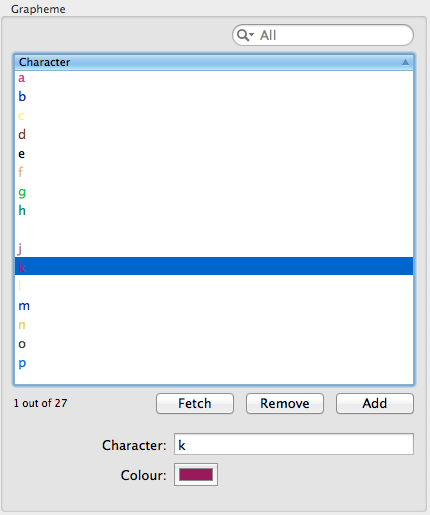
Then you can type in some text, and you’ll see the text with the letters in the right colours, like so:

But even though this sample is using the ‘right’ colours for the letters, it still looks all wrong to me. When I think of a word, usually the colour of the word is dominated by the first letter. So I added another view with a slider, where you can choose how much the first letter of a word influences the colours of the rest of the letters in the word.

This shows reasonably well what words are like for me, but sometimes the mix of colours doesn’t really resemble either original colour. It occurred to me that an even better representation would be to have the letters in their own colours, but outlined in the colour of the first letter. So I added that:

Okay, so that gives you some idea of what the words look like in my head. And maybe feeding text through this could help me to memorise it. Here’s an rtf file of the lyrics to Mike Phirman‘s song ‘Chicken Monkey Duck‘ in ‘my’ colours, with initial letter outline. I’ll study these and let you know it it helps me to memorise them. To be scientific about it, I really should recruit another synaesthete (who would have different colours from my own, and so might be hindered by my colours) and a non-synaesthete to try it as well, and define exactly how much it should be studied and how to measure success. But I’m writing a blog, not running a study, so if you want to try it, download the file. (I’d love it if somebody did run a study to answer some of my questions, though. I’d add whatever features were necessary to the app.)
But these functions don’t go too far in answering the questions I asked earlier. How about reading a code? Well, I figured I’d be more likely to intuit letters from coloured things if they looked a little bit like letters: squiggles rather than blobs. So first I added a view that simply distorts the letters randomly by an amount that you can control with the slider. I did this fairly quickly, so there are no spaces or word-wrapping yet.
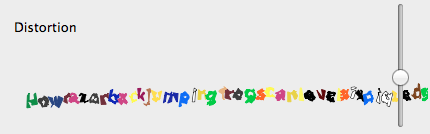
I can’t read it when it gets too distorted, but perhaps it’s easier to read at low-distortion than it would be if the letters were all black. Maybe I’d be able to learn to ‘read’ the distorted squiggles based on colour alone, but I doubt it. This randomly distorts the letters every time you change the distortion amount of change the text, and it doesn’t keep the same form for each occurrence of the same letter. Maybe if it did, I’d be able to learn and read the new graphemes more easily than a non-synaesthete would. Okay, how about just switching to a font that uses a fictional alphabet? Here’s some text in a Klingon font I found:

I know that Klingon is its own language, and you can’t just write English words in Klingon symbols and call it Klingon. But the Futurama alien language fonts I found didn’t work, and Interlac is too hollow to show much colour.
Anyhow, maybe with practice I’ll be able to read that ‘Klingon’ easily. I certainly can’t read it fluently, but even having never looked at a table showing the correspondence between letters and symbols, I can figure out some words if I think about it, even when I copy some random text without looking. I intend to add a button to fetch random text from the web, and hide the plain text version, to allow testing of reading things that the synaesthete has never seen before, but I didn’t have time for that.
Another thing I’ll probably do is add a display of the Japanese kana syllabaries using the consonant colour as the outline and the vowel colour as the fill.
Here’s a screenshot of the whole app:

As I mentioned, you can download it and try it for yourself. It works on Mac OS X 10.7, and maybe earlier versions too. To use it, either open my own colour file (which is included with the download) or create a new document and add some characters and colours in the top left. Then enter some text on the bottom left, and it will appear in all the boxes on the right side. If you change the font in the bottom left, say to a Klingon font, it will change in all the other displays except the distorted one.
This is something I’ve coded fairly hastily on the occasional train trip or weekend, usually forgetting what I was doing between stints, so there are many improvements that could be made, and several features already halfway developed. It could do with an icon and some in-app help, too. I’m still working on this, so if you have any ideas for it, I’m all ears.
Valentine Day Massacre chapbook
Posted by Angela Brett in News, Publishing on February 10, 2011
Just in time to arrive late for Valentine’s Day, Červená Barva Press have released a chapbook of poems mentioning the word ‘heart’, which were posted on Fictionaut in response to a Valentine’s Day challenge. I’m going to assume they removed the customary apostrophe and ensuing S in order to avoid any unintentional SQL injection. Anyhow, this book includes my scientific love poem, Chemistry, which you can see me reading while wearing two fake moustaches here:
The words and explanations of the science behind it can be found on a few previous blog posts, so I’ll just link to one of them.
Feel free to buy a copy of the chapbook for yourself or your valentine. I don’t get any money from it, and neither does anyone else except for the publisher, because apparently we did it for love, but if you buy it, you’ll get to read quite a varied set of poems, which will make you happy. Alternatively, you could read the poems on Fictionaut by searching the site for ‘Valentine’s Day Massacre’.
On the subject of fake moustaches, I recently went on a cruise with Jonathan Coulton and many of his famous friends and fans. The cruise featured a moustache formal, so if you would like to see how my moustache has changed over time, here’s a picture of me at the formal. I’ll probably post more about the cruise later, if I can come up with a sufficiently creative way of describing it. In the mean time, you could enjoy the many videos I took of the cruise.
Video: Chemistry
Posted by Angela Brett in The Afterlife on July 4, 2010
Well, my last six months are over, without the rules really having been adhered to, and I’m still alive. On the subject of Still Alive, Steam is now available on the Mac so I finally played all the way through Portal on the very Mac that sang Still Alive for my last video (the older Mac only lip-synched, although it was perfectly capable of singing.) And on the subject of my last video, that wasn’t my last video after all, because here’s a new one. It’s a ‘performance‘ of the scientific love poem Chemistry, which I wrote during Writing Cards and Letters and revised for a challenge on Fictionaut.
It’s one of those things that was meant to be simple but resulted in my buying lipstick, cotton swabs, a T-shirt, nerd specs and two fake moustaches, and breaking a wine glass which I never used anyway. I bought the moustaches in New Zealand because I couldn’t find any here. While I was there I recorded another video, which is not quite finished yet, so watch this space.
To save you a click, here are the words and study guide, mostly cut and pasted from other posts but with some irrelevant bits taken out and other bits added:

This work is licensed under a Creative Commons Attribution-Noncommercial-Share Alike 3.0 Unported License.
Please tell me if you do something cool with it.

 Creative Output