Shoe Shop Map
Posted by Angela Brett in Culture, The Afterlife on November 9, 2014
A while ago a friend of mine was excited to discover that she could fit the shoes in the children’s section, which were cheaper. Someone else was delighted to discover that she could fit shoes in the ladies’ section, having assumed her feet were too small. This kind of thing happens because shoe shops label sections according to who they are trying to sell to, rather than what is in those sections. So I walked around a few shoe shops in Vienna and made a rough map of the actual contents of each section, so that you can figure out from your shoe size and shoe design priorities where the shoes you’re looking for are most likely to be.
The maps just happen to fit neatly onto two pages, so if you want, you can print them and hang them at the entrance of a shoe shop as a public service (though I do not advise this, as it may be considered littering or vandalism or something like that.) You can click on the image below to get a nice smooth vector pdf.

Note that not all shoe shops contain all of these sections, and some others contain ‘sport’ sections, which I think are reasonably self-explanatory. Also, there are of course exceptions and differences between shops — I found one pair of size-36 boots in a ‘men’s’ section, and there’s usually a small cache of shoes designed primarily for comfort in the ‘women’s’ section, and some shops only go up to size 41 in that section. This map is simply intended to let people know which sections they might find shoes they like in, in case they had missed those sections due to their age and gender and the shops’ inaccurate signage.
Dinosaurs and Meteors (Arrogant Worms Parody)
Posted by Angela Brett in The Afterlife on November 4, 2014
Yesterday I read an article about quasicrystals in New Scientist (which I am still several issues behind in) in which Paul Steinhardt is quoted as saying:
It turns out with wealthy people there are two subjects they’re interested in: dinosaurs and meteors. We just had to find the meteorite people.
I immediately read the phrase ‘dinosaurs and meteors’ to the tune of ‘Tylenol and Clearasil’ from The Arrogant Worms’ song ‘The Prescription Drugs Song‘, and I put down the article to start writing a parody. This kind of thing happens to me a lot; I’m halfway through writing another parody inspired by a New Scientist headline I read last week.
I had the chorus written in pretty short order, then had to look up the rest of the lyrics to remember how it went. The verses have a lot of pauses for dramatic effect where I expect there to be more unstressed syllables, and it’s all somewhat irregular due to the way the quoted speech is read. Since I didn’t have the song available to listen to at the time, I just added in the syllables in most cases, making the verses sound a bit more like the chorus. Hopefully you understand how it’s meant to be sung, because as usual, I’m probably not going to sing it. Here are the lyrics:
I ended my first quarter, as broke as broke can be.
I wondered if my customers were twice as broke as me.
So I went to a rich man with the stock I hadn’t sold
hoping that he’d pay each worthless trinket’s weight in gold.
He said, “Fellow dirt-poor fellow, the highness of my birth
means I am far above the things that still are made on Earth.”
He pondered for a minute then he said, “I’ll tell you what,
I’ll give you the Earth for these two things I haven’t got.”
He asked for:
Dinosaurs and meteors, not diamond ores or needy orph-
-ans taking police academy course to fight crime dressed as bats,
chromatophores, or Apple stores, extant apex carnivores,
or coffee laced with fungal spores that’s pooped by civet cats.
I ended my second quarter, half-starved and far in debt,
with dust from Hayabusa that I shot a star to get
and amber-cased mosquitos that had dined on dino blood
and went back to the rich man, gave his door a torpid thud.
He said, “Fellow, dirt-poor fellow, this asteroid is dust.
If you can’t provide the meteor right, the rest I cannot trust
I’ll have to grow a dinosaur before you get your pay.”
He had his lawyer shut the door and tell me, “go away!”
I gave him:
Dinosaurs and meteors, not diamond ores or needy orph-
ans taking police academy course to fight crime dressed as bats,
chromatophores, or Apple stores, extant apex carnivores,
or coffee laced with fungal spores that’s pooped by civet cats.
I came back the third quarter, too poor for skin or bone
to ask if he could pay me for the dino he had grown,
but as I sat there chewing the remainder of my shoes
I faintly heard the rich man deliver his bad news.
He said, “Fellow, dirt-poor fellow, oh, I should have known!
My dinos were wiped out by your infernal deep-space stone!
So I have failed in my travail to ‘teach a man to fish’
but worms have turned and I have learned: be careful what I wish
’cause I got:
Dinosaurs and meteors, not diamond ores or needy orph-
ans taking police academy course to fight crime dressed as bats,
chromatophores, or Apple stores, extant apex carnivores,
or coffee laced with fungal spores that’s pooped by civet cats.
Dinosaurs and meteors, not diamond ores or needy orph-
ans taking police academy course to fight crime dressed as bats,
chromatophores, or Apple stores, extant apex carnivores,
or coffee laced with fungal spores that’s pooped by civet cats.”
…and I died and that was that.
∎
Now, you might complain that Hayabusa is an asteroid, not a meteor, but since there’s no way to get a meteor, the rich man should have specified in the first place whether he wanted an asteroid, a meteoroid, or a meteorite. I’m not sure if rich people are particularly interested in chromatophores, but I like the word (and I especially like the rhythm of ‘cephalopod chromatophore‘) so I included it anyway. The other things all seem to be things certain people will pay a lot of money for.
Without planning it, I managed to mention the Arrogant Worms album titles ‘Dirt‘ and ‘Torpid‘ in this song, so I changed the original ‘shooting stone’ to ‘deep-space stone’ in order to mention ‘Space‘. The song this is parodying is on Beige.
On the subject of song parodies, I think I forgot to mention that Glen Raphael recorded a parody of Oasis’s Wonderwall about the van der Waals force, and I contributed some of the lyrics over Twitter.
If you need yet more funny music, James Dempsey has finally released an album of his songs about Cocoa development. I’ve been listening to him since a song he sang at WWDC 2003 was put online. You can see that 2003 Model View Controller song in the background of my music video for A Laptop Like You, at around 2:13, so who knows, perhaps that stealth advertising sent an average of half a viewer his way. Anyway, I saw James Dempsey do another song at WWDC 2004 and asked when he was going to release an album. Last week at NSScotland I even met a conditional Breakpoint (an occasional member of his band) and he said the album was doing really well on the Billboard comedy charts. Anyway, I love the new album and you should listen to if it you’ve ever done software development or if you just like listening to great-sounding funny songs you don’t understand.
Another thing you might want to do if you like geeky comedy is back the Kickstarter for the Full Frontal Nerdity DVD, featuring Helen Arney, Matt Parker and Steve Mould. Oh, and check out my friend Black Pig’s comic, and if you’re in Vienna, come to Open Phil! And I almost forgot, support Arrogant Worm Trevor Strong‘s Patreon. Gosh, there’s really too much cool stuff out there. Don’t worry if there isn’t time and space to do it all.
Haiku Detector Achieves its Purpose (and will now proceed to have an existential crisis)
Posted by Angela Brett in Haiku Detector on October 19, 2014
I originally wrote Haiku Detector because my friend Gry saw Times Haiku and wondered whether there were any haiku in her Ph. D. thesis. The other day I heard back about the haiku she found. It turns out that even the title of the thesis is a haiku:
Developments for
studies of the extremes of
nuclear matter
Here’s another one, which could be about anything. The last line is a bit of an anticlimax.
As of today, the
origin of this strength is
not well understood.
When I read this one, I wondered if miniball was a mini-golf style version of another ball game:
At HIE-ISOLDE
the MINIBALL would be used
for the same purpose.
The impurities
of 48,50Ti
are easily seen.
After seeing these, I sent her the as-yet-unreleased new version of Haiku Detector, which can detect haiku made up of several sentences. Having mostly had my name on papers authored by the entire CMS collaboration, I expected her to find a lot of haiku in the author list. But ISOLDE is much smaller, and also this is her thesis that she wrote, not some paper whose author list she got tacked onto. So she got some from references:
Kitatani, S.
Goko, H. Toyokawa,
K. Yamada, T.
C 47,
537
(1993).
and some things with section numbers tacked on:
2.1.1
Open shell nuclei and
collective models
This matrix is the
starting point for the Oslo
method. 45
That last one has so many possibilities. I like to think of it as being about an electronic band called The Oslo Method which released a 45rpm record about The Matrix. Unfortunately, nobody can be told what the haiku is. You have to see it for yourself. And indeed, you can see the other haiku she found on the #MyHaikuThesis tag on Twitter.
I noticed something interesting while writing this post — some of the ‘haiku’ Gry found include gamma (γ) symbols:
The γ-ray strength functions
display no strong enhancement
for low γ energies.
5.2.3
Particle energy-γ-ray
energy matrix
Haiku Detector on her Mac has treated them as having zero syllables, as if they are not pronounced, and I think I recall characters like that not being pronounced in the Princeton Companion to Mathematics. But I just checked on my Mac running Mac OS X Yosemite, and the speech synthesis (which Haiku Detector relies on for syllable counting) pronounces γ as ‘Greek small letter gamma’, so Haiku Detector does not find those erroneous haiku. I think that this might be a new feature in Yosemite.
But here’s where it gets weird: you’d think that it’s just reading ‘Greek small letter gamma’ because that’s the unicode name of the character. I tried with a few emoji and other special characters, and that hypothesis is upheld. But the unicode character named ‘chicken’ (🐔) is pronounced ‘chicken head’. Spooky. Another strange thing is that there is no unicode ‘duck’ character.
If you’ve been paying attention, you probably know why I happened to come across those oddities. I’ll have to investigate them later, though; right now I’m in Edinburgh for NSScotland, and it’s about time I looked at some tourism information.
So, Haiku Detector; what now? Maybe look for supersymmetric haiku?
Update: It seems that in Mac OS X 10.8, γ is not pronounced, and 🐔 is pronounced ‘chicken emoji’. Other emoji also have ’emoji’ in their pronunciations, while still others are not pronounced. I wonder if pronunciations were added (and later edited to remove the ’emoji’) for certain emoji, and now the default pronunciation has changed from nothing to the unicode name. So ‘🐔’ ended up with the explicit pronunciation ‘chicken head’ while others which were not previously pronounced use their unicode names. So this should be a haiku in Yosemite, though for some reason Haiku Detector does not detect it:
🐒🐔
🐔🐒🐒
🍄🍄🐍
Forms and Formulae: Proof and Presupposition
Posted by Angela Brett in Forms and Formulae on October 16, 2014
 This is the sixth in a series called ‘Forms and Formulae‘ in which I write about articles in the Princeton Companion to Mathematics using poetic forms covered by articles in the Princeton Encyclopedia of Poetry and Poetics. This installment’s mathematics article is entitled ‘Geometry’, and the poetic form is anecdote. This poem tells a true story I was reminded of by the discussion of the many attempts to prove Euclid’s parallel postulate from the other postulates, before people finally considered what would happen if it were false, opening up whole new geometries. This anecdote is not directly analogous, however, since I actually proved a statement to be false rather than proving it to be independent of the other axioms and then investigating what would happen if it were false.
A statement that the learned man had tried for days to prove
was set for students as a test
for four points extra credit,
to boost percentage marks assessed
of anyone to get it.
I mined brain gold with mind-brainpan, but things did not improve.
My efforts could not beat a path
from axiom to conjecture.
I sighed, and then let go of math
and headed to a lecture.
As I was sitting on the can, the shit began to move.
I saw the field with eyes anew
and found a boundary sample
that proved the statement was not true —
an outright counterexample.
To draw for years a foregone plan, for sure does not behoove
explorers hoping quests provide
not just what’s sought, but more.
Perhaps the field was opened wide,
but I scored one-oh-four.
∎
I’ve been sitting on a draft of this one for a while, because, as noted above, disproving something is not the same thing as proving that one axiom can neither be proven nor disproven from the others, and then launching new fields of mathematics in which the axiom is taken to be false. Besides that, it’s a poem mentioning poop (though written before Shit Your Inner Voice Says), and it has a really weird rhyme scheme and awkward rhythm, for no good reason. Then again, I did once credit my short-story-writing success to the mention of toilets.
It is a true story; my abstract algebra professor at university set a couple of problems he hadn’t managed to prove himself for extra credit, and after proving problem number one I happened to think of a counterexample for problem number 2 while doing number 2s, and ended up scoring more than 100% for that class. I felt like I couldn’t make up an entirely fictional anecdote (though that is allowed, according to to the encyclopaedia) and while I’m sure I could write all sorts of other poems about geometry (on top of at least one I already have), I don’t have a lot of anecdotes about it.
Unimpressed as I am by this particular effort, I have to publish this to get onto the next Forms and Formulae, which will be… oh, for the love of Gödel — a national anthem for the development of abstract algebra?! What have I let myself in for?! It will take a while, because I’m heading to a programming conference followed by a translation conference soon, and then I’ll probably have to exercise my fledgling musical skills again.
Meanwhile, you can enjoy the highlights videos from Open Phil, an awesome open mic night in Vienna, where I’ve been practising reciting my poetry for audiences, and other people have been doing amazing musical things and other performances. Also, here‘s a very Vi-Hart-esque video I found while searching to see whether Vi Hart had anything to say on non-Euclidean geometry:
The Vatican Nag (Tom Lehrer Parody)
Posted by Angela Brett in Holiday Highlights, The Afterlife on October 9, 2014
I visited the Vatican recently, and a friend was kind enough to put this song in my head beforehand:
After arriving early enough to get to the front of the line for Saint Peter’s Basilica fairly quickly, being turned away because of a weapon I’d brought from Geneva (no, not antimatter), coming back unarmed and being let through without waiting in the then-hours-long line because they noticed I had ‘problems’ (I had blisters. Also, I’m not very good at walking), and then being repeatedly offered paid guided tours to skip the line while I was going to the post office and generally chilling out, I decided to write a parody. Here it is; The Vatican Nag:
Half off gods that come in threes!
Twelve for ten on rosaries!
Fourteen euros ninety-nine
to skip the line, skip the line, skip the line!
Buy a stick to take a selfie.
Try a discount saved-from-hell fee.
Whatever your indulgence is,
they’ll upsell the whole Jesus
doing the Vatican Nag.
Get in line for that basilica?
Only clueless pilgrims will, a co-
lossal fee will leave you poor as a m-
onk enjoying guided tourism.
You don’t have to spend the day there.
Save the day and spend your pay there.
Two, four, six… great!
Ninety euros, skip the wait!
Half off gods that come in threes!
Twelve for ten on rosaries!
Fourteen euros ninety-nine
to skip the line, skip the line, skip the line!
Hawkers oft insisting crap’ll
put you off the Sistine Chapel.
Don’t Holy See ’em;
try the Colosseum.
Hide in your attic and
never do that again.
Out of the Vatican Nag!
I used some artistic license here, but a lot of it is true. There were plenty of people selling 12 one-euro rosaries for the price of ten, and the ‘skip the line’ tours were either €15 or €43 depending on the kind of tour. People selling selfie sticks, hats, cellphone chargers, and flat wooden things that magically transform into sets of bowls were all over Rome and the Vatican. I did not see anyone selling indulgences (‘saved-from-hell fees’), however. Also, it wasn’t all that annoying, really. But do see the Colosseum.
I thought about saying ‘then the cost’ll send you Pentecostal’ but I think that’s even worse than the lines I have. I also wanted to use ‘poperies’ in the first line, but since it would be indistinguishable from ‘pot pourris’ if anyone actually sang it, I decided to go with the holy three-for-one deal.
In other news, I’ve been reciting my poems at Open Phil, a great open mic night in Vienna hosted by the Phil half of Crazy for Jane. You can watch some of the performances on the online highlights reels, but to see the whole thing you really have to be there.
Also, Shit Your Inner Voice Says is now on The FuMP Sideshow.
Shit Your Inner Voice Says (a song)
Posted by Angela Brett in The Afterlife, Things To Listen To on October 5, 2014
I am learning about four-part harmonies, so I wrote and recorded [mp3] a short song about self-confidence and poop. Anyone with a head and a butt should understand; understand also that I do not condone headbutting buttheads. These are four voices that might accumulate in one’s head as a child grows up and vacillates between self-confidence and self-doubt.
Here are the lyrics:
Soprano: Look how in-control my bowel is. Clearly I know where my towel is.
Alto: What if all I do is shit? How do they put up with it?
Tenor: Push and push and I’ll improve. Know my shit, my bowel will move.
Bass: Everyone poops.
All: If everyone poops…
Soprano & Tenor: Maybe I’m no better than them.
Alto & Bass: Maybe I’m no worse than them.
All: Maybe I am just as good.
It is sung by my robot choir (a program I wrote to make my Mac sing using the built-in speech synthesis), with the voice Princess as the soprano, Victoria as alto, Fred as tenor and Ralph as the bass, unless I’ve misunderstood how the parts are named or which octaves they were meant to be singing in, which is entirely likely after one half-hour lesson on the topic.
I’ve mentioned before that I’m doing music lessons with John Anealio over the internet. A couple of weeks ago I decided I wanted to learn about harmonies. We picked out some chords and random and then decided which notes each voice would sing from them. I checked out what they sounded like using instruments in GarageBand, then I decided I may as well write some words with it, with each voice singing the same sequence of notes over and over. I remember thinking about making them conflicting inner voices, but I’m not sure what made me decide that those inner voices were full of shit. Of course, I can’t tell whether this song is shit, good shit, horse shit, or the shit; when it comes to music, I’m still figuring out how not to soil myself. But it’s about poop, so it ought to entertain someone.
One of these days I’ll find a more convenient way to host podcasts so that I actually bother to put things like this on mine.
Unintentional Haiku Spoken in a Courtroom 241 Years Ago
Posted by Angela Brett in Haiku Detector on September 1, 2014
When I discovered that the court proceedings of the Old Bailey were available online, naturally I had to see whether they contained any haiku. The archive is too huge to put into Haiku Detector all at once, so I just checked the ‘on this day in…’ link whenever I had time. The most haiku-rich I’ve seen so far was from a wounding case on 8 September 1773, which, now that I think about it, should not have appeared as an ‘on this day…’ link yet. I had to clean up the text a little first, to remove all the Q.s and speakers’ names. Here are some of the 55 haiku that were left.
These ones sound like some kind of metaphor for the fiddly final steps towards achieving goals, and the monsters that might demotivate us from climbing toward those goals, but which are secretly part of ourselves:
How far is it from
the upper step of the stairs
to the door itself?
Upon the landing.
Was the door within view of
you at that time? Yes.
The General must
have seen you coming up two
or three steps at least?
How far had you got
up stairs before you saw Hyde?
Did you hear Hyde’s voice?
Who else was with you
there? I cannot remember
any one but me.
Where did you wait while
Hyde went into the house? At
the top of the street.
The world’s simplest riddle:
Yes. Where did you go
when you came into the house?
Into the entry.
And some more intriguing questions:
After Lee struck me:
the knife dropped upon the ground.
Was it by a blow?
Had he no blow with
the butt end of a pistol?
Not that I know of.
You say you knew the
General very well; do
you think he knew you?
When you came back what
part of the family did
you find below stairs?
In what condition
was the door when he fired
the second pistol?
What did he tell him?
That a parcel of fellows
were below with sticks.
Did you observe the
hole in the door case that was
made by the pistol?
Did you look through the
door to see the direction
the ball had taken?
Was the General
upon his legs or not? He
was upon his legs.
Some which sound like bloody massacres until you get to the last line:
I believe this is
the knife you was cutting the
bread and butter with.
Was James in the room
with you while you was cutting
the bread and butter?
Finally, a few which sound a bit dirty (or so I am told) if you have that kind of mind:
Forms and Formulae: Not A Number
Posted by Angela Brett in Forms and Formulae on August 30, 2014
This is the fifth in a series called ‘Forms and Formulae‘ in which I write about articles in the Princeton Companion to Mathematics using poetic forms covered by articles in the Princeton Encyclopedia of Poetry and Poetics. This installment’s mathematics article is entitled ‘From Numbers to Number Systems’ and the poetic form is allegory, making this the third poetic form in a row that isn’t actually a poem.
A long time ago in Greece, there was a community of numbers where everybody lived as one, or two, or three. They were not all equal, because each was unique, but they were all numbers, and that’s what counted. They were the true numbers, and they lived alongside the false, or negative, numbers.
Then One day, which was the day when the number One was celebrated, One Seventh came along. The other numbers looked at it with pity.
“You poor, broken thing,” they said. But the seventh didn’t feel broken.
“I’m not broken. I’m a number, just like you!” said One Seventh.
Seven looked at One Seventh with trepidation. “I don’t think it’s safe to be around a part of seven. What if it wants to take more of my parts?”
Three agreed. “It’s just not wholesome.”
One Seventh pointed to its numerator. “Is this not a one, like the number of the day? How can I not be a number when my very numerator is the purest number of all?”
One was flattered by the description, and in the spirit of the celebration, declared, “One must not only celebrate Oneself, but also display kindness to all those around One. I declare One Seventh to be a number, along with all little Ones like it!” After that, the other numbers were largely kind to the unit fractions, and the fractions always reciprocated.
The next day, Two Fifths came along. Emboldened by the success of One Seventh, Two Fifths said, “I’m a number too! Can I join the celebration?”
Two, whose day it was, said, “But you’re just One Fifth plus One Fifth. It’s just not proper to be going around as if you’re a single number. Split into unit fractions before you scare the little Ones!”
But Two Fifths persisted. “What are you,” it said to Two, “if not One plus One?”
Two did not like the idea two bits, but it could not find a problem with the argument.
Five, who was never any good at acting composed, protested. “This is preposterous! Two, I always knew you weren’t quite as prime as us. Think about it. If we let these two fifths…”
“This two fifths,” corrected Two Fifths.
Five shot it an incalculable look. “If we let these two fifths act like a whole number, next we’ll have matrices, or lengths, or linear graphs wanting to be numbers. It’s a steep gradient!”
“That’s not true!” said Two Fifths. “In other cultures I am a perfectly acceptable number. In Mesopotamia, nobody thinks twice about my being a number, but they would never allow One Seventh. It’s all a matter of culture! And graphs are not numbers there either, so you needn’t worry about that.”
Two was divided by Five’s argument. It worried about diluting the number system, of course, but it was aware that even it could have been excluded from the primes using such an argument. Having always felt like an outsider itself, it had pity on Two Fifths, and declared the fraction and others like it to be numbers.
The next day, The Square Root of Two, who could not be expressed as a fraction, decided to join the numbers. Three said, “Don’t be absurd. You’re not really the square root of two; only square numbers have square roots. You’re just a fraction who’s confused. You look like about one and a hundred and sixty nine four hundred and eighths, to me.”
But the square root was resolute. “Look,” it said, holding up a square. “If we say the sides have length one, then the diagonal has length the square root of two. There is no way we can find a unit that can measure both of them as whole numbers. I can prove it to you!” And The Square Root of Two proved it.
“Okay,” said Three. “You’ve shown that the diagonal can’t be measured with the same unit as the sides. But they’re just lengths, not numbers. All you’ve done is show that not all lengths can be measured with numbers. The numbers are not going to be happy about this, you know.”
“But I am a number! I am the number which can measure that diagonal!”
“That’s just irrational. Lengths are not numbers. Either you’re a number, in which case you should show yourself as a fraction instead of wearing that radical outfit, or you’re a length, or a ratio of lengths, and you should go back where you belength. Make up your mind.”
“I told you this would happen!” said Five. “I told you lengths would be next!”
So the Square Root of Two skulked back to geometry, and commiserated, but did not commensurate, with the ratio of a circumference to a diameter.
Meanwhile, Two Fifths told all its new number friends about its adventures in Babylon, and the sexy sexagesimal numbers there. Before long, it became fashionable for numbers to represent themselves using decimal places instead of fractions. Some of them had to use zeros to make sure their digits hung in the right places.
Zero saw its chance, and claimed its right to be considered a number.
“But you’re not a number!” said Four. “You’re just a placeholder that the fractions use when they’re dressing up in their costumes for their unwholesome sexagesimal parties.” Four looked down its slope at a nearby decimal.
“But if I add myself to you, is there not equality? I should be treated the same as you.”
“But,” said One, “numbers have to be able to multiply. If you multiply you only get yourself. Only multiplying with me should do that! I’m the Unit around here, not you.”
“You’re destroying the family Unit!” shouted Five, in defense of its onely other divisor.
“I can’t even tell whether you’re true or false!” cried One Seventh, nonplussed.
So Zero went back to dutifully holding places, quietly adding itself to everyone and everytwo it met, until they were all convinced it held a place in society.
On the Seventh day, which was the day when One Seventh’s acceptance as a number was celebrated, they rested.
On the Tenth day, which was the day when The Tenth was celebrated, The Tenth returned from a vacation in Flanders and declared, “There are no absurd, irrational, irregular, inexplicable, or surd numbers!”
Five and Three cheered, and made obtuse gestures at The Square Root of Two and its friends. “You see? You’re not numbers.”
“All numbers are squares, cubes, fourth powers, and so on. The roots are just numbers. Quantities, magnitudes, ratios… they are all just numbers like us. We can all fit along the same line.”
Five and Three looked at each other in primal disgust. “I’m not a point on a line! I’m a number! A real number!” Five shouted.
“Real numbers,” countered The Tenth, “include everyone, and everyfraction, and everylength in between.”
The Square Root of Two led its friends into their places between the other numbers, and they celebrated with unlimited sines, cosines, and logarithms. Some of the stuffier primes and fractions protested, but they backed down when they realised just how many of these strange new numbers there were.
But even as The Tenth spoke, it knew that not everything it said was true. After all, false numbers were not the square of anything, even though it had seen them act like they were in some delightful formulae.
At Length, which was the day when the acceptance of lengths as numbers was celebrated, somereal wondered what would happen if false numbers were squares of something too. It imagined a new kind of radical, like those the square roots wore, but for false numbers. It imagined a world where every polynomial equation had roots, be they real, false, or imaginary. These were clearly not like all the other numbers The Tenth had listed.
Soon after, the imaginary numbers came out of hiding. “We do exist!” they said. “And we can add and subtract and multiply and divide just like you!”
The other numbers were wary, for they could not work out where the imaginaries fit amongst them. They could not even tell who was bigger. Five was disgusted that such numbers had been secretly adding themselves to real numbers all along.
The real numbers were nonetheless intrigued by and slightly envious of these exotic creatures, and despite having become accustomed to all having equal status as numbers, sought new ways to distinguish themselves from the crowd. The whole numbers had never quite got over the feeling of being generally nicer than the other numbers, so they used the new trend to vaunt their natural wholesomeness. The ratio of a circumference to a diameter, who had taken on the name Pi, discovered that in addition to not being expressible as a fraction, it was so much more interesting than The Square Root of Two that it couldn’t even be expressed in such roots. It called itself ‘transcendental’, and had quite some cachet until most of its admirers realised that they had the same property.
Finally they discovered that instead of trying to organise everynum into a line, they could arrange themselves in two dimensions, with the imaginaries along one axis and the reals along the other, and the vast plane in between filled with complex combinations of both.
Some of the more progressive numbers were so excited by this system that they tried to find new numbers that they could arrange into a three-dimensional volume, but they couldn’t find any. However, during their search they found things called quaternions, which lived in a fourth dimension.
An excited transcendental, whose name is too long to write here, brought a subgroup of quaternions in front of the crowd and announced, “I have travelled to the fourth dimension, and found numbers there just like us. We are not alone!”
Five kept its fury pent up this time, but Four Sevenths called out, “They are not numbers like us. I have seen how they multiply. When two quaternions multiply, they can give different results depending on which comes first!”
The numbers clattered their numerals in shock, and a great amount of whispering about unlikeabel multiplication practices ensued.
A complex transcendental sneered, “And what were you doing watching them multiply, eh?”
“Oh, get real!” retorted Four Sevenths, crudely conveying what the transcendental should do with its complex conjugate.
The pair fought, and disorder spread throughout the dimensions. Some sets of numbers sneaked off into the fields to form their own self-contained communities, sick of the controversy surrounding being or not being numbers. As they did, they found still other communities which functioned much like theirs, and some were communities of functions themselves. Indeed, even matrices and graphs formed structures which the enlightened subgroups found familiar, though rather than trying to be accepted as numbers, these groups took pride in having their own identities. The p-adics were adamant that they were numbers, but did not care to join the rest of the real or complex numbers. The octonions did not associate themselves with such labels, going about their operations however it worked for them, and consenting to be called numbers only when it was useful to act as such.
When peace finally settled, there were more groups of objects than there had been numbers, and still more came about when those groups interacted with each other. Most no longer cared about being called numbers, and simply communicated which rules they followed before participating in a given system. And if the requisite system turned out not to exist yet, well, it just had to be invented.
∎
Turning this particular article into an allegory did not take much work. It almost seemed like one already, when I read it in that frame of mind. There are a few direct quotes in the story. The Tenth’s proclamations come from The Tenth, in which Simon Stevin introduced decimal notation to Europe. The very last line of the story is paraphrased from the last line of the article. All I really did was rephrase it as a story from the perspective of the numbers, and add in far too many mathematical puns of greatly varying levels of subtlety.
I’m sorry to anyone with ordinal linguistic personification who thinks I’ve given the wrong personalities to the numbers. Also, in case anyone was wondering, the Greek numeral for four does have a slope.
The next Forms and Formulae will be an anecdote about geometry.
Forms and Formulae: Self-Avoiding Walk
Posted by Angela Brett in Forms and Formulae, Things To Listen To on August 14, 2014
This is the fourth in a series called ‘Forms and Formulae‘ in which I write about articles in the Princeton Companion to Mathematics using poetic forms covered by articles in the Princeton Encyclopedia of Poetry and Poetics. This post’s mathematics article is entitled ‘The General Goals of Mathematical Research‘ and the poetic form is alba, which is a kind of song; I recorded it [direct mp3 link] using my robot choir and some newfound musical knowledge, and there are many notes on that after the lyrics below.
Here are some extracts from the article on the alba, explaining the features that I ended up using:
A dawn song about adulterous love, expressing one or both lovers’ regret over the coming of dawn after a night of love. A third voice, a watchman, may announce the coming of dawn and the need for the lovers to separate. An Occitan alba may contain a dialogue (or serial monologues) between lover and beloved or a lover and the watchman or a combination of monologue with a brief narrative intro.
The alba has no fixed metrical form, but in Occitan each stanza usually ends with a refrain that contains the word alba.
…the arrival of dawn signaled by light and bird’s song…
The watchman plays an important role as mediator between the two symbolic worlds of night (illicit love in an enclosed space) and day (courtly society, lauzengiers or evil gossips or enemies of love)
I based the song on section 8.3 of the article, entitled ‘Illegal Calculations‘. In retrospect, using the word alba in each refrain (are these even refrains?) doesn’t make much sense, since I’m not writing in Occitan, and the casual listener will not know that alba means ‘dawn’ in Occitan. But hey, it kind of rhymes with the start of ‘self-avoiding walk‘. How can I not rhyme an obscure foreign word with an obscure mathematical concept?
Introduction:
Mathematicians struggle even today to learn about the average distance between the endpoints of a self-avoiding walk. French physicist Pierre-Gilles de Gennes found answers by transforming the problem into a question about something called the n-vector model when the n is zero. But since this implies vectors with zero dimensions, mathematicians reject the approach as non-rigorous. Here we find that zero waking up next to its cherished n-vector model after a night of illicit osculation.
Zero:
I am just a zero; I am hardly worth a mention.
I null your vector model figure, discarding your dimension,
and every night I’m here with you I fear the break of day,
when day breaks our veneer of proof, and we must go away.
Here by your side
till alba warns the clock.
Fear’s why I hide
in a self-avoiding walk.
N-vector model:
Let the transformations of De Gennes show your place.
Never let them say we’re a degenerate case.
When I’m plus-two-n there’s just too many ways to move,
But you’re my sweetest nothing and we’ve got nothing to prove.
Here by your side
till alba warms the clock.
Fear can’t divide;
it’s a self-avoiding walk.
Watchman:
The sun has come; your jig is up. It’s time for peer review.
You think your secret union has engendered something new.
You thought you would both find a proof, but is it you’re confusing
The sorta almost kinda-truths the physicists are using?
That’s not rigorous,
says alba’s voice in shock.
All but meaningless
to the self-avoiding walk.
Zero and N-vector model together:
If you say that our results don’t matter,
then go straight to find a better path.
For as long as you insult our data,
Is it wrong to say you’re really math?
Hey there, Rigorous
at alba poised in shock,
you are just like us,
in a self-avoiding walk.
∎
All voices are built-in Mac text-to-speech voices, some singing thanks to my robot choir (a program I wrote to make the Mac sing the tunes and lyrics I enter, which still needs a lot of work to be ready for anyone else to use.) Older voices tend to sound better when singing than the newer ones, and many new voices don’t respond to the singing commands at all, particularly those with non-US accents. So for the introduction I took the opportunity to use a couple of those non-US voices. These are the voices used:
Introduction: Tessa (South African English) and, since I also can’t fine-tune Tessa’s pronunciation of ‘Pierre-Gilles de Genne’, Virginie (French from France)
Zero: Junior
N-vector Model: Kathy
Watchman: Trinoids
Most of the bird noises come from the end of Jonathan Coulton’s ‘Blue Sunny Day‘, and I can use them because they’re either Creative Commons licensed or owned by the birds. The two peacock noises are from a recording by junglebunny. Free Birds!
As I mentioned, I’ve been learning about songwriting from John Anealio, and since the Forms and Formulae project sometimes requires me to write songs, I’m putting the new knowledge into practice sooner than I expected. This song uses several musical things I’ve never tried before, which is quite exciting, but it also means I probably didn’t do them very well, because there’s only so much I can learn in a couple of months of half-hour weekly lessons. I welcome friendly criticism and advice. The new things are: Read the rest of this entry »
Misinterpreting Douglas Adams: Digital watches were a pretty neat idea.
Posted by Angela Brett in Culture on August 3, 2014
My first watch was digital. I was probably nine or ten, and the watch was a black Casio with a dashed line around the face in alternating green and blue. My brother and I would race to find each other whenever we noticed the hour was about to change, so that we could watch the watch digits all change at once. Needless to say, the changes from 9:59:59 to 10:00:00 and 12:59:59 to 1:00:00 were especially thrilling[⁉︎].
I’d learnt how to read an analogue clock, of course, but not fluently. To me, reading an analogue clock was akin to reading Roman numerals: a quirky, difficult system from long ago. Some analogue clocks even had the hours in Roman numerals. Some had no numbers at all. Some such watches only seemed to exist to give men a socially acceptable way to wear bracelets. Telling time was clearly not a priority.
So when I read in the Hitchhikers’ Guide to the Galaxy that humans were “so amazingly primitive that they still think digital watches are a pretty neat idea,” I naturally assumed it was because intelligent life forms had invented them so long ago that digital watches had about as much chance of being described as a ‘neat idea’ as the wheel. Digital watches are too simple an invention for anyone to find interesting. These days, almost everything has a digital clock built in, so the most important thing about a digital watch is a strong strap to keep it conveniently on the wrist.
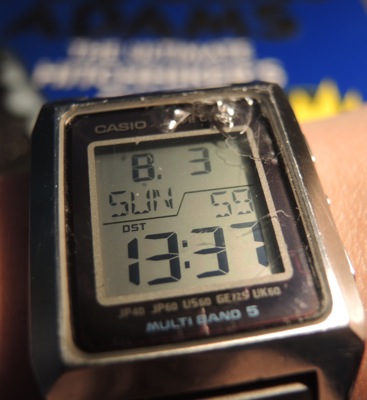 A few digital watches and a grudge against fragile watch straps and lost pins later, I moved to Switzerland, and when my watch strap broke or fell off I felt obliged to check out some of the famous Swiss watches. I was baffled by the evidence that not only did humans still think digital watches were a pretty neat idea, they also still thought analogue ones were. The only Swiss digital watches with good straps I could find had skeuomorphic round faces, or lacked such basic features as seconds, dates, or a light. I get it: the Swiss are proud of how precise they can be with tiny gears. But it’s the third millennium; get with the timepieces!
As Swiss innovations go, I prefer milk chocolate and Velcro. I found a Casio dealer and bought a solar-powered, waterproof, digital watch that synchronises daily with an atomic clock using radio waves and has a well-attached metal strap. It will stay on my wrist and display precisely the right time in plain digits, indefinitely with no intervention whatsoever, for less than the price of a piece of Swiss jewellery that doesn’t even have numbers on it. A fall onto concrete gave it some sparkly cracks in one corner, but it is still waterproof and functional many years and no battery changes or time adjustments later.
Unhappy with the hypothesis that most of the human race was more concerned with adding respectability to their diamond bracelets than with locating themselves in spacetime, I had to eventually accept that there was something people liked about analogue watches. Just as there must be something great about shoelaces that keeps Earthbound people using them even after the invention of Velcro, and even though Back to the Future fans know that by 2015 we shouldn’t still be tying them.
The thought crept up on me that maybe Douglas Adams didn’t like digital watches at all. Maybe he didn’t think they were ever a pretty neat idea. I thought about this for a few years, gradually becoming less and less sure that my initial interpretation was the correct one. Eventually, I looked it up:
So there you have it. Douglas Adams liked pie charts. I like pie charts too, but after the first glance I will look for the labels with exact percentages, and be frustrated if they aren’t there. For me, a word can be worth a thousand pictures, and a number can be worth a poorly-defined number of words.
As he says, digital watches have improved since then. I don’t need to put down my suitcase to press a button on my watch, unless it’s either dark and I need to turn the watch light on, or it’s recently been dark and the watch turned off its display to save power. In fact, my suitcase has four wheels (wheels! Now, aren’t they a neat idea?) so I never have to pick it up to begin with; I just give it a push occasionally while I stroll along, reading the time like a frood.
Reader participation alert:
Did you interpret the statement about digital watches the same way I did? If not, how did you interpret it, and how did it mesh with your own opinion on digital watches?
[⁉︎] If you think you’ve grown out of such primitive excitement, try watching the hour change on this clock made of planks of wood and rearranged manually by construction workers. The website only delivers one image at a time, now, so you’d have to refresh a lot to get a video effect there, but they sell an iOS app which will show you video, the Lite version of which has the transition from 9:59 to 10:00.
∎

This work is licensed under a Creative Commons Attribution-Noncommercial-Share Alike 3.0 Unported License.
Please tell me if you do something cool with it.

 Creative Output