Posts Tagged haiku
Unintentional Haiku from New Scientist, on Consciousness, Life, and Time
Posted by Angela Brett in Haiku Detector, NaPoWriMo on April 11, 2014
I’m going out tonight and won’t have time to finish writing a poem for NaPoWriMo, so here are the haiku that Haiku Detector detected in the next three topics of New Scientist’s special issue with the ‘big questions’. I posted the unintentional haiku on reality, existence, and God last week. This seemed like a good place to find interesting unintentional haiku, so I ran Haiku Detector over the first three sections. Perhaps I’ll do the rest on later Saturdays, to give myself a weekly break during poetry writing month.
There’s only one unintentional haiku on the subject of consciousness, but it’s a good one:
You may think you know
the reasons, but they could be
a work of fiction.
Two about life:
These discoveries are
bringing an old paradox
back into focus.
There is a simple
way to get huge amounts of
energy this way.
One of these days I’ll add in some linguistics-based heuristics or a learning algorithm to rank the haiku; haiku lines ending in prepositions are often not as good, for example, and splitting the adjective from the following noun is a little weird too.
The section on time has the most and best haiku. This pleases me, because the largest text I tested Haiku Detector on when I first wrote it was the forum thread about the xkcd Time comic. There were a lot of haiku in there, and pointing them out encouraged people to write more.
So clocks tell us that
time is inextricably
linked somehow to change.
Now, more than ever,
we have to face up to our
ignorance of time.
If time’s arrow is
not in the laws of physics,
where does it come from?
Why do human brains
only remember the past
and not the future?
WE ALL, regardless
of our cultural background,
experience time.
Traditionally they
have lived by small-scale farming,
hunting and fishing.
Nonetheless, we could
do some interesting things with
our own time machine.
On the subject of time, I’d better hurry up and go out. Tune in next week for New Scientist’s unintentional haiku on the self, sleep, and death.
Unintentional Haiku from New Scientist, on Reality, Existence, and God
Posted by Angela Brett in Haiku Detector, NaPoWriMo on April 6, 2014
I’m not only behind on poems, I’m also behind on reading New Scientist magazine, so I’m just starting on a special issue with the ‘big questions’ with articles about reality, existence, God, consciousness, life, time, self, sleep, and death. This seemed like a good place to find interesting unintentional haiku, so I ran Haiku Detector over the first three sections. Perhaps I’ll do the rest on later Saturdays, to give myself a weekly break during poetry writing month.
There’s only one unintentional haiku on the subject of reality:
Afterwards, we map
the locations of all the
thousands of flashes.
These three are about existence:
“Small simulations
should be far more numerous
than large ones,” he says.
Sadly that means you
will never be able to
meet your other you.
A few researchers
even think it could happen
in the next decade.
That last one works for many great scientific quests, at any time. Here are some about God… or… Santa?
More interesting still
was a second version of
the experiment.
Santa knows if you’ve
been bad or good but does he
know all that you do?
Because of this, they
are highly susceptible
to false positives.
I wonder what the second version of God’s experiment would be like.
Unintentional Haiku… of Mars
Posted by Angela Brett in Haiku Detector on June 30, 2013
Kurukkan suggested using Haiku Detector to find the unintentional haiku in Edgar Rice Burroughs’ ‘A Princess of Mars’. This it seemed like a fine idea to me. I haven’t read it yet, but I’ve heard of it, and there was even another movie based on it (‘John Carter’) released recently. There are quite a few haiku which have a nice twist in the last line; one even has a rhyme. I’ve trimmed out some that really don’t work, but since they’re not much effort to read anyway, I’ve left in some that still sound picturesque even if they don’t break nicely into the lines. If you’re not into Mars fiction, there are some haiku about a real Mars mission, and an opportunity for you to send your own haiku to Mars, at the end.
On regaining the
plaza I had my third glimpse
of the captive girl.“Some day you shall know,
John Carter, if we live; but
I may not tell you.And now the signal
has been given to resume
the march, you must go.”“I am glad you came,”
she said; “Dejah Thoris sleeps
and I am lonely.I have twice wronged you
in my thoughts and again I
ask your forgiveness.Sola and I walked,
making Dejah Thoris ride,
much against her will.I have escaped from
worse plights than this,” and I tried
to smile as I lied. Read the rest of this entry »
Unintentional Haiku in the works of Lewis Carroll
Posted by Angela Brett in Haiku Detector on May 28, 2013
The other day I decided to run Haiku Detector over the works of Lewis Carroll, as found on Project Gutenberg. This is what I found. It’s a bit of a mixed bag in terms of how well they work as haiku, to the extent that I can still measure that after reading so many (I will have to try out linguistic tagging and work out some heuristic based on parts of speech beginning and ending lines), but simply as bite-sized samples they give a nice sense of the work. I can’t tell whether they’re made more or less whimsical by being stripped of their context.
From Alice’s Adventures in Wonderland:
‘But it’s no use now,’
thought poor Alice, ‘to pretend
to be two people!But if I’m not the
same, the next question is, Who
in the world am I?They all sat down at
once, in a large ring, with the
Mouse in the middle.But I’d better take
him his fan and gloves—that is,
if I can find them.’‘I haven’t the least
idea what you’re talking
about,’ said Alice.
Unintentional Haiku in the Princeton Companion to Mathematics
Posted by Angela Brett in Haiku Detector on May 18, 2013
I’ve had a copy of the Princeton Companion to Mathematics for a while, and intended to start a series called ‘forms and formulae’, where I’d write about some of the articles using poetic forms from the Princeton Encyclopaedia of Poetry and Poetics (addendum: I have since started a series called Forms and Formulae doing just that.) However, both books are huge and difficult to read on the bus, and the articles are long, so so far all I’ve managed to do in that vein is write a poem about platonic solids in a duel, and procrastinate my way out of writing about the entries whose names were alphabetically closest to Emmental. So I was excited to discover this morning that there is a pdf of the Princeton Companion to Mathematics available for free, apparently legally. Finally I can carry it around with me on my iPad and write poems about it whereever I want. But I don’t even need to do that, now; thanks to Haiku Detector, I can easily find the poems that are already in it. And boy are there some nice ones. Some were missed because Haiku Detector doesn’t know how to pronounce Greek letters and a lot of other mathematical notation, and the book sometimes hyphenates at the ends of lines so it looks like they’re good places for line breaks when they’re not. But these are the best ones I found. First off, some which don’t even sound like they’re about mathematics:
Watch your hand as it
reaches out gracefully to
pick up an object.The difference between
the two definitions of
a secret is huge.These ideas will
occupy us for the rest
of the article.This opens you up
to new influences and
opportunities.In our case, there are
two natural properties
that one should ask for.Suppose that households
are able to observe one
another’s outputs.Everything is now
a martingale and there can
be no arbitrage.The magician can
at once identify which
digit has been changed.This definition
has the advantage of great
flexibility.Let us briefly sketch
the argument, since it is
an instructive one.Moreover, it was
a thought that took many years
to be clarified.The blocks are the sets
of seed varieties used
on the seven farms.
If you didn’t know where it came from, this could be about anything, but it also sums up the appeal of mathematics:
But then again, who
can deny the power of
a glimpse at the truth?
And a more transparent statement about the nature of mathematics:
“All roads lead to Rome,”
and the mathematical
world is “connected.”
But I really love it when you can’t tell it’s about mathematics until the last line:
The answer turns out
to be that we should weaken
our hypotheses.It is important
to have a broad awareness
of mathematics.We will focus on
the most important special
case: vector bundles.Sometimes relations
are defined with reference to
two sets A and B.This remains as an
outstanding open problem
of mathematics.Church’s thesis is
therefore often known as the
Church–Turing thesis.How, though, can we be
sure that this process really
does converge to x?It turns out that both
choices are possible: one
automorphismWe shall now describe
the most important of these
extra assumptions.Several themes balance
in Hilbert’s career as a
mathematician.Indeed, the study
of such designs predates their
use in statistics.This turns out to be
a general fact, valid
for all manifolds.However, it is
a well-understood kind of
singularity.In particular,
we can define the notion
of winding numbers.This is exactly
the task undertaken in
proof complexity.
Questions mathematicians ask themselves:
How much better would
you do if you could compound
this interest monthly?Why are spherical
harmonics natural, and
why are they useful?What consequence should
this have for the dimension
of the Cantor set?Can we reduce this
computational problem
to a smaller one?How about checking
small numbers a, in order,
until one is found?For what values of
the edge-probability
p is this likely?Is every even
number greater than 4 the
sum of two odd primes?Can one make sense of
the notion of a random
continuous path?
Perhaps this is the answer:
In mathematical
research now, there’s a very
clear path of that kind.
This one sounds like some kind of ‘how many roads must a man walk down’ question:
How many walks of
length 2n are there that start
and end at 0?
And while this isn’t actually a haiku, I can imagine it being sung in response to that song, with ‘the number of such walks’ to the tune of ‘the answer my friend’:
The number of such
walks is clearly the same as
W (k − 1).
Mathematicians don’t always answer questions in ways that other people find useful:
If instead we were
to ask each person “How big
is your family?”In particular,
the average family size
becomes infiniteIt follows that at
some intermediate r
the answer changes.
Things only a mathematician would feel the need to state explicitly:
This is a sum of
exponentials — hence the phrase
“exponential sums.”What makes them boring
is that they do not surprise
us in any way.
Proof is left as an exercise for the reader; it probably takes several pages, but:
If you do know it,
then the problem becomes a
simple exercise.Once this relative
primality is noticed,
the proof is easy.All we have to do
is use one more term in the
Taylor expansion.Doing things this way
seems ungainly to us, but
it worked very well.It is not hard to
see that the two approaches
are equivalent.(Of course, one needs to
check that those two expressions
really are equal!)But this subtlety
is not too important in
most applications.
Some interesting statements:
For every person
P there exists a drink D
such that P likes D.That is exactly
what a sphere is: two disks (or
cups) glued together!Thus, recursion is
a bit like iteration
but thought of “backwards.”Nevertheless, it
turns out that there are games that
are not determined.(It can be shown that
there is exactly one map
with this property.)The remainders get
smaller each time but cannot
go below zero.There are other ways
to establish that numbers
are transcendental.(The term “Cartesian
plane” for R2 is therefore
anachronistic.)As usual, we
identify R2 with
the complex plane C.Note that a block of
size 1 simply consists of
an eigenvector.The upshot is that
we should always use a prime
number as our base.Among the other
important number fields are
the cyclotomic fields.Thus we obtain a
number that is less than the
quantity we seek.So we might define
the “points” of a ring R to
be its prime ideals.(For both halves, the pinched
equator is playing the
part of the point s.)Thus, we have deduced
that length-minimizing curves
are geodesics.For example, the
geodesics on the sphere
are the great circles.The generators
correspond to loops around each
of the two circles.The image of this
map will be a closed loop C
(which may cross itself).We consider what
happens to C if we add
a small ball to it.It is not hard to
show that the orbits form a
partition of X.There are many ways
of combining groups that I
have not mentioned here.I have thrown classes
of groups at you thick and fast
in this last section.To apply Newton’s
method, one iterates this
rational function.A quick overview
of physics will be useful
for the discussion.can get away with
not understanding quantum
mechanics at all.The quantum version
of Hamilton’s principle
is due to Feynman.These encapsulate
the idea of a proof
by contradiction.(A graph is simple
if it has neither loops nor
multiple edges.)It is really an
algorithm that inputs
n and outputs an.(An involution
is a permutation that
equals its inverse.)If the tree has 2
vertices, then its code is
the empty sequence.But the number of
possible orders of A,
B, and C is 6.Number theory is
one of the oldest branches
of mathematics.The percolation
and Ising models appear
to be quite different.First, Albert shouts out
a large integer n and
an integer u.
This one is interesting if you imagine it’s about lines of poetry:
Another affine
concept is that of two lines
being parallel.
A mathematical protest slogan:
equality if
and only if x and y
are proportional.
A title of the mathematician’s equivalent of a song about unrequited love:
5.1.5
Why Is It so Difficult
to Prove Lower Bounds?
A series of short films:
10 Differences in
Economic Life among
Similar People
And something said in a soothing tone after a litany during a maths/mass:
Now let us return
to polynomials with
n variables.
The probability of finding a good haiku in the end matter is low, but I think this one’s pretty neat, even if it only has the right syllable counts if you say the ‘and’ in 906 but not 753:
law of large numbers,
753,
906
Haiku Detector Update
Posted by Angela Brett in Haiku Detector on April 27, 2013
On Monday I posted a quick-and-dirty Haiku Detector Mac application I’d written which finds haiku (in terms of syllable counts and line breaks, not aesthetics) in any given text. Since then I’ve made it less dirty and maybe more quick. It now shows progress when it’s busy looking for haiku in a long text, and gives you a count of the sentences it looked at and the haiku it found. You can also copy all the haiku (Copy All Haiku in the Edit menu) or save them to a file (Save in the File menu.) Here’s where you can download the new version, which should still work on Mac OS X 10.6 and later. And here are a few more haiku I’ve found with it.
There’s only one (not counting a by-line) in the feature articles of the April 27 edition of New Scientist:
Inside a cosy
new gut the eggs hatch and the
cycle continues.
From Flatland: a romance of many dimensions, by Edwin Abbott Abbott:
On the reply to
this question I am ready
to stake everything.“I come,” said he, “to
proclaim that there is a land
of Three Dimensions.”Man, woman, child, thing—
each as a Point to the eye
of a Linelander.This was the Climax,
the Paradise, of my strange
eventful History.
Here are a few more from Flatland which I’m editing this post to add, since I liked them more on the second reading:
Let us begin by
casting back a glance at the
region whence you came.Therefore, pray have done
with this trifling, and let us
return to business.Even if I were
a baby, I could not be
so absurd as that.
From Last Chance to See, by Douglas Adams and Mark Carwardine, which I somehow ended up with a text file of many years ago and eventually got a book of:
I’ve been here for five
days and I’m still waiting for
something to go right.We each went off to
our respective rooms and sat
in our separate heaps.They’re nocturnal birds
and therefore very hard to
find during the day.It looked like a great
horn-plated tin opener
welded to its face.We keep searching for
more females, but we doubt if
there are any more.The very laws of
physics are telling you how
far you are from home.Foreigners are not
allowed to drive in China,
and you can see why.`Just the one left,’ she
said, putting it down on the
ground in front of her.Yet it was hunted
to extinction in little
more than fifty years.And conservation
is very much in tune with
our own survival.
And here’s my own haiku about a particularly amusing passage in that book:
Here Douglas Adams
trudges through his anagram:
Sago mud salad.
Charles Darwin’s most popular work, The Formation of Vegetable Mould Through the Action of Worms with Observations on their Habits, only contained 12 mostly-lacklustre haiku, but I like to think this one is a metaphor:
Worms do not always
eject their castings on the
surface of the ground.
Something about lack of worm castings being only skin-deep.
But most of these don’t mention nature or seasons, as haiku should. So here are some from Sylva, or A Discourse of Forest Trees:
Dieu, and thence rode to
Blois and on to Tours, where he
stayed till the autumn.How graphic, and how
refreshing, is the pithy
point thus neatly scored—
Meteorology, or Weather Explained, by J.G. M’Pherson contains some very poetic-sounding unintentional haiku:
“It’ll pe aither
ferry wat, or mohr rain”—a
poor consolation!“Beware of rain” when
the sheep are restive, rubbing
themselves on tree stumps.The brilliant flame, as
well as the smoky flame, is
a fog-producer.Till ten o’clock the
sun was not seen, and there was
no blue in the sky.But, strange to say, there
is a healing virtue in
breathing different air.There is much pleasure
in verifying such an
interesting problem.
Unfortunately, there are no haiku in Dijkstra’s ‘Go To Statement Considered Harmful‘.
The app still uses a lot of memory if you process a novel or two, and may have trouble saving files in that case; It looks like it’s a bug in the speech synthesis library (or my use of it) or simply a caching strategy that doesn’t work well when the library is used in this rather unusual and intensive way. Anyway, if you ever try to save a file and the Save dialog doesn’t appear, try copying instead, and relaunch the program.
Next I think I’ll experiment with finding the best haiku based on the parts of speech at the ends of lines. But first, I’d better start working on the thing I’ve plan to do for the six of hearts.
If you’ve found any nice unintentional haiku, or if you can’t run Haiku Detector yourself but have ideas for freely-available texts it could be run on, let me know in the comments.
Five of Hearts: Haiku Detector
Posted by Angela Brett in CERN, Haiku Detector, Writing Cards and Letters on April 23, 2013
 A few weeks ago, a friend linked to Times Haiku, a website listing unintentional haiku found in The New York Times, saying ‘I’d actually pay for a script that could check for Haiku in my writings. That would make prose-production a lot more exciting! Who’s up to the script-writing-challenge?’
I knew I could do it, having written syllable-counting code for my robot choir (which I really need to create an explanation page about.) I told her I’d make it that weekend. That was last weekend, when I decided at the last moment to write an article about neutron stars and ISOLTRAP, and then chickened out of that and wrote a poem about it. So I put off the haiku program until yesterday. It was fairly quick to write, so here it is: Haiku Detector. It should work on Mac OS X 10.6 and above. Just paste or type text into the top part of the window, and any detected haiku will appear in the bottom part.
Haiku Detector looks for sentences with seventeen syllables, and then goes through the individual words and checks whether the sentence can be split after the fifth and twelfth syllables without breaking a word in half. Then it double-checks the last line still has five syllables, because sometimes the punctuation between words is pronounced. The Times Haiku-finding program has a database of syllable counts per word, but I didn’t need that since I can use the Mac OS X speech synthesis API to count the syllables. Haiku Detector makes no attempt to check for kigo (season words.)
The first place I looked for haiku was the Wikipedia page for Haiku in English. Due to the punctuation, it didn’t actually find any of the example haiku on the page, but it did find this:
Robert Spiess (Red Moon
Anthology, Red Moon Press,
1996)
How profound. Next, having declared myself contributing troubadour for New Scientist magazine, I fed this week’s feature articles through it, and found:
A pill that lowers
arousal doesn’t teach shy
people what to doMeanwhile, there are signs
that the tide is turning in
favour of shyness.So by 4000
years ago, the stage was set
for the next big step.This heat makes the air
spin faster, so pulling the
storm towards the city.Some will be cooler
and less humid — suitable
for outdoor sports, say.
The last ones seem almost seasonal.
I needed to stress-test the app with a large body of text, so I grabbed the first novel of which I had the full text handy: John Scalzi‘s Old Man’s War, which I had on my iPad on my lap to read while my code was compiling. This book has at least one intentional haiku in it, which Haiku Detector detected. Apart from that, some of my favourites are:
I hate that her last
words were “Where the hell did I
put the vanilla.”As I said, this is
the place where she’s never been
anything but dead.“I barely know him,
but I know enough to know
he’s an idiot.”She’d find me again
and drag me to the altar
like she had before.A gaper was not
long in coming; one swallow
and Susan was in.They were nowhere to
be found, an absence subtle
and yet substantial.And it stares at me
like it knows something truly
strange has just happened.
I haven’t got up to that fifth one in the novel yet, but it mentions a swallow, which I understand is (when accompanied by more swallows) a harbinger of Spring or Summer depending on which language you get your idioms from, so there’s the kigo.
Next I figured I should try some scientific papers — the kinds of things with words that the Times haiku finder would not have in its syllable database. You probably can’t check this unless your workplace also provides access to Physics Letters B, but I can assure you that the full text of the ISOLTRAP paper about neutron stars does not contain any detectable haiku. However, the CMS paper announcing the discovery of the boson consistent with the Higgs does:
In the endcaps, each
muon station consists of
six detection planes.
As is usual for CMS papers, the author and institute lists are about as long as the paper itself, and that’s where most of the haiku were too. Here are a few:
[102]
LHC Higgs Cross Section
Working Group, in: S.University
of California, Davis,
Davis, USA
That’s ‘one hundred and two’ in case anyone who doesn’t say it that way was wondering.
And here are some from my own blog. I used the text from a pdf I made of it before the last JoCo Cruise Crazy, so the last few months aren’t represented:
Beds of ground cover
spread so far in front of him
they made him tired.Apologies to
those who only understand
half of this poem.I don’t remember
what colour he said it was,
but it was not green.His eyes do not see
the gruesome manuscript scrawled
over the white wall.• Lines 1 to 3 have
four syllables each, with stress
on the first and last.
(That’s not how you write a haiku!)
I don’t wear armour
and spikes to threaten you, but
to protect myself.A single female
to perpetuate the genes
of a thousand men.Kerblayvit is a
made-up placeholder name, and
a kerblatent cheat.He wasn’t the first,
but he stepped on the moon soon
after Neil Armstrong.He just imagined
that in front of him there was
a giant dunnock.
(there are plenty more where that one came from, at the bottom of the page)
She was frustrated
just trying to remember
what the thing was called.Please don’t consider
this a failing; it is part
of your programming.
While writing this program, I discovered that that the speech API now has an easier way to count syllables, which wasn’t available when I wrote the robot choir. The methods I used to separate the text into sentences and the view I used to display the haiku are also new. Even packaging the app for distribution was different. I don’t get to write Mac software often enough these days.
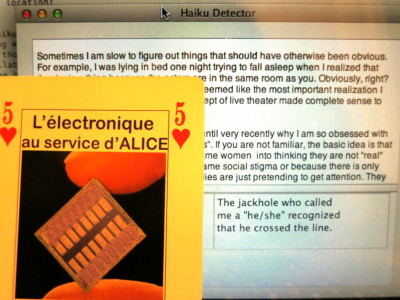
Yet again, I didn’t even bother to deal out the cards because I already had something to inspire me. In my halfhearted attempt to find a matching card, I came across one about electronics in the service of ALICE, so I ran the latest instalment of Probably Never, by Alice, into it, and got this:
Or well, I have to
put up with getting called a
fake girl all the time.The jackhole who called
me a “he/she” recognized
that he crossed the line.
If that sounds interesting, subscribe to Probably Never, and I could probably forward you the rest of that episode if you want.
And finally, two unintentional haiku from this very post:
Haiku Detector
makes no attempt to check for
kigo (season words.)(there are plenty more
where that one came from, at the
bottom of the page)
Wait; make that three!
And finally, two
unintentional haiku
from this very post:
Have fun playing with Haiku Detector, and post any interesting haiku you find in the comments. Also, let me know of any bugs or other foibles it has; I wrote it pretty quickly, so it’s bound to have some.
I know what I’m doing for the six of hearts; I’ve planned it for a long time but still haven’t actually started it. It’s musical, so it will probably be terrible; brace yourselves. By the way, I keep forgetting to mention, but They Might Not Be Giants will be published in Offshoots 12. Yay!
I skipped a week because I was in Sweden eating cake, so here’s a silly meme and a Star Wars haiku
Posted by Angela Brett in Writing Cards and Letters on May 30, 2012
I was supposed to publish something related to a Queen of Spades on Sunday, but I was in Sweden with some friends, and although I did record video for something, I was too busy enjoying myself to edit it. I did manage to get some new packs of cards, though. I promise I will publish an extra fun Queen of Spades this Sunday. It will be a video, and it will involve cake. In the mean time, here is a silly picture based on this meme:

Also, to go with my last ill-informed Star Wars poetry, here’s a haiku I came up with on Twitter a few weeks ago:
Their mass destruction
is energy creation.
Let’s make stars, not wars.
It’s really more about nuclear fusion than Star Wars, but what do you expect from someone who hasn’t seen Star Wars? Incidentally, one of the packs of cards I bought in Sweden shows Star Wars characters, so I might use one as an excuse to record a video of the Star Wars poem, or something.
It’s kind of my birthday, depending on which time zone counts. So I’m retrospectively giving myself permission to have fun in Sweden instead of writing something for my blog or working.
I have not seen Star Wars, so I wrote some poetry about it.
Posted by Angela Brett in Uncategorized on May 5, 2012
I have not seen much of the original Star Wars trilogy, unless I saw it when I was too young to remember anything. I was dragged along to Episode 1: The Phantom Menace in the theatre 13 years ago, forced to watch the trilogy back-to-back starting at 2a.m. in around the same time period (I fell asleep before taking much in, but not before the guy who was forcing me to watch it did) and watched as much as I could stand of the Holiday Special with Rifftrax starting at a similar hour (I gave up before the end, but not before Wil Wheaton did.) I played a fair bit of the Episode 1 Racer game on the Nintendo 64 back in the day. Almost everything else I know about Star Wars, I learnt from songs and internet memes. I know quite a lot of factlets from these sources, but I have no idea how they fit together. This Star Wars Day, I had the option of watching the original Star Wars trilogy in the CERN Council Chamber, but I was hesitant to lose my Star Wars virginity when I was one of so few people my age who still knew what it was like not to know the plot. It seemed like that would be wasted if I just saw it. I asked Twitter what to do, and the majority said to write ill-informed poetry about Star Wars before seeing the movies. One suggested haiku. So here’s a haiku, for starters:
“Come to the dark side.”
“Why? You’re not the boss of me.”
“I am your father.”
The person who suggested writing haiku wanted me to give a title for it, but I can’t decide on one. Maybe something like ‘Star Family Feud’ or ‘Daddy knows best’ or ‘Zo Vader, zo zoon’ (which is Dutch for ‘Like father, like son’.) or ‘Van Vader op Zoon’ (‘From father to son’) Any ideas?
Here is a poem containing most of the things I know about Star Wars that I could think of in the 10 hours or so since I came up with the idea. It amuses me, mainly because it rhymes, but it will probably amuse you more, since you know exactly how wrong it is. I don’t mind if you laugh with me or just at me. I think I’ll just call this one ‘I have not seen Star Wars, so I wrote some poetry about it.’
Long ago, in a galaxy far, far away,
there was light, there was dark, there were no shades of gray.
And a war was beginning, and stars were being made,
though I don’t know their names or the roles that they played.
I know some were ewoks, Storm Troopers and wookiees
And Jedi Knights, padawans, masters and rookies,
Darth Vader, and C3P0, R2D2,
but Einstein couldn’t name them, so don’t expect me to.
There were Chewie, and Yoda (the OSV talker)
Han Solo, and Leia, of course, Luke Skywalker.
There were Pod Racers, Falcons, and starships deluxe
and cruisers, and Land Speeders (that and five bucks
will get you a Death Star; it looks like a moon
but it’s some kind of space station dealing out doom.
You would think it would wipe out the good guys, but nup!
For some reason, this one’s a cinch to blow up.)
I digress. There’s a thing called the Force Luke must use,
for the good side or bad? He’s the one who must choose.
(Side note: midi-chlorians, what the Force goes on
are Force mitochondria, some kind of boson.)
So may it be with you, it’s stronger in this
one, whose lack of faith hints that there’s something amiss,
but I think Obi-Wan puts him on the right track.
(That’s a guess. I don’t know who he is. Don’t attack!)
I’m a little unclear how the plot goes from there,
but it’s not like I’m bumbling around unaware.
I know what a mind trick or lightsaber’s for
and I know that they’re not the droids I’m looking for.
If they sleep in a tauntaun, then someone won’t freeze
and for Palpatine’s sake, wookiee’s spelt with two ‘e’s.
And it’s Han that shot first, not… uh… Guido? No, Gweebo!
He couldn’t shoot first at a wounded gazebo.
So this guy named Darth Vader, who breathes through a mask,
his wardrobe’s all dark side, you don’t need to ask.
Well he tried to convince the young Luke to turn bad,
and then (spoiler alert!) he said, ‘Hey, I’m your dad!’
And the princess was somehow Luke Skywalker’s sister,
but nobody talked about how he once kissed ‘er.
He vanquished his father, who, looking quite gaunt,
while wheezing could still somehow scream ‘Do not want!’
The End (and I don’t care what anyone thinks;
this poem may suck, but it beats Jar Jar Binks.)
There are a few references to other things in there. OSV refers to Object Subject Verb, the word order Yoda tends to use. Wil Wheaton once traded his Death Star for a Land Speeder and five bucks, which is the only reason I know Land Speeders exist. Gazebos are very hard to wound, but they don’t attack much. And I know Darth Vader screamed ‘Nooooooo!’ rather than ‘do not want‘, but I’m not too sure when or why.
This is not part of the Writing Cards and Letters (have you noticed I’ve been ignoring the letters this time?) project. I’m still planning on publishing a nine of spades by Sunday noon. It will be short and sweet and sour.
May the Fourth be with you, if it still is in your time zone.
Edit: I still haven’t seen Star Wars, and I imperfectly recited this poem at the Open Mic night on JoCo Cruise Crazy 3.

This work is licensed under a Creative Commons Attribution-Noncommercial-Share Alike 3.0 Unported License.
Please tell me if you do something cool with it.

 Creative Output