Posts Tagged physics
Six of Clubs: Hydrogen Gas
Posted by Angela Brett in CERN, Holland, St James's Gate, Wildflowers of Canada, Writing Cards and Letters on October 27, 2008

Just over twelve hours to write something. I should have started sooner. I’ll start by reading the section on short short stories in Susan Tiberghian’s book, because it’s about time I wrote some prose. She says, ‘A story, be it short or book length, creates a dream in the reader’s mind.’ Can I create a universe in your head in twelve hours? How much of the real universe had been created after twelve hours? It didn’t take much more than seventeen minutes for the newly created protons and neutrons to band together into light nuclei.
Things go a little slower now, but perhaps I can do something similar in the time I have. First, I need some protons to start from. That’s easy. Take three random cards from my pile of sixes of clubs. With any luck, they’ll be different enough that merely finding a link between them will give me an entire story, but not so different that I can’t find a link. Three quarks to form a proton or neutron, two the same, one different.
An ordinary six of clubs. Why do the boring cards always come up when I do this? A close-up of a black spotted cow in Holland. Well, cows eat clovers. Spreading phlox in Canada. Sounds like something made up by Dr. Seuss. Too similar. Do the phlox and clovers vie for the cow’s attention? Can I write an interesting story about a perfectly ordinary cow eating clovers? Susan quotes Eunice Scarfe as saying, ‘If we have lived, we each have a story.’ What is the cow’s story? Perhaps the letter of the week can help me. H, from the Semitic letter ח. According to wikipedia, the form of the letter probably stood for a fence or posts. There are none, in the field where this Dutch cow lived.
Green clovers and phlox
I do not like this spreading phlox,
I would not like it with an ox.
I’d rather risk a mad cowpox,
by joining all the other stocks
and munching on a tasty clover,
but alas I can’t get over,
Thank goodness I’ve a bale of stover,
some for me and some left over.
No, this isn’t going anywhere. I quite like the CERN card this week though: formation of nuclei, or nucleosynthesis: Temperature is low enough to allow protons and neutrons to combine to form nuclei (deuterium, helium, lithium) Conditions similar to interior of stars. It could be an analogy for so many things.
Nuclear Bonds
At first, I was friends with everyone. Any kid who would play with me for five minutes was my friend for five minutes, maybe six. Later on, they tired of bouncing between playmates, and formed more lasting friendships. I flew through them alone, at times kicked here and there by their repulsion, at times accepted temporarily into a more neutral group. Finally I collided with another lone spark, and we bonded.
Not bad, I guess. But I don’t know how long I could continue it. What’s the letter of the week again? Ah… H is for hydrogen, which has the lightest nucleus of all, a single proton, which would have existed even before nucleosynthesis started. What can I say about hydrogen? I may not have much of a story, but I have the best title ever.
Big Bang Nucleosynaesthesia
Hydrogen’s green,
Helium too.
I didn’t know how,
but somehow I knew.I used to think hydrogen was green. The letter H was as green as they come, and I didn’t know where else I would have got that association from.
My family had several old cars, often referred to as ‘old bombs’. One was exactly the colour of H, and I was burning to make a joke about it being an H-bomb. I always stopped just short of saying anything, because I couldn’t figure out what made H green. Was hydrogen green? It ought to be. Eventually, the frustration of not being able to tell this joke got to me, and I asked my dad whether hydrogen was green. It wasn’t.
Some time later, I gathered the courage to ask him whether the letter H was green. I don’t remember what colour he said it was, but it was not green. He said that perhaps the colours we associated with numbers and letters came from fridge magnets or alphabet books we had as children. A is for apple, so maybe that’s why it was red. Only, it’s more of a pinkish red.
When I was a teenager, I heard about something called synaesthesia, where people could taste colours, see sounds, and all sorts of other weird and wonderful combinations. How strange it must be to see a red apple and taste
a steak and cheese pie. How amazing it must be to see an entire symphony laid out like an intricately knotted carpet. How enlightening it must be to feel a graph tingling on the back of the neck, and linking intuitively with other information like a massage from a well-trained masseuse.Synaesthetes were real-world superheroes, until I found out I was one. A few years ago I read about something called grapheme-colour synaesthesia, which means that people automatically associate letters and numbers with colours. Like all kinds of synaesthesia, it runs in families. Different people have different colours for each letter and number, although ‘A’ is quite frequently reported to be red. It does not seem to depend on the fridge magnets the synaesthetes were exposed to. Nor does it reveal any deep truths about the universe outside my head. On the other hand, people are talking a lot about hydrogen as a green alternative to fossil fuels these days…
Perhaps this idea would just about cut it. Perhaps not. The H fridge magnet which I’ll have to use to illustrate it is an incongruous red. An H in disguise; it took me a while to find.
Sunset. The faintly fading photons remind me that it’s time to fuse all these proto-ideas into the nucleus of a story. Perhaps if I force myself to write them, a link will reveal itself. But they stubbornly stay separate, isolated and inadequate. Perhaps that’s how it should be. Most of the universe today is made of hydrogen, those lone protons which slipped through the nucleosynthesis stage unaffected. I just need to embellish them with electrons, and send them electronically across the globe.
Nine of Clubs: Grand Unification
Posted by Angela Brett in CERN, Writing Cards and Letters on October 5, 2008
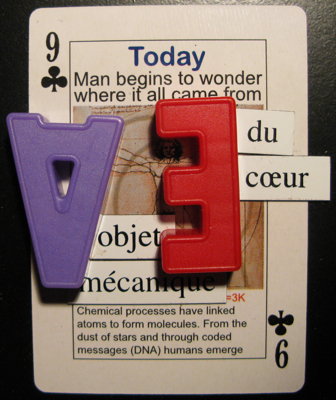 Note: I wrote this with the tune and sentiment of Tom Smith‘s A Boy and his Frog (mp3) in my head. If you know the tune, please imagine that this poem is sung to the same tune as whichever verses it fits.
You might think that we’re just doing science
With a hadron collider so large.
But we’ve built this electric alliance
to give weight to our positive charge.
Take researchers from every nation,
Let the humans within them collide.
We will find the grand unification
when we see we’re all on the same side.
And with ev’ry race, tongue and religion
we’ll find how to give all the world mass.
If we’d all interact just a smidgen
with the openness through which we pass
we’d see life’s ups and downs become charming and strange,
when we face them head on, and what’s more,
seeking beauty and truth we can make a big change
with small change from the purses of war.
Take the light at the end of the tunnel,
and ensure it goes all the way round,
to illuminate more than the sun’ll,
and enlighten with what we have found:
When you’ve unresolved matters, and not enough kin,
and face too many forces to name,
if you cut out the din, and put energy in,
it turns out that we’re all just the same.
Ten of Clubs: Still Point Five
Posted by Angela Brett in CERN, Writing Cards and Letters on September 28, 2008
 This is to be sung to the tune of ‘Still Alive‘ by Jonathan Coulton. I will post a recording, and probably a video, some time in the next few days.
This isn’t TRIUMF
We’re sending a beam through CMS.
Can’t wait to see some novel interactions.
Popular Science
will call up their troubadour(k)y man
To sing in praise of all of us
and he’ll sound better than this.
But there’s no sense cheering over every beam
they’ll just keep appearing till you have an umpteen
when the celebration’s done,
do your calibration run.
Tell the crackpots they’re all still alive.
We’re not yet colliding.
But soon we’ll be lighting up the barrel
with 14 TeV of former protons
We’ll smash them to pieces
and slam every piece into a wire
except the LSP because
it will go all the way through.
Now our points of data come from crystals of lead tungstate,
and we’re out of beta we’re releasing a few years late
but the science gets done,
and more funding will come
now you’ve seen that you’re all still alive.
We’ll find the Higgs boson.
We’ll find that the answer’s forty-two.
Maybe we can even find the question.
We’ll blow up the planet.
That was a joke. ha ha, fat chance.
Anyway, this spaceplane’s great,
let’s try to make it collide.
Look at me still talking when there’s science to do
when I look up there I think I see a mu-mu.
But we need to repair
see you in the new year,
In the meantime the DAQ’s still online.
And believe me we are still online.
We’re taking cosmics and we’re still online
And when there’s beam we will be still online
And ISOLDE will be still online
Because those show-offs had beam all the time.
All the time
still online
Queen of Clubs: A History of the Large Hadron Collider, part I: Conception
Posted by Angela Brett in CERN, Writing Cards and Letters on September 15, 2008
 Between March 21 and 27, 1984, theorists, experimentalists, accelerator physicists, and experts in superconducting magnets gathered for a workshop in Lausanne and Geneva. They were not there to discuss the Large Electron Positron collider, for which excavation of a 27km near-circular tunnel would soon begin at CERN, the European Organization for Nuclear Research. They had come to discuss a possible playmate for the LEP, a collider of protons and perhaps antiprotons to be installed alongside the LEP in the same tunnel. Some nicknamed it the Juratron, after the Jura mountains under which part of it would pass. Officially, it was known as the Large Hadron Collider, or LHC.
The LHC would accelerate protons to an energy of up to 9 TeV, more than nine million times the energy of a proton at rest. To keep such high energy particles on course in a ring as small as the LEP, the LHC would need superconducting magnets with a magnetic field of 10 Tesla, about 2000 times the strength of a refrigerator magnet (pictured.) The superconductor technology available at the time could theoretically be extended to create magnetic fields of up to 6 or 7 Tesla, but substantial new developments would be necessary to reach the required 10 Tesla.
Carlo Rubbia concluded the workshop with the statement, “Perhaps the time has come for us to pause, at least until the magnet, accelerator, and detector issues have made some significant progress.” There would be no playmate for LEP just yet, but it would come.
The LEP tunnel was made big enough to fit two accelerators. By the end of 1986, only half a kilometre of it remained to be dug. A preliminary technical study on the possibility of building the LHC on top of the LEP was carried out, and it seemed like a better deal than the alternative proposition of a 1 TeV linear electron-positron collider. With the LHC and LEP together, electron-positron collisions, electron-proton and proton-proton collisions would all be possible, with protons injected by CERN’s existing proton accelerators. Nobody had managed to make strong enough superconducting magnets yet, but there was optimism that it was possible.
In 1987, the first LEP magnet was installed in the newly-completed tunnel, and the first model of an LHC dipole magnet was made. To save space and money, the two opposing proton beams would pass through separate channels within the same magnet. Studies were underway of the possibilty of using either niobium-titanium or niobium-tin for the magnets, or perhaps the recently developed ‘high temperature’ superconductors. The next year, a niobium-titanium superconducting magnet was made which could provide a magnetic field of more than 9 Tesla. It was hoped that the LHC would be able to reach an energy comparable to the 20 TeV of the Superconducting Super Collider being built in Texas.
In the early afternoon of Bastille day 1989, physicists were jublilant to see the evidence of the first beam of positrons sent around the LEP: an unassuming white oval on a blue screen. But for all the eyes fixed on the LEP, more than ever were looking forward to its companion, the LHC.
Many studies were carried out on the feasibility of the superconducting magnets, cryogenics, and civil engineering that would be required. All confirmed that such a machine could indeed be constructed. Two models of LHC dipole magnets in niobium titanium, and one in niobium-tin, both produced fields of around 9.4 Tesla. A cost estimation and construction schedule for the LHC were established: it could be put into service by 1998, while only slightly disturbing the functioning of the LEP.
In 1990, more detailed plans of the LHC were prepared, and delegates from CERN member states proposed the idea to their respective states, expecting a decision by 1992. A timely decision would mean that the LHC could start operations in 1998, as predicted, for a cost comparable to that of the LEP. With 9 metre magnets creating a field of 10 Tesla, it would collide two beams of protons with an energy of up to 7.7 TeV each. Four prototype 1 metre long 10 Tesla dipole magnets were ordered from four different companies. A life-sized prototype was constructed, with a field strength of 7.5 Tesla.
On 20 December, 1991, the CERN council unanimously approved the LHC project. By that time, thousands of hours of on supercomputers had been spent simulating the interactions that would occur in the LHC. The council asked that all technical and financial details be worked out by 1993.
Preparations picked up momentum in 1992. A conference in March on the LHC attracted 600 scientists. In October, the LHC Experiments Committee received letters of intent for three possible LHC experiments: ATLAS (A Toroidal LHC Apparatus), CMS (Compact Muon Solenoid) and L3P (Lepton and Photon Precision Physics.)
Although the required 10 Tesla field had already been achieved, it was considered too difficult to maintain. Therefore the decision was taken to elongate the dipole magnets to 13.5 metres by deplacing other elements. This would increase the time that the protons were exposed to the field, lowering the necessary field strength to 9.5 Tesla.
In 1993, two of the proposed experiments, CMS and ATLAS were approved, along with a new proposition, ALICE (A Large Ion Collider Experiment.) In December 1993, exactly two years after the council’s approval of the LHC, the requested information was presented. Construction could soon begin.
Four of Hearts: Alice and Bob
Posted by Angela Brett in CERN, Writing Cards and Letters on June 29, 2008
 I gave a note to Isaac meant for you,
but Marvin changed my message to a curse,
and though the barb that reached you wasn’t true,
you shivered at the harshness of my verse.
The next time I made sure to use a code,
So such a change would never fit the rhythm.
But Eve was smart, and understood my ode,
Her friends took part, and took our secret with ’em.
Embarrassed by such semaphore of hearts,
I used entangled light to write my note on.
But Eve still looked, and such a look imparts
an altered quantum state upon the photon.
To heχ with fears of stickybeaks or malice
Dear Bob, I’ll shout, I love you, signed, your Alice.
Three of Hearts: Chpamnorbosg Eiurnyngillyng
Posted by Angela Brett in CERN, Writing Cards and Letters on June 22, 2008
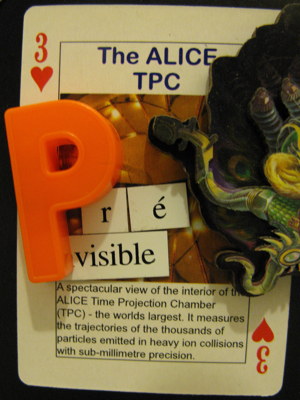 A lad at a fair who was lacking directions,
found a booth which was offering temp’ral projections.
“We’ll show you the future, we’ll show you the past,
you’ll gape at the first and you’ll gasp at the last.”
Being fond of projections, and not short of time,
he sat in the chamber and paid in the dime.
There were buttons for films of both pre- and post-diction
in all sorts of genres; he chose science fiction.
Way out behind the shroud of night,
beyond the Milky Way
the sothnax live in perfect time,
not slaves of night or day.They see the world through two stalked eyes
one each of time and space.
What humans see as future time
is just a further place.In such a world it’s rather hard
to pull off any capers,
a fresh-made scheme is by that time
already in the papers.But one mad sothnax killed and fled
without the slightest plan
without the slightest thought that time
flew faster than he ran.For since a lengthy moment he
was blinded in one eye,
the police approached, and just in time,
the killer found out why.For all the speed a photon has,
it’s far outpaced by souls.
For all their pow’rs to see through time,
they can’t see through black holes.And so the killer’s soul escaped
and made its way toward Earth,
to steal a dying egg in time
to steer it back toward birth.Their unforeseen collision forced
the dying human soul
to think it was not yet its time.
They fused to make a whole.
But enough with this fiction of tempo-transmography,
Our fact-hungry viewer went next to biography.
Chpamnorbosg Eiurnyngillyng
Lived a life of greed and killing
then he got in a mother
and started another.
And with that our young lad was left thirsting for more
so he pressed on the button that said ‘film d’amour’.
roses are red,
sothnax xanthose.
One soul mates a sothnax,
two soulmates arose.
Such soulful emotion was too strong a homily,
So to lighten things up he selected a comedy
An alien thought he was winning
till he got into trouble for sinning
So he came down to Earth
underwent a new birth
and completely forgot his beginning.
Just for fun our lad moved to the edge of his chair
then selected a horror and braced for a scare.
She screamed bloody murder
as the monster interred her
and without an escape route
she was juiced like a grapefruit
but the killer’s black soul
sped to make a black hole
to escape being observed
an escape undeserved.And he grew as a boy
with no thoughts of the ploy
till the day he was found
by a bloodless bloodhound
And our hero could see that in fact it was he,
and they came in the stall
and forced his downfall
he screamed a waul
lost the brawl
lost all
gall
King of Spades: My Favourite Strings
Posted by Angela Brett in CERN, Writing Cards and Letters on June 1, 2008
 The following is to be sung to the tune of ‘My Favourite Things’ from The Sound of Music. For those of you who either don’t know the tune, or prefer to listen to something being sung badly than to imagine it being sung well, here is a hastily recorded demo.
Leptons and sleptons and quarks and gluinos,
positrons, Higgs bosons, muon neutrinos.
Some folks will tell you that all of these things
are just vibrations in closed loops of string.
D-branes and p-branes and strings heterotic,
worldsheets and nerd feats and mesons exotic,
Scores of false vacuums and questions they bring,
many more concepts that I can not sing
All existence
from Planck distance
strings can well explain,
and if you don’t think that 1D is enough,
then gen’ralise to membrane.
Don’t tie your strings into everyday chatter.
Don’t tell the truth when they ask what’s the matter.
Ordin’ry people just ask on which fing-
er they should put your new synchrotron ring.
Start off by getting all Klein-and-Kaluzy.
Add more dimensions and then you’ve got SUSY.
Have fun with spinors and Lie groups and rings,
call it a theory of everything.
When they mention
your dimension
doesn’t seem to show,
you simply remind them they’re all curled up small,
and that we will never know.
Nine of Spades: 0.5|1〉+0.5|0〉+8i Lives
Posted by Angela Brett in Flowers and Animals, Writing Cards and Letters on May 4, 2008
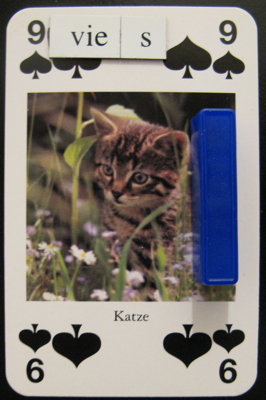 The first, I landed right-side up,
The next, I saved my skin.
The third, I won at cat and mouse,
The fourth, I dragged me in.
The fifth, I wasn’t curious.
The sixth, I wasn’t swung.
The seventh, I escaped the bag.
The eighth, I got your tongue.
So of my deaths, I’ve sidestepped eight
with guile and movements deft.
And while I’m in a quantum state,
I’ve still a half-life left.
Six of Spades: Three perspectives on CERN Open Days
Posted by Angela Brett in CERN, Writing Cards and Letters on April 13, 2008
 Strong: Did you miss the CERN Open Day? I did, in 2004. It wasn’t my last chance.
I planned my visit to CERN far in advance, and found out on my arrival that an open day was planned for a few weeks after my departure.
Thanks to an Englishman arranging a lift, I did manage to get to CERN’s 50th birthday party in Crozet. The speeches were enlightening… I had never realised that humans could make such bizarre sounds. What they were saying in French, I could only guess. My English companion had learnt enough French at school to understand some of it. From him I learnt one of my first words of French: Cernois, a person who works at CERN.
I wrote in my travel log:
After I’d looked at everything, I bought too much stuff at the souvenir shop, just like I did at the Apple Campus. The reason is the same — ‘when am I ever going to be here again?’ and so is the answer to that rhetorical question… when I work there.
A month before writing that, I had found out that my application for a CERN junior fellowship had been rejected. While still in Geneva, I found out that I had not been accepted into CERN’s Marie Curie fellowship programme either. So when I got home, I applied again.
My Marie Curie fellowship began in April 2005 and ended two years later. Before the end of the fellowship, I had been offered a position at ETH Zurich, based at CERN, so I continued going to work as usual, inasmuch as working at the world’s largest scientific facility can be considered usual.
That September, I got wind that CERN would be having open days the following April. I sent the news to everybody I knew, hoping that with enough notice, nobody with the slightest chance of making it to Geneva would miss out as narrowly as I had. I realised that as a Cernoise, I had the once-in-a-lifetime chance of not only going to a CERN open day, but being part of it. So I signed up as a volunteer for the Cernois-only open day on the Saturday.
Weak: I arrived at CERN at 8a.m, and was given a lift to the CMS pit in Cessy by a colleague and fellow volunteer. We all had our official T-shirts, windbreakers, and polar fleeces, several sizes too large. Guides had their hard hats, the people at the info point had their souvenirs to sell, physicists had brains brimming with answers, and I… I had tables, paper, coloured pencils, and pictures of CMS for colouring in. Kids’ corner.
After lunch I found myself alone at the art table, with two children approaching. Their mother asked in French if this was where they would be minded while she went underground, and would I like to take down her phone number? Would I? I had no idea. I looked around, only to have some guides confirm that it was indeed me in charge of the kids’ corner.
I mutely took the number, and finally the mother asked me in English whether I spoke French. Oui, oui, bien sûr… I like to pretend that I do. She explained to her kids that I didn’t. By this time the kids had the idea that I was a little odd, and sat there glumly staring. I asked in French if they wanted to draw something. They didn’t. The older one started halfheartedly colouring in. I tried to bribe them with promises of prizes for good drawing. They did not respond. Not sure of what else to do, I sat and dutifully watched them, feeling like some kind of psychopath. I started drawing, in an attempt to look less like one. Anyone who had seen my drawings would not have been convinced.
To my relief, a friend appeared with his young nephews, and I talked to him for a while, occasionally checking that my charges hadn’t exploded.
When the mother finally came to rescue her children from their ill-adapted babysitter, the younger one, who had barely touched his pencils, didn’t want to go. Perhaps, in the end, I am quite interesting to glumly stare at. I probably would have held the Cernois in awe too, if I’d been a member of the public at the 2004 open day.
Electric: Sunday was the open day for the general public, and the day when I, too, would be in the general public rather than a volunteer.
The bus to CERN was almost full at its first stop. It was great to see that I wasn’t the only one excited about the open day. At CERN, there were already crowds surrounding the Globe of Science and Innovation, near the entry to visit the ATLAS experiment. I’d already seen ATLAS, thanks to a friend who was trained as an ATLAS guide, so I headed into the rest of the site to see what else there was to see.
The whole place was eerily quiet. I saw a few signs, but no crowds to show me what might be interesting. I went to the café in bulding 40, knowing that there should be some events there, or at least some coffee. There were more volunteers than visitors, and no food yet. Still five minutes until the official start of the open day.
The restaurant was not crowded. I bumped into the friend from the day before, with his nephews and the rest of the family. Was it another day for the Cernois, after all? I checked the volunteers’ interface on the web. There was a few hours wait to visit ATLAS. The amateur radio club was still waiting for visitors. Shuttles supposed to take people from the Meyrin site to visit the ALICE experiment had still not arrived. At 9:30, I heard that some friends of mine who had come from Lausanne early that morning had already been underground to see CMS. What was going on?
What was going on was that 20 000 people were going underground to see the LHC and the detectors. 20 000 out of a previously stated maximum limit of 15 000.
The first visitors arrived at CMS at 7a.m. With queues filling the detector assembly hall and stretching hundreds of metres down the street, there was little choice but to start the underground visits half an hour early, at 8:30. The elevators ran at full capacity and full speed. At LHCb, tour sizes were kept smaller in order to allow more foreign language tours, but they still had a huge number of visitors. By 11a.m. the waiting time to see ATLAS was close to four hours.
Meanwhile, the rest of the 53 000 visitors were dispersed around the various sites, watching machines making machines, Nobel prizewinners making revelations, superconducting magnets making people and things fly, superfluids making their way up the walls of their containers, and actors making out they’d lost some protons.
By the end of the day, the forecast cold and rain had finally arrived. My friends drove me the short distance to the bus stop, where a busload of people were already waiting. One had come from London. One from Paris. One was an art student from Lausanne, who was more interested in the logo and other designs used for the event. One was a guide for CMS, who had volunteered to guide people in English and Portuguese, but ended up speaking French all day and getting a sore throat from it. When the bus arrived, the crowd surrounded it like a plague of zombies… but so much more alive.
Five of Spades: Calorimeter for Atlas (in the key of E)
Posted by Angela Brett in CERN, Writing Cards and Letters on April 6, 2008
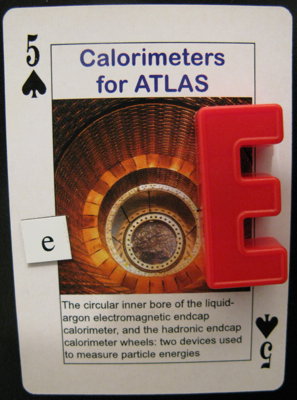 When Titans weren’t successful in a coup,
‘Twas Atlas who was made to hold up Heaven.
Now let’s assume the heavens weighed a tonne,
How much did Atlas burn to hold that weight?
Let’s say he lifts a metre, on genu,
For this way it’s a cinch to calculate.
Now, force times distance travelled’s called work done.
The pull of Gaia’s roughly nine point eight.
One metre times one thousand times her glue,
Is nine eight zero zero, at which rate?
That energy’s to lift it off the floor,
the trick from there on in’s to stay alive,
for if he doesn’t wobble the Divine,
then force times distance is exactly zero.
That’s not quite true, he still must sweat some more,
Beneath his skin he’s into overdrive.
We must consider muscle tension too,
to figure out the total energy.
But this, my simple physics can’t derive.
It’s something we must find empirically
by burning the Titanic sugar fix,
that’s eaten every second by our hero.

This work is licensed under a Creative Commons Attribution-Noncommercial-Share Alike 3.0 Unported License.
Please tell me if you do something cool with it.

 Creative Output