Posts Tagged poetry
A Guide to Understanding the Redefinition of the Sonnet
Posted by Angela Brett in NaPoWriMo on April 1, 2014
The sonnet is a noble little song,
that rambles with loquaciousness of yore.
In times of Twitter, quatrains are hardcore;
an octave and a sestet’s just so long!
And so decree the OED: So long!
The fourteen lines expected heretofore
will henceforth shrink by one per year or more.
TL;DR: yo, Shakes, ur doin’ it wrong!
Like tweets, the turn seems rash and vain and fast,
but nobody would dare to redefine
if all existing verse would break the rule.
So here’s the sanctioned way to fix the past:
just never read beyond the thirteenth line.
(Unless, of course, you’re not an April Fool.)
Ten Minutes A Day (Live on JoCo Cruise Crazy)
Posted by Angela Brett in Holiday Highlights on March 29, 2014
I recited a revised version of Ten Minutes a Day at the JoCo Cruise Crazy 4 open mic, because it’s about how to start doing the things you’re passionate about when you’re not in a position to literally quit your job like all these JoCo cruisers did. I introduced it with some quotes from John Hodgman from this video, which can be seen with more context in the JoCo Cruise Crazy 2 Q&A.
Here are the words I intended to say:
Ten minutes a day:
that’s all you need
to realise your dreams —
not as hard as it seems!
Ten minutes can always be freed.
Ten minutes a day,
a sixth of a clock,
to keep up your writing,
the forced march providing
the force to march through writers’ block.
Ten minutes a day
can’t be denied,
to read through your bookshelf
and castle your rook self,
with culture of kings by your side.
Ten minutes a day,
one day at a time.
To inch past the worst of it,
combat inertia that
nothing excuses, must try if it uses just
ten minutes a day.
Don’t you forget
to learn a new language:
word spread, grammar sandwich.
Ten minutes to keep your tongue wet.
Ten minutes a day,
not big amounts,
to work on your fitness;
don’t tire yourself witless,
but even a small workout counts.
Ten minutes a day,
on or offline
to maintain your friendships;
accept rain, and send drips,
as long as it’s something, it’s fine.
Ten minutes a day —
find it somehow!
Deny social network fun;
finally get work done.
You’ve got all these things to make, it’s really not hard to take
ten minutes a day.
That’s all you do.
To try meditation —
it’s self-re-creation!
You have to take some time for you!
Ten minutes a day;
it doesn’t take long
to tidy a tight space,
put junk in the right place,
and live with things where they belong.
Ten minutes a day;
put down those chores
to teach well your baby;
remember that maybe
its life will be bigger than yours.
Ten minutes a day?
I can do that!
Grab life while I’m alive!
Did all the things, and I’ve
got what I’m leaping for now,
and I’m sleeping for
ten minutes a day.
That’s all I need. [yawn]
Night dreams are boring,
my real dreams are [sound of snoring]
The main change since the last version of this poem is that I replaced ‘if you’ve spread spores’ with ‘put down those chores’ and moved that stanza nearer the conflicting advice to tidy up, because in the end it’s all about conflicting advice. The ‘spores’ line always seemed like grhyme scraped off the bottom of a barrel anyway. Also, people might take offense at my likening parents to fungi (not that there’s anything wrong with fungi), and if they’re going to take offense at my views on reproduction, I’d rather they react to The Family Tradition.
I’d recited an earlier version of this at an open mic in Geneva, which went well: my stated goal for that performance was to make the audience yawn, and I succeeded. But I was nervous that people would think it was over when it wasn’t, so I started the last few lines while people were still laughing too loudly about the previous ones to hear me. It’s a good problem to have, I guess. So my goal on the cruise, aside from getting all the words right (I got six words wrong, but they weren’t the most important ones, and I don’t remember whether ‘sleep dreams’ instead of ‘night dreams’ was a mistake or a premeditated improvement) not hesitating or rushing too much, and not dropping entire lines or displaying as much high rising terminal as I did at the last JCCC open mic, was to wait until the laughter died down before continuing with the last few lines. I succeeded! Achievement unlocked: elementary stagecraft.
My dictionary says that ‘stagecraft’ doesn’t mean what I thought it meant, but I’m sticking with it because ‘stagecraft’ is only two letters away from ‘spacecraft’. It’s a pretty cool thing to have. On the subject of spacecraft, I highly recommend seeing Atlantis on display at Kennedy Space Center; the way they show it to you is great. I’ll put up my video of it later.
While practising the poem, I got pretty self-conscious about the corny/overwrought rhymes, and wondered whether it was worth wading through them to get to the laugh line. Oh well: stagecraft! Jack Conte from Pomplamoose was hosting the open mic, and I think he is made of stagecraft. Hank Green was also hosting, but he made it pretty clear that he is made mostly of quarks. Hank Green, we’re not so different, you and I.
A few people who heard this poem at open mic have told me they were inspired by it, and are making progress on various projects because of it, and that’s great. But when I wrote this it was out of frustration with the idea. It always takes more than ten minutes, and there are always other things to do in the day, and if I try to do more than a few of these ‘ten minute’ things there isn’t enough time for sleep. Maybe I need to be stricter about stopping when the time’s up no matter whether I feel like doing more or am still waiting for my nearly-five-year-old Mac Ayu to let me start. I put in the ‘teach well your baby’ stanza almost as a joke, because I’m amazed that people with children have time and energy to do anything else at all, and yet they are told to spend just that wafer-thin amount of extra time doing each of several conflicting things to raise their children better, as well as all the other things. If you really only have ten minutes a day for a child, consider spending them on contraception.
The spontaneous Mr. Creosote reference in the last paragraph made me think of this extra stanza:
Ten minutes a day:
it’s just wafer-thin!
To add to your total,
create, Creosotal!
Conserve it, but don’t hold it in.
Which is kind of gross and kind of negative, but if you have something you want to create, and you just spew out whatever you can in ten minutes, it’s better than forgetting about it or using up mental energy fretting about forgetting it. If time is your nemesis, fight it with emesis.
I’ll leave you with the much prettier words of Jonathan Coulton and Hank Green: There isn’t time and space to do it all, so pick the right addiction.
When the Posters Become the Post-It
Posted by Angela Brett in Adventures in Affluent Homelessness on November 17, 2013
You rent a room by the week.
You want to make it unique.
How do you make it ‘home’ when changes won’t fly?
Non-permanently! Non-permanently! Non-permanent-L-Y.
(to be sung to the tune of ‘L-Y‘ by Tom Lehrer)
In my continuing quest to get to visit and eventually rent an apartment in Wiener-Neustadt without being sufficiently good at speaking German on the telephone, I am currently in a short-term apartment in a building that is under construction. I actually pay by the month rather than by the week, but… well, my poetic license is in storage in Geneva at the moment [as is my heart], but I assure you I have one. Anyway, in my continuing quest to forget that I’m somewhat homeless in a town with terrible public transport, a couple of weeks ago I travelled around Europe visiting friends and going to concerts by Marian Call and Scott Barkan (who have one more show in London today, which still has room for you) and Bettens (whose tour is over for now.) It was most excellent; I saw Marian at house concerts in Amsterdam and Rotterdam, and also at CERN and my favourite venue on land (not counting places such as CERN which derive most of their awesomeness from things other than being music venues) in Trogen.
For the sake of making the temporary home look more like a home and less like temporary, I planned to pick up some posters that I’d got for free from the esa tent at the CERN open days and left with a friend in Geneva. Unfortunately they only made it halfway back before I accidentally left them in a train station. But no matter! The Marian Call tour is part of her postcard tour, so at each of the concerts I picked up a postcard from a stranger at a previous concert, and wrote one to a different stranger. Since I know many of her fans from JoCo Cruise Crazy, at least one of them wasn’t even from a stranger, and I know that one of the postcards I wrote went to someone I know as well. It’s pretty neat receiving postcards from friends when you don’t have a mailing address. I also had some esa postcards (some of which I donated to the postcard tour) which I got from the same place as the posters.
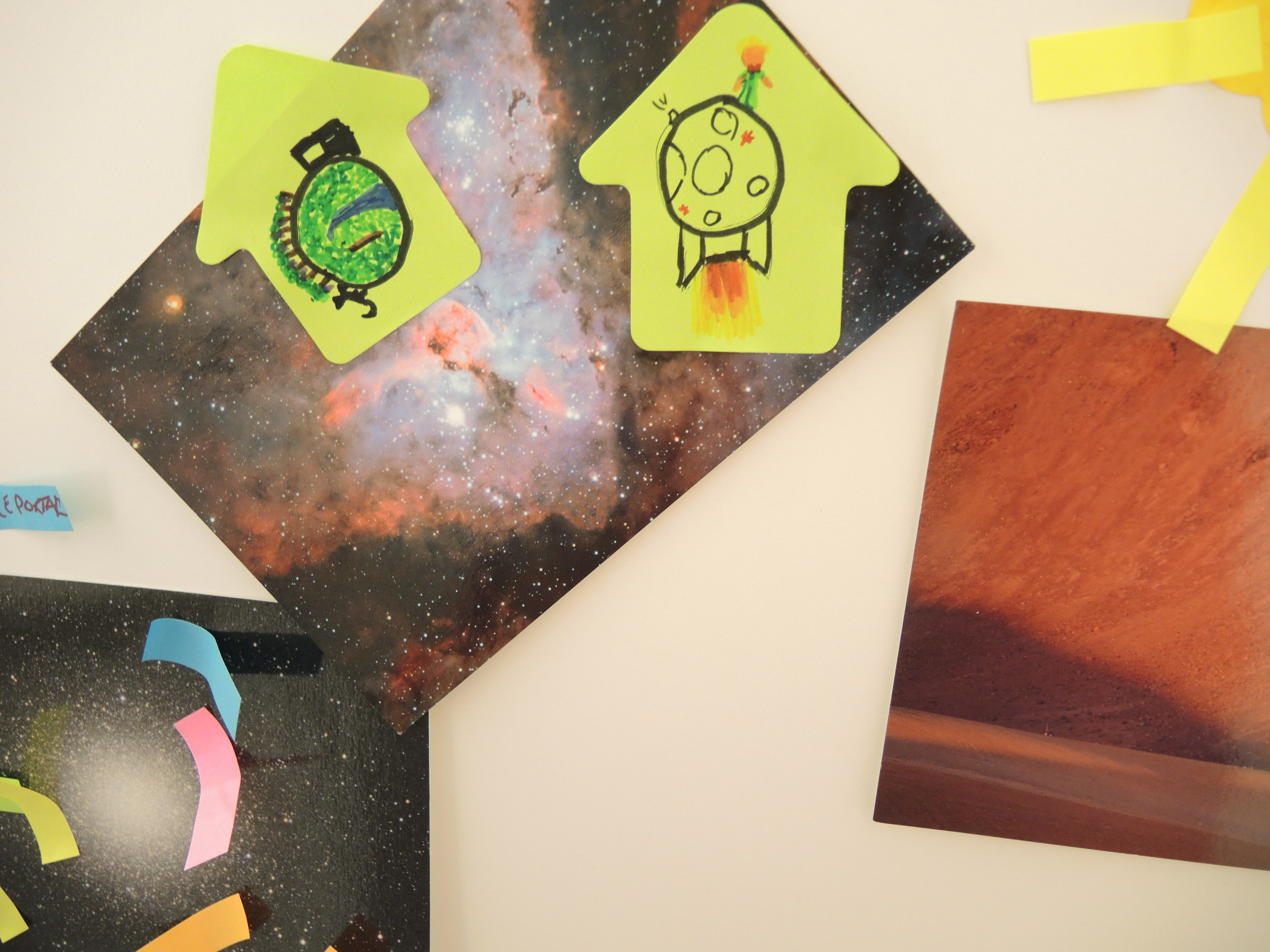
Back in Wiener-Neustadt, I bought some poster strips to stick the postcards on the walls, and, on impulse, some felts and some Post-It notes of various shapes and colours. When I got home-ish I made this poem on the wall next to my pillow, using the words on two of the postcards and the shapes of the Post-Its:

In case you’re not sure which bits to read, or have trouble reading the small text, it goes like this:
Good morning, Moon,
wake up⇧
The clouds will soon
break up⇧
Take heart♥ from
mottled sky⛅
it’s there➮ you’ve
got to fly.
[spaceship drawn in the style of Marian Call]🚀
The next day I got to thinking about how I should do certain things as often as possible, such as attempt to contact someone about an apartment, write something, or look for a job in a city where I could more easily get an apartment. I could show my progress on this with Post-Its too; an arrow for each thing I should do, pointed down if I still need to do it, and up if I’ve done it. When all the arrows were pointing up, I’d add a heart and then turn them back down again. Eventually I’d have a life bar of all the hearts I’d earned, and also probably an apartment and a billion-dollar book deal I could work on from home. Sounds encouraging, right? But then I figured out how to cheat:

So much for that.
Still in the video game spirit, the next night I made this level of some kind of platformer:

with Le Petit Prince on a rocket-powered asteroid as the protagonist:
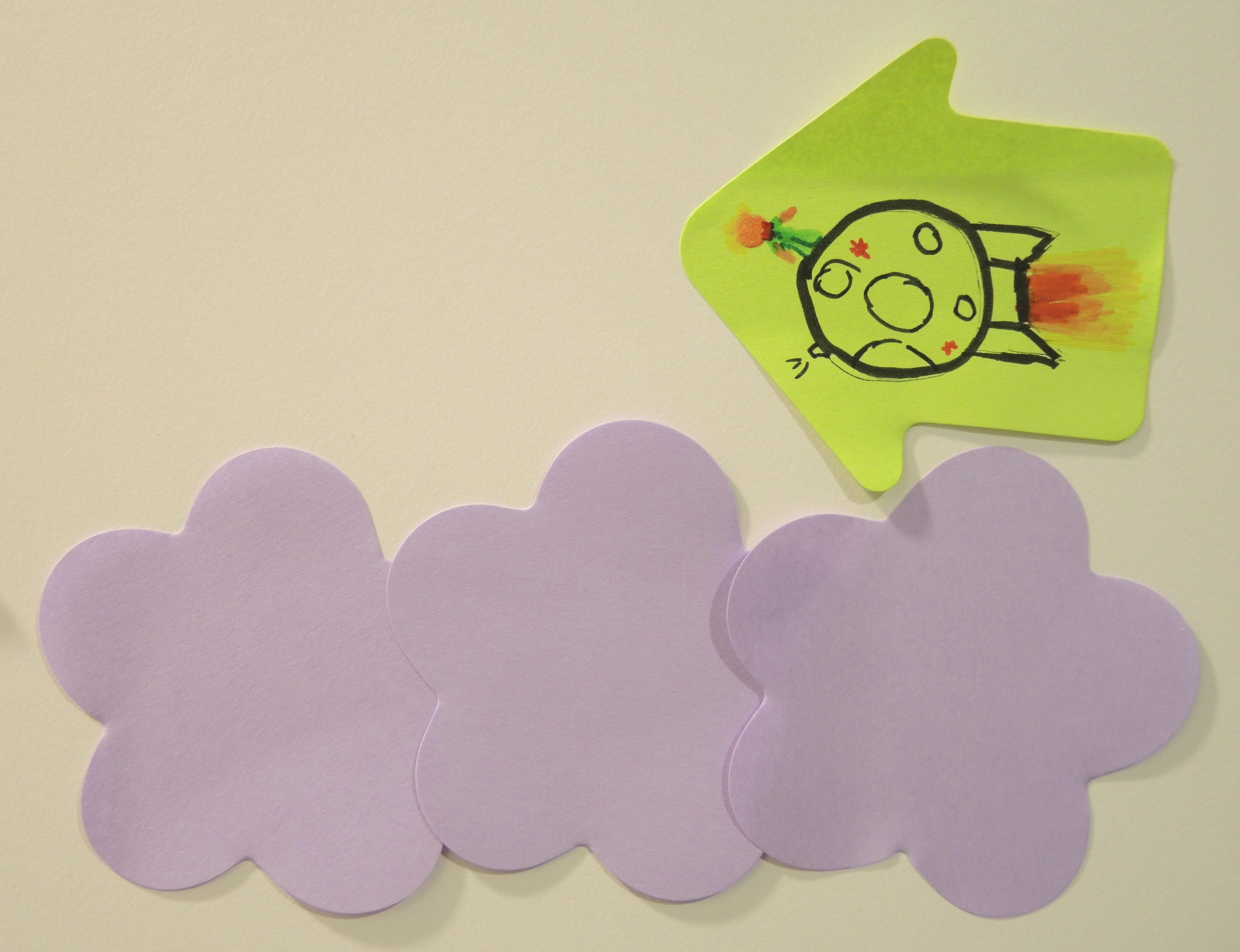
If you’re wondering why there are craters on the asteroid, it’s because that’s no asteroid; it’s a Moon space station. I originally just wanted some kind of round character on the arrow, something that wouldn’t need to change if you turned the arrow in a different direction to make it go right or jump. I decided on the Moon, since we already said good morning to it in the original Post-It poem. Of course, the Moon needed a rocket or it’d just orbit. In any case those had better be some pretty thick clouds to hold it up. So I added the rocket, but then it just looked like a ball with a rocket attached. I added craters, and it looked like a ball with circles on it and a rocket attached. Finally I realised the only way to make it look like a celestial body was to put a little prince on it. I think I’ve only read snippets of that story, but I promise I will read the whole thing soon.
The goal in this level is to collect the hearts and reach the exit. The ‘EXIT (TO SPACE)’ heart is over the place you have to push to open the wardrobe door.
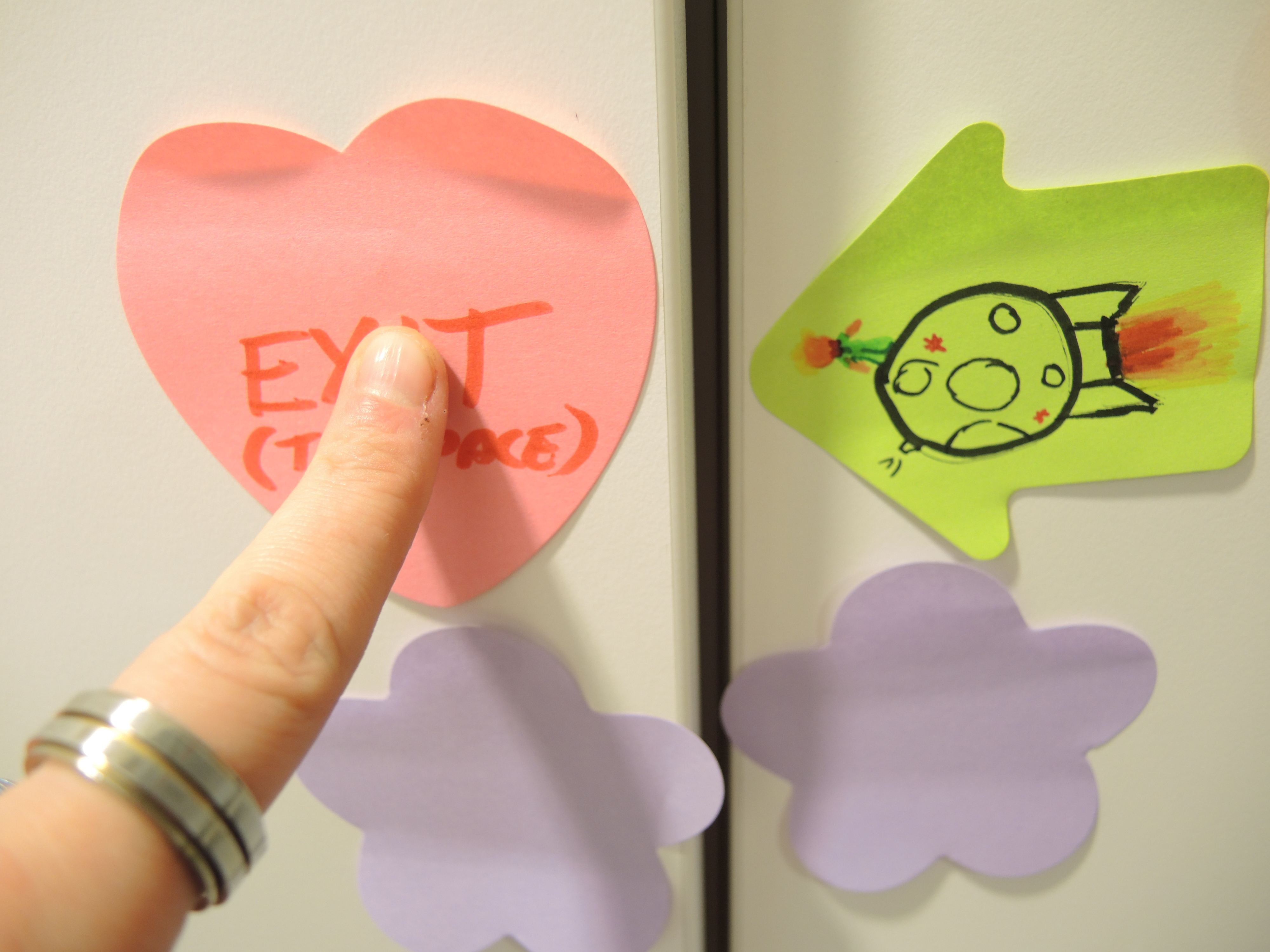
The door goes to space.
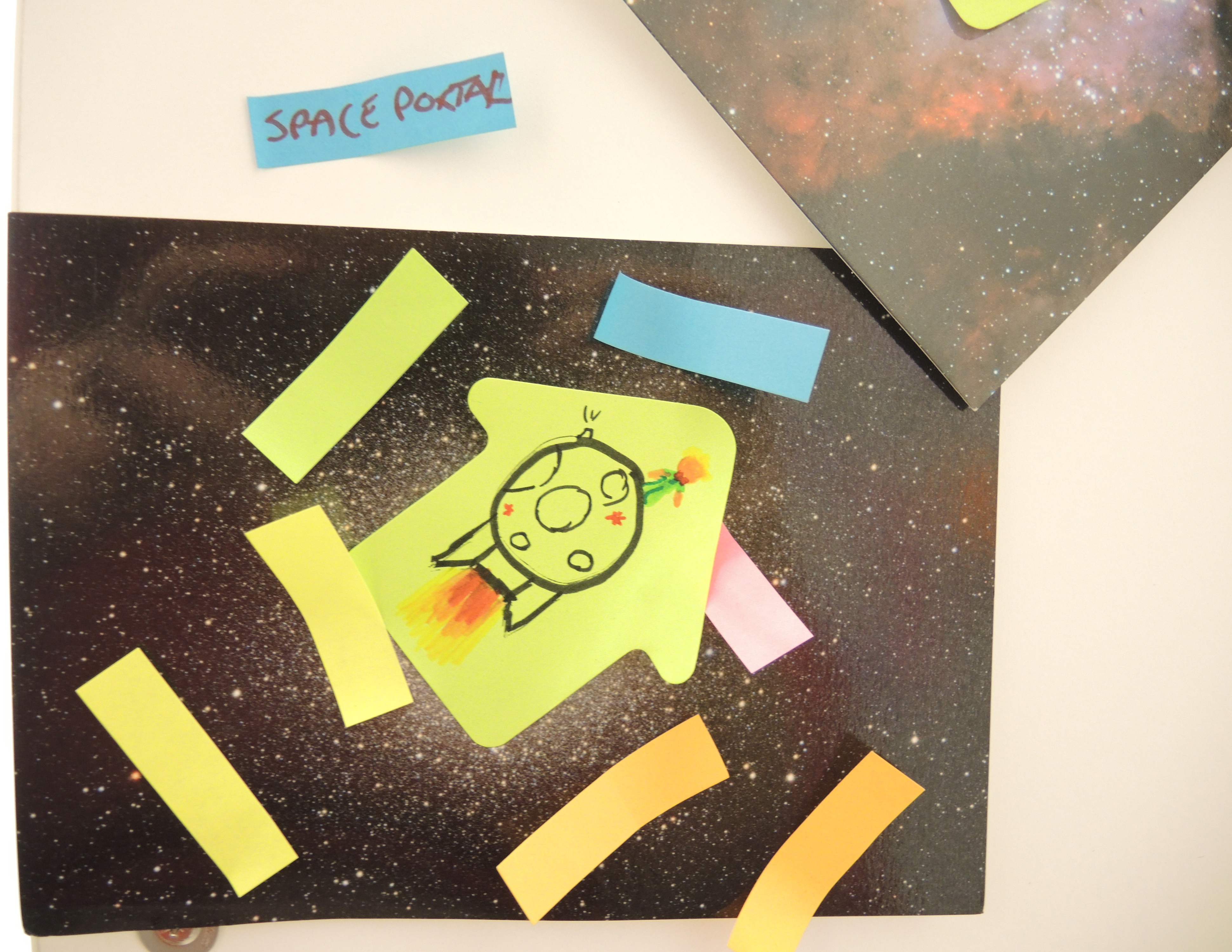
Space is full of wondrous things.
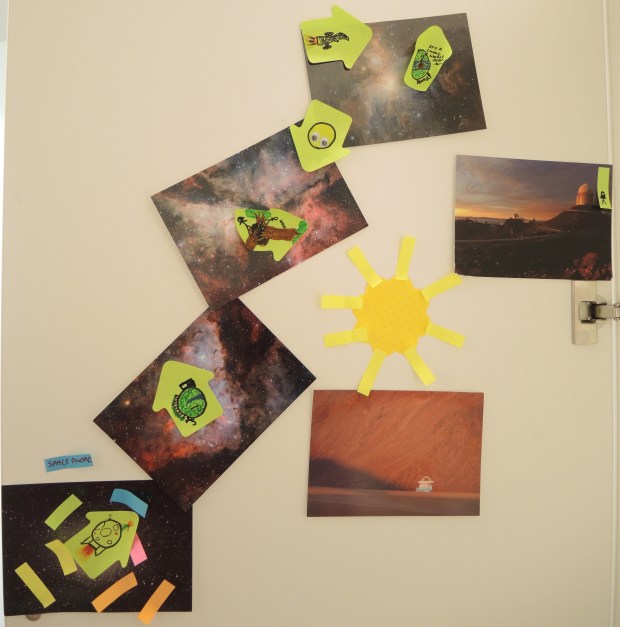
Space and time are part of the same continuum, so space contains several scenes and characters from the xkcd Time comic.
Space is a place of great serenity, and not-so-great drawings of Serenity. Space makes you realise just how small our world really is. Space is watching you. 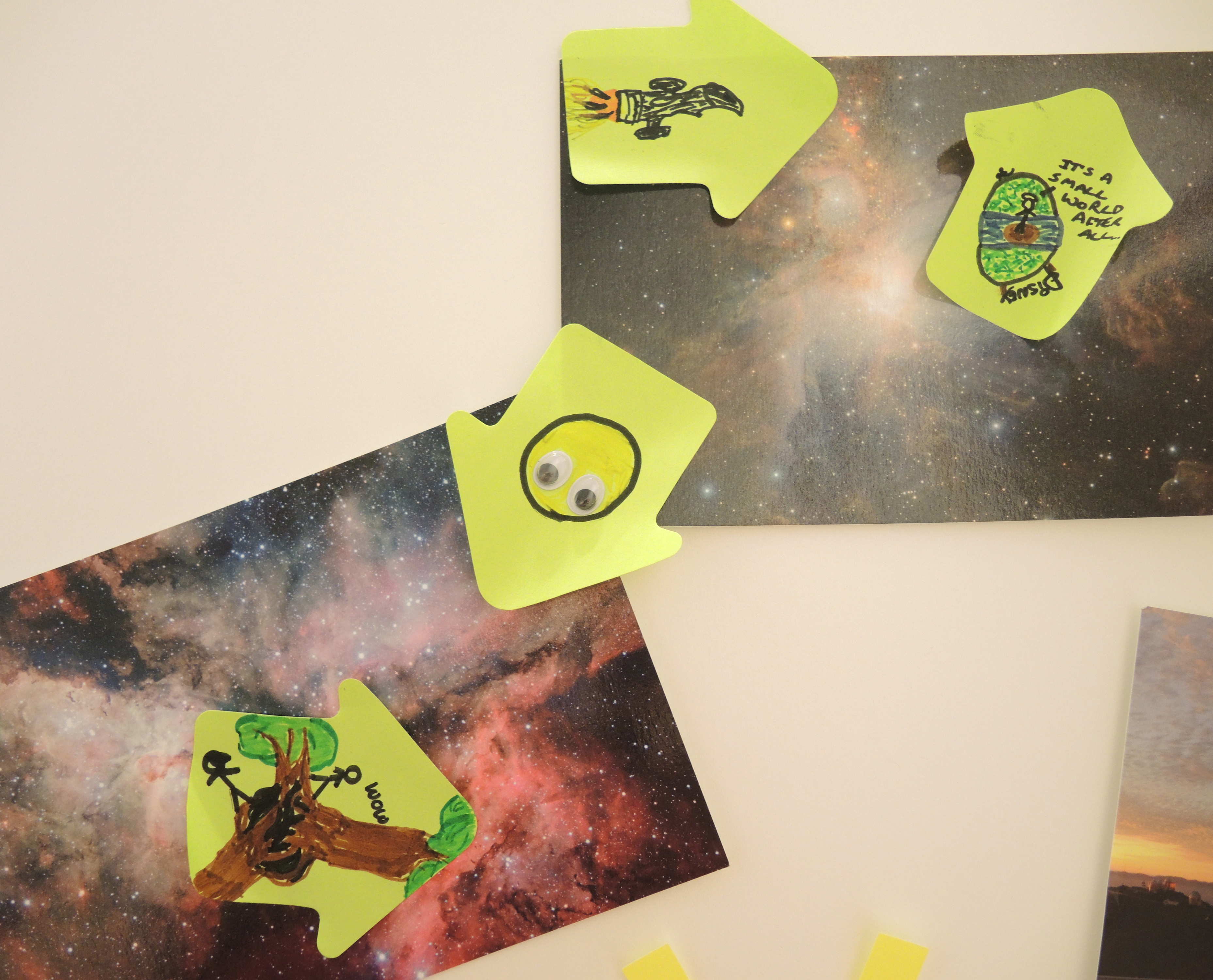
You are watching space. 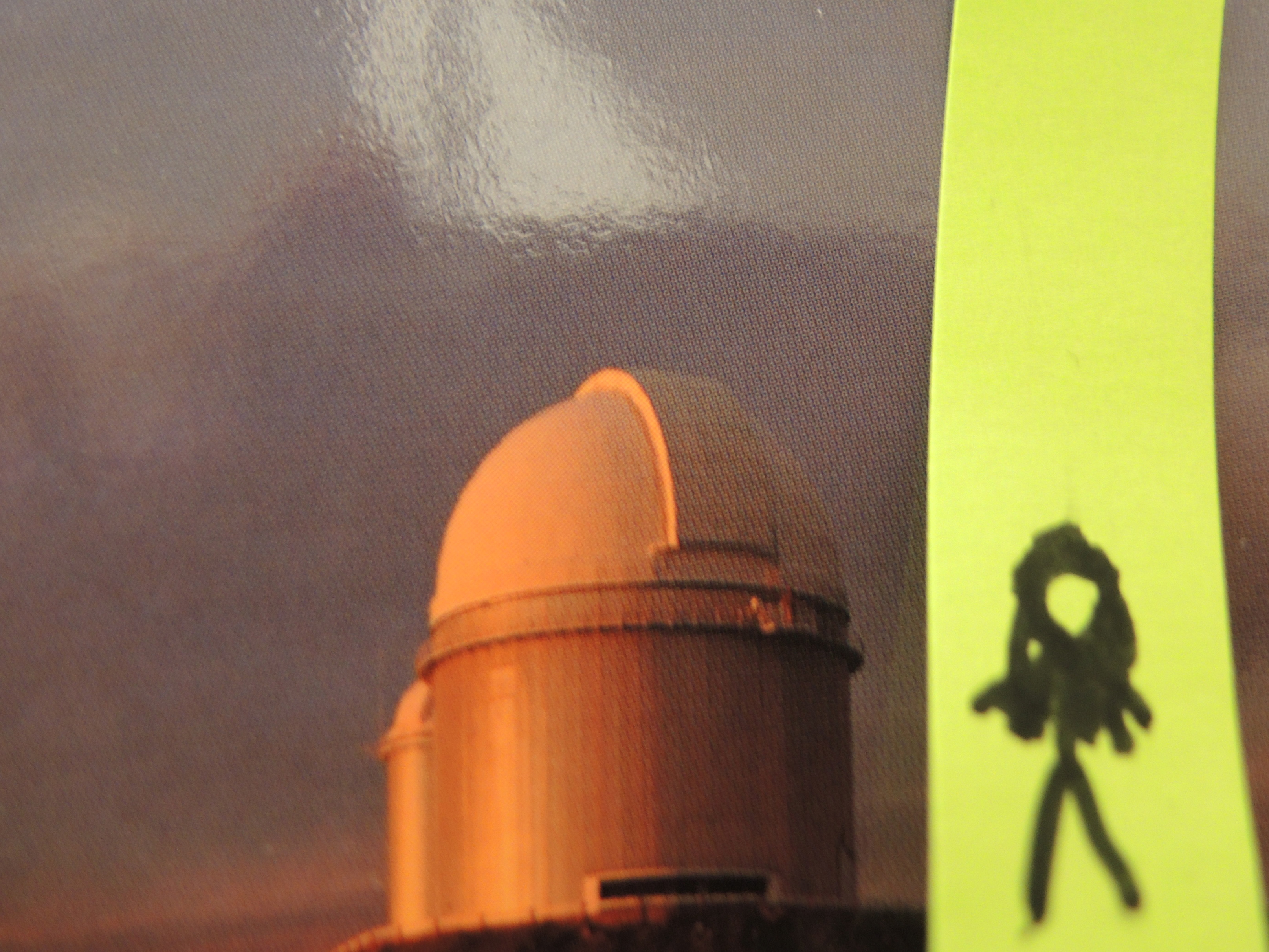 Space will have more things in it just as soon as I get around to launching them. In the mean time, make up your own stories about what might happen if the assorted spaceships or asteroids or planets meet, and who might live on the lower planet, and what Rosetta has seen from the observatory.
Unintentional Haiku… of Mars
Posted by Angela Brett in Haiku Detector on June 30, 2013
Kurukkan suggested using Haiku Detector to find the unintentional haiku in Edgar Rice Burroughs’ ‘A Princess of Mars’. This it seemed like a fine idea to me. I haven’t read it yet, but I’ve heard of it, and there was even another movie based on it (‘John Carter’) released recently. There are quite a few haiku which have a nice twist in the last line; one even has a rhyme. I’ve trimmed out some that really don’t work, but since they’re not much effort to read anyway, I’ve left in some that still sound picturesque even if they don’t break nicely into the lines. If you’re not into Mars fiction, there are some haiku about a real Mars mission, and an opportunity for you to send your own haiku to Mars, at the end.
On regaining the
plaza I had my third glimpse
of the captive girl.“Some day you shall know,
John Carter, if we live; but
I may not tell you.And now the signal
has been given to resume
the march, you must go.”“I am glad you came,”
she said; “Dejah Thoris sleeps
and I am lonely.I have twice wronged you
in my thoughts and again I
ask your forgiveness.Sola and I walked,
making Dejah Thoris ride,
much against her will.I have escaped from
worse plights than this,” and I tried
to smile as I lied. Read the rest of this entry »
Eight of Hearts: Ten Minutes a Day
Posted by Angela Brett in Alcatraz Rules and Regulations, Writing Cards and Letters on May 26, 2013
Ten minutes a day,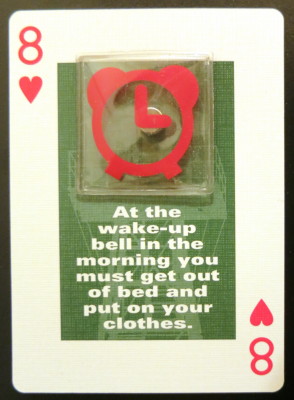
that’s all you need
to realise your dreams —
not as hard as it seems.
Ten minutes can always be freed.
Ten minutes a day,
a sixth of a clock,
to keep up your writing,
its forced march providing
a force to march through writer’s block.
Ten minutes a day
can’t be denied,
to read through your bookshelf
and castle your rook self
with culture of kings by your side.
Ten minutes a day,
one day at a time,
to inch past the worst of it,
combat inertia that
nothing excuses; must try if it uses just
ten minutes a day,
don’t you forget,
to learn a new language:
word spread, grammar sandwich.
Ten minutes to keep your tongue wet.
Ten minutes a day
(if you’ve spread spores)
to teach well your baby;
remember that maybe
its life will be bigger than yours.
Ten minutes a day,
on- or offline,
to maintain your friendships,
accept rain and send drips;
as long as it’s something it’s fine.
Ten minutes a day —
find it somehow.
Forego social network fun,
finally get work done.
You’ve got all these things to make, it’s really not hard to take
ten minutes a day.
That’s all you do
to try meditation
and self re-creation;
you have to take some time for you.
Ten minutes a day —
it doesn’t take long
to tidy a tight space,
put junk in the right place;
and live with things where they belong.
Ten minutes a day,
not big amounts
to work on your fitness;
don’t tire yourself witless,
but even a small workout counts.
Ten minutes a day?
I can do that!
Grab life while I’m alive,
did all the things and I’ve
got what I’m leaping for now, and I’m sleeping for
ten minutes a day.
That’s all I need. [yawn]
Night dreams are boring;
my real dreams are [sound of snoring]
[snoring continues]
This is another one of those poems which has a tune in my head, and I had a hard time reading it without the tune to see if there were any lapses in rhythm the tune was forgiving. I fear I this may have caused me to write a terrible song and mediocre poem instead of a good poem. But I like it anyway. I might have to make a robot choir recording of it. It even has guitar bits after the second line of each stanza, which will be a fun challenge to record using only my MIDI keyboard and my vague suspicion that things called chords are involved.
I’ve been thinking about this one for several weeks, every so often adding something to the list of things that people say we should spend some negligible and underestimated amount of time on every day. It wasn’t really inspired by that card, and I still haven’t even tidied up my cards since the cruise. On the subject of the cruise, and people telling us to write every day, here’s my video recording of the live episode of the Nerdist Writers Panel recorded on JoCo Cruise Crazy 3.
It might be nice if I changed ‘ten minutes’ to either ‘five minutes’ or ‘one hour’ (‘hour’ pronounced as two syllables) so that I could arrange the first twelve stanzas around a clock and put the last one somewhere where there isn’t time for it, but I prefer the sound of ‘ten minutes’. I was thinking of making it zigzag across the page, three stanzas wide, but that would be pretty gratuitous.
I can consistently introduce and read this one in under three minutes, so I might read or recite it at the poetry open mic at ICV Arcade on the 31st. Let’s see if I can memorise it. My goal will be to make the audience yawn, and with that as a goal I don’t think it’s possible to fail. I bet you’re yawning already, so I’ll stop this now.
Addendum:
I changed some of the words. It originally went:
to try social network fun,
or you could get work done.
but who ever advises people to use social networks more? Apart from to maintain your friendships, of course, but conflicting interests is what this poem is about. Also, I used to have ‘for’ instead of ‘but’ about the small workout counting. I’m thinking about ‘a’ to ‘the’ in the fourth line of the second stanza.
Further Addendum: I recited this at open mic, and lots of people said they liked it, and I wish I could have said the same to the other poets there but I am not good enough at absorbing poetry and memorising faces and attaching the two all at the same time. I have some ideas for illustrations which could turn this poem into a small picture book or large comic strip for people who are told they’re too old for Dr. Seuss, and maybe aren’t yet old enough to realise they’re not. It would also be used for a halfhearted slide-show-style music video when I eventually teach my robot choir to sing this. I’m not sure whether I should attempt to draw it myself using stick figures, or commission someone else to do it. I’m starting to think it would be fun to have merch to shill, even if it the profit would be inevitably approaching zero from one side or the other. I have a day job so I can do that if I want. I enjoyed the ego boost when the occasional person would buy my shareware in the late 90s, and I still have the T-shirts and most of the cheques (the payments were processed by a US company, so they actually used cheques, even though it was almost the 21st Century.) But I won’t start on any of that until I’ve finished the King of Hearts.
Synaesthete’s Blues, Immersive Edition
Posted by Angela Brett in Publishing on May 19, 2013
On Thursday I was thinking about interesting things I could do if I made a book of some of my writing and typeset it myself, and one of the things I thought of was running Synaesthete’s Blues (a poem about discovering my ‘S’ fridge magnet was blue, when according to my grapheme → colour synaesthesia it should be orange) through Synaesthetist (an app I wrote to display text in a given synaesthetist’s colours) so that it would be displayed in my colours. This would annoy other grapheme → colour synaesthetes in exactly the manner described in the poem (since their colours are almost certainly different from mine) and would probably be jarring for non-synaesthetes too.
If I did make such a book, it would probably be very expensive and time-consuming to produce, so for now, I will just put a coloured version of Synaesthete’s Blues here. The letters are coloured with the colours I associate with them, and outlined with the colour of the first letter of the word they’re in, because the first letter of a word tends to dominate, and the outline makes it clearer what’s going on and easier to read than simply mixing the colours would — see the post about Synaesthetist for more about that. It’s in bold text, which means the outline is thinner than usual relative to the letters, and makes its effect less true to how I see the words, but it makes the text easier to read, and should make it easier for you to see the colours of the individual letters without them being so dominated by the first letters. The title, URL and my name at the bottom are all done by blending the first letter’s colour in with the others in a fraction that looks just right to me.

Coincidentally, Friday’s xkcd comic was about grapheme → colour synaesthesia. Neat as a tree. In case you’re wondering, I couldn’t see either big number (though they are there.) I have to look at a few graphemes at a time to get colours from them; I can’t see a colour picture just by glancing at it.
A couple of dictionaries tell me that ‘immersive’ applies to electronics which engage several senses apart from sound and vision, whereas ‘immersion’ does have the meaning I’m after but isn’t an adjective. I’m going to stick with calling this immersive until I think of a better idea. You’re immersed (but not embedded) in synaesthesia and the frustration of seeing graphemes in the wrong colours.
Unintentional Haiku in the Princeton Companion to Mathematics
Posted by Angela Brett in Haiku Detector on May 18, 2013
I’ve had a copy of the Princeton Companion to Mathematics for a while, and intended to start a series called ‘forms and formulae’, where I’d write about some of the articles using poetic forms from the Princeton Encyclopaedia of Poetry and Poetics (addendum: I have since started a series called Forms and Formulae doing just that.) However, both books are huge and difficult to read on the bus, and the articles are long, so so far all I’ve managed to do in that vein is write a poem about platonic solids in a duel, and procrastinate my way out of writing about the entries whose names were alphabetically closest to Emmental. So I was excited to discover this morning that there is a pdf of the Princeton Companion to Mathematics available for free, apparently legally. Finally I can carry it around with me on my iPad and write poems about it whereever I want. But I don’t even need to do that, now; thanks to Haiku Detector, I can easily find the poems that are already in it. And boy are there some nice ones. Some were missed because Haiku Detector doesn’t know how to pronounce Greek letters and a lot of other mathematical notation, and the book sometimes hyphenates at the ends of lines so it looks like they’re good places for line breaks when they’re not. But these are the best ones I found. First off, some which don’t even sound like they’re about mathematics:
Watch your hand as it
reaches out gracefully to
pick up an object.The difference between
the two definitions of
a secret is huge.These ideas will
occupy us for the rest
of the article.This opens you up
to new influences and
opportunities.In our case, there are
two natural properties
that one should ask for.Suppose that households
are able to observe one
another’s outputs.Everything is now
a martingale and there can
be no arbitrage.The magician can
at once identify which
digit has been changed.This definition
has the advantage of great
flexibility.Let us briefly sketch
the argument, since it is
an instructive one.Moreover, it was
a thought that took many years
to be clarified.The blocks are the sets
of seed varieties used
on the seven farms.
If you didn’t know where it came from, this could be about anything, but it also sums up the appeal of mathematics:
But then again, who
can deny the power of
a glimpse at the truth?
And a more transparent statement about the nature of mathematics:
“All roads lead to Rome,”
and the mathematical
world is “connected.”
But I really love it when you can’t tell it’s about mathematics until the last line:
The answer turns out
to be that we should weaken
our hypotheses.It is important
to have a broad awareness
of mathematics.We will focus on
the most important special
case: vector bundles.Sometimes relations
are defined with reference to
two sets A and B.This remains as an
outstanding open problem
of mathematics.Church’s thesis is
therefore often known as the
Church–Turing thesis.How, though, can we be
sure that this process really
does converge to x?It turns out that both
choices are possible: one
automorphismWe shall now describe
the most important of these
extra assumptions.Several themes balance
in Hilbert’s career as a
mathematician.Indeed, the study
of such designs predates their
use in statistics.This turns out to be
a general fact, valid
for all manifolds.However, it is
a well-understood kind of
singularity.In particular,
we can define the notion
of winding numbers.This is exactly
the task undertaken in
proof complexity.
Questions mathematicians ask themselves:
How much better would
you do if you could compound
this interest monthly?Why are spherical
harmonics natural, and
why are they useful?What consequence should
this have for the dimension
of the Cantor set?Can we reduce this
computational problem
to a smaller one?How about checking
small numbers a, in order,
until one is found?For what values of
the edge-probability
p is this likely?Is every even
number greater than 4 the
sum of two odd primes?Can one make sense of
the notion of a random
continuous path?
Perhaps this is the answer:
In mathematical
research now, there’s a very
clear path of that kind.
This one sounds like some kind of ‘how many roads must a man walk down’ question:
How many walks of
length 2n are there that start
and end at 0?
And while this isn’t actually a haiku, I can imagine it being sung in response to that song, with ‘the number of such walks’ to the tune of ‘the answer my friend’:
The number of such
walks is clearly the same as
W (k − 1).
Mathematicians don’t always answer questions in ways that other people find useful:
If instead we were
to ask each person “How big
is your family?”In particular,
the average family size
becomes infiniteIt follows that at
some intermediate r
the answer changes.
Things only a mathematician would feel the need to state explicitly:
This is a sum of
exponentials — hence the phrase
“exponential sums.”What makes them boring
is that they do not surprise
us in any way.
Proof is left as an exercise for the reader; it probably takes several pages, but:
If you do know it,
then the problem becomes a
simple exercise.Once this relative
primality is noticed,
the proof is easy.All we have to do
is use one more term in the
Taylor expansion.Doing things this way
seems ungainly to us, but
it worked very well.It is not hard to
see that the two approaches
are equivalent.(Of course, one needs to
check that those two expressions
really are equal!)But this subtlety
is not too important in
most applications.
Some interesting statements:
For every person
P there exists a drink D
such that P likes D.That is exactly
what a sphere is: two disks (or
cups) glued together!Thus, recursion is
a bit like iteration
but thought of “backwards.”Nevertheless, it
turns out that there are games that
are not determined.(It can be shown that
there is exactly one map
with this property.)The remainders get
smaller each time but cannot
go below zero.There are other ways
to establish that numbers
are transcendental.(The term “Cartesian
plane” for R2 is therefore
anachronistic.)As usual, we
identify R2 with
the complex plane C.Note that a block of
size 1 simply consists of
an eigenvector.The upshot is that
we should always use a prime
number as our base.Among the other
important number fields are
the cyclotomic fields.Thus we obtain a
number that is less than the
quantity we seek.So we might define
the “points” of a ring R to
be its prime ideals.(For both halves, the pinched
equator is playing the
part of the point s.)Thus, we have deduced
that length-minimizing curves
are geodesics.For example, the
geodesics on the sphere
are the great circles.The generators
correspond to loops around each
of the two circles.The image of this
map will be a closed loop C
(which may cross itself).We consider what
happens to C if we add
a small ball to it.It is not hard to
show that the orbits form a
partition of X.There are many ways
of combining groups that I
have not mentioned here.I have thrown classes
of groups at you thick and fast
in this last section.To apply Newton’s
method, one iterates this
rational function.A quick overview
of physics will be useful
for the discussion.can get away with
not understanding quantum
mechanics at all.The quantum version
of Hamilton’s principle
is due to Feynman.These encapsulate
the idea of a proof
by contradiction.(A graph is simple
if it has neither loops nor
multiple edges.)It is really an
algorithm that inputs
n and outputs an.(An involution
is a permutation that
equals its inverse.)If the tree has 2
vertices, then its code is
the empty sequence.But the number of
possible orders of A,
B, and C is 6.Number theory is
one of the oldest branches
of mathematics.The percolation
and Ising models appear
to be quite different.First, Albert shouts out
a large integer n and
an integer u.
This one is interesting if you imagine it’s about lines of poetry:
Another affine
concept is that of two lines
being parallel.
A mathematical protest slogan:
equality if
and only if x and y
are proportional.
A title of the mathematician’s equivalent of a song about unrequited love:
5.1.5
Why Is It so Difficult
to Prove Lower Bounds?
A series of short films:
10 Differences in
Economic Life among
Similar People
And something said in a soothing tone after a litany during a maths/mass:
Now let us return
to polynomials with
n variables.
The probability of finding a good haiku in the end matter is low, but I think this one’s pretty neat, even if it only has the right syllable counts if you say the ‘and’ in 906 but not 753:
law of large numbers,
753,
906
May the Fourth be with you (even if you haven’t seen Star Wars)
Posted by Angela Brett in News on May 4, 2013
I’ve mentioned this before, but it’s Star Wars day, so it seems like a good time to repost. Remember last Star Wars Day, when I snubbed the CERN CinéClub’s showing of the original three Star Wars movies in order to write a poem about Star Wars, from my perspective as someone who has only seen The Phantom Menace, several hours of The Star Wars Holiday Special (with Rifftrax), the start of the original trilogy, under duress, while tired, from 2a.m. until I fell asleep, and a lot of Star-Wars-related songs and Internet memes? Well, I still haven’t seen the movies, and it doesn’t look like the CERN CinéClub is showing them today. But I did recite the poem in front of a crowd of nerds and geeks at the open mic night on JoCo Cruise Crazy 3, and they didn’t lynch me as an infidel, or throw me in the hot tub and force me to drink mudslides and watch Star Wars on the on-deck movie screen. Some of them even said they liked the poem! Even several people who I know write great things themselves! Here is my video of it. Having a decent microphone and no need to use up all my breath to speak loudly eliminated most causes and symptoms of nervousness, but oh boy, is my high-rising terminal showing at the beginning.
If you’re wondering, my first comment referred to Mike Phirman saying earlier that when you go on stage your body shuts down its vital functions and ‘you can really, really, really have to pee before you go on, and then you walk on stage and your body goes into like war mode, where it’s like, ‘There’s no time for that! We are at war!” I don’t think anyone laughed at the reference to the story Wil Wheaton read on the first cruise, so there goes my best chance at any audience noticing that. I missed out the following lines, at the start of the second stanza:
There were Chewie, and Yoda (the OSV talker)
Han Solo, and Leia, of course, Luke Skywalker.
I excused that in advance by saying I’d spent more time memorising Chicken Monkey Duck than this poem. That was not a joke, although I also made one mistake in Chicken Monkey Duck, so I guess I’m just imperfect. That means I’m not a replicant; hooray! (For what it’s worth, I saw all of Blade Runner for the first time this year, while outside in the rain, no less, so I finally know what that means. And I’m still using it wrong, because it seems like replicants aren’t perfect either. But passing the Voight-Kampff test just seems like it would give a higher-level qualification than passing the Turing test.)
To anyone else out there who still hasn’t seen Star Wars and feels like they should have: remember it’s entertainment. It should not be on your to-do list. Put it on your ‘things that might be fun to do when I need a break from the to-do list’ list if it seems interesting to you. Or, like me, use it to quickly dispatch anyone’s insistence that you see, read or listen to every other piece of culture that they deem important. Once you tell them you haven’t even seen Star Wars yet, they dismiss you as a lost cause and stop trying to add things to your to-do list. And if you’re a geek and they tell you this makes you a fake one, just tell them that, as Marian Call says, you have been a nerd since your first five syllable word, and no TV series or movie changes that:
In other news, I’ve signed up to read something at the Leman Poetry Workshop open mic night (warning: gratuitously-Flash-only website; don’t bother clicking if you have special needs that this won’t cater for) on May 31. I haven’t decided what to read yet, but it’s on my birthday, so probably something about birth, or death, or cake.
Also, I’m working on several different things at the moment, including the long-planned but little-implemented six of hearts, so hopefully I’ll finish those and post them here soon.
Haiku Detector Update
Posted by Angela Brett in Haiku Detector on April 27, 2013
On Monday I posted a quick-and-dirty Haiku Detector Mac application I’d written which finds haiku (in terms of syllable counts and line breaks, not aesthetics) in any given text. Since then I’ve made it less dirty and maybe more quick. It now shows progress when it’s busy looking for haiku in a long text, and gives you a count of the sentences it looked at and the haiku it found. You can also copy all the haiku (Copy All Haiku in the Edit menu) or save them to a file (Save in the File menu.) Here’s where you can download the new version, which should still work on Mac OS X 10.6 and later. And here are a few more haiku I’ve found with it.
There’s only one (not counting a by-line) in the feature articles of the April 27 edition of New Scientist:
Inside a cosy
new gut the eggs hatch and the
cycle continues.
From Flatland: a romance of many dimensions, by Edwin Abbott Abbott:
On the reply to
this question I am ready
to stake everything.“I come,” said he, “to
proclaim that there is a land
of Three Dimensions.”Man, woman, child, thing—
each as a Point to the eye
of a Linelander.This was the Climax,
the Paradise, of my strange
eventful History.
Here are a few more from Flatland which I’m editing this post to add, since I liked them more on the second reading:
Let us begin by
casting back a glance at the
region whence you came.Therefore, pray have done
with this trifling, and let us
return to business.Even if I were
a baby, I could not be
so absurd as that.
From Last Chance to See, by Douglas Adams and Mark Carwardine, which I somehow ended up with a text file of many years ago and eventually got a book of:
I’ve been here for five
days and I’m still waiting for
something to go right.We each went off to
our respective rooms and sat
in our separate heaps.They’re nocturnal birds
and therefore very hard to
find during the day.It looked like a great
horn-plated tin opener
welded to its face.We keep searching for
more females, but we doubt if
there are any more.The very laws of
physics are telling you how
far you are from home.Foreigners are not
allowed to drive in China,
and you can see why.`Just the one left,’ she
said, putting it down on the
ground in front of her.Yet it was hunted
to extinction in little
more than fifty years.And conservation
is very much in tune with
our own survival.
And here’s my own haiku about a particularly amusing passage in that book:
Here Douglas Adams
trudges through his anagram:
Sago mud salad.
Charles Darwin’s most popular work, The Formation of Vegetable Mould Through the Action of Worms with Observations on their Habits, only contained 12 mostly-lacklustre haiku, but I like to think this one is a metaphor:
Worms do not always
eject their castings on the
surface of the ground.
Something about lack of worm castings being only skin-deep.
But most of these don’t mention nature or seasons, as haiku should. So here are some from Sylva, or A Discourse of Forest Trees:
Dieu, and thence rode to
Blois and on to Tours, where he
stayed till the autumn.How graphic, and how
refreshing, is the pithy
point thus neatly scored—
Meteorology, or Weather Explained, by J.G. M’Pherson contains some very poetic-sounding unintentional haiku:
“It’ll pe aither
ferry wat, or mohr rain”—a
poor consolation!“Beware of rain” when
the sheep are restive, rubbing
themselves on tree stumps.The brilliant flame, as
well as the smoky flame, is
a fog-producer.Till ten o’clock the
sun was not seen, and there was
no blue in the sky.But, strange to say, there
is a healing virtue in
breathing different air.There is much pleasure
in verifying such an
interesting problem.
Unfortunately, there are no haiku in Dijkstra’s ‘Go To Statement Considered Harmful‘.
The app still uses a lot of memory if you process a novel or two, and may have trouble saving files in that case; It looks like it’s a bug in the speech synthesis library (or my use of it) or simply a caching strategy that doesn’t work well when the library is used in this rather unusual and intensive way. Anyway, if you ever try to save a file and the Save dialog doesn’t appear, try copying instead, and relaunch the program.
Next I think I’ll experiment with finding the best haiku based on the parts of speech at the ends of lines. But first, I’d better start working on the thing I’ve plan to do for the six of hearts.
If you’ve found any nice unintentional haiku, or if you can’t run Haiku Detector yourself but have ideas for freely-available texts it could be run on, let me know in the comments.
Five of Hearts: Haiku Detector
Posted by Angela Brett in CERN, Haiku Detector, Writing Cards and Letters on April 23, 2013
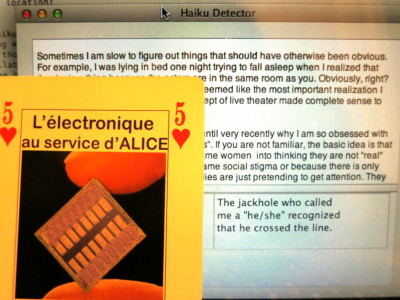 A few weeks ago, a friend linked to Times Haiku, a website listing unintentional haiku found in The New York Times, saying ‘I’d actually pay for a script that could check for Haiku in my writings. That would make prose-production a lot more exciting! Who’s up to the script-writing-challenge?’
I knew I could do it, having written syllable-counting code for my robot choir (which I really need to create an explanation page about.) I told her I’d make it that weekend. That was last weekend, when I decided at the last moment to write an article about neutron stars and ISOLTRAP, and then chickened out of that and wrote a poem about it. So I put off the haiku program until yesterday. It was fairly quick to write, so here it is: Haiku Detector. It should work on Mac OS X 10.6 and above. Just paste or type text into the top part of the window, and any detected haiku will appear in the bottom part.
Haiku Detector looks for sentences with seventeen syllables, and then goes through the individual words and checks whether the sentence can be split after the fifth and twelfth syllables without breaking a word in half. Then it double-checks the last line still has five syllables, because sometimes the punctuation between words is pronounced. The Times Haiku-finding program has a database of syllable counts per word, but I didn’t need that since I can use the Mac OS X speech synthesis API to count the syllables. Haiku Detector makes no attempt to check for kigo (season words.)
The first place I looked for haiku was the Wikipedia page for Haiku in English. Due to the punctuation, it didn’t actually find any of the example haiku on the page, but it did find this:
Robert Spiess (Red Moon
Anthology, Red Moon Press,
1996)
How profound. Next, having declared myself contributing troubadour for New Scientist magazine, I fed this week’s feature articles through it, and found:
A pill that lowers
arousal doesn’t teach shy
people what to doMeanwhile, there are signs
that the tide is turning in
favour of shyness.So by 4000
years ago, the stage was set
for the next big step.This heat makes the air
spin faster, so pulling the
storm towards the city.Some will be cooler
and less humid — suitable
for outdoor sports, say.
The last ones seem almost seasonal.
I needed to stress-test the app with a large body of text, so I grabbed the first novel of which I had the full text handy: John Scalzi‘s Old Man’s War, which I had on my iPad on my lap to read while my code was compiling. This book has at least one intentional haiku in it, which Haiku Detector detected. Apart from that, some of my favourites are:
I hate that her last
words were “Where the hell did I
put the vanilla.”As I said, this is
the place where she’s never been
anything but dead.“I barely know him,
but I know enough to know
he’s an idiot.”She’d find me again
and drag me to the altar
like she had before.A gaper was not
long in coming; one swallow
and Susan was in.They were nowhere to
be found, an absence subtle
and yet substantial.And it stares at me
like it knows something truly
strange has just happened.
I haven’t got up to that fifth one in the novel yet, but it mentions a swallow, which I understand is (when accompanied by more swallows) a harbinger of Spring or Summer depending on which language you get your idioms from, so there’s the kigo.
Next I figured I should try some scientific papers — the kinds of things with words that the Times haiku finder would not have in its syllable database. You probably can’t check this unless your workplace also provides access to Physics Letters B, but I can assure you that the full text of the ISOLTRAP paper about neutron stars does not contain any detectable haiku. However, the CMS paper announcing the discovery of the boson consistent with the Higgs does:
In the endcaps, each
muon station consists of
six detection planes.
As is usual for CMS papers, the author and institute lists are about as long as the paper itself, and that’s where most of the haiku were too. Here are a few:
[102]
LHC Higgs Cross Section
Working Group, in: S.University
of California, Davis,
Davis, USA
That’s ‘one hundred and two’ in case anyone who doesn’t say it that way was wondering.
And here are some from my own blog. I used the text from a pdf I made of it before the last JoCo Cruise Crazy, so the last few months aren’t represented:
Beds of ground cover
spread so far in front of him
they made him tired.Apologies to
those who only understand
half of this poem.I don’t remember
what colour he said it was,
but it was not green.His eyes do not see
the gruesome manuscript scrawled
over the white wall.• Lines 1 to 3 have
four syllables each, with stress
on the first and last.
(That’s not how you write a haiku!)
I don’t wear armour
and spikes to threaten you, but
to protect myself.A single female
to perpetuate the genes
of a thousand men.Kerblayvit is a
made-up placeholder name, and
a kerblatent cheat.He wasn’t the first,
but he stepped on the moon soon
after Neil Armstrong.He just imagined
that in front of him there was
a giant dunnock.
(there are plenty more where that one came from, at the bottom of the page)
She was frustrated
just trying to remember
what the thing was called.Please don’t consider
this a failing; it is part
of your programming.
While writing this program, I discovered that that the speech API now has an easier way to count syllables, which wasn’t available when I wrote the robot choir. The methods I used to separate the text into sentences and the view I used to display the haiku are also new. Even packaging the app for distribution was different. I don’t get to write Mac software often enough these days.
Yet again, I didn’t even bother to deal out the cards because I already had something to inspire me. In my halfhearted attempt to find a matching card, I came across one about electronics in the service of ALICE, so I ran the latest instalment of Probably Never, by Alice, into it, and got this:
Or well, I have to
put up with getting called a
fake girl all the time.The jackhole who called
me a “he/she” recognized
that he crossed the line.
If that sounds interesting, subscribe to Probably Never, and I could probably forward you the rest of that episode if you want.
And finally, two unintentional haiku from this very post:
Haiku Detector
makes no attempt to check for
kigo (season words.)(there are plenty more
where that one came from, at the
bottom of the page)
Wait; make that three!
And finally, two
unintentional haiku
from this very post:
Have fun playing with Haiku Detector, and post any interesting haiku you find in the comments. Also, let me know of any bugs or other foibles it has; I wrote it pretty quickly, so it’s bound to have some.
I know what I’m doing for the six of hearts; I’ve planned it for a long time but still haven’t actually started it. It’s musical, so it will probably be terrible; brace yourselves. By the way, I keep forgetting to mention, but They Might Not Be Giants will be published in Offshoots 12. Yay!

This work is licensed under a Creative Commons Attribution-Noncommercial-Share Alike 3.0 Unported License.
Please tell me if you do something cool with it.

 Creative Output