Posts Tagged space
Nine of Hearts: ISS vs. LHC update
Posted by Angela Brett in CERN, Space Shuttle, Writing Cards and Letters on June 4, 2013
 A while ago I made a somewhat whimsical but as accurate as I could manage too-much-infographic comparing many aspects of the International Space Station with the Large Hadron Collider, and jokingly asking which would win in a fight. I’ve given that a bit of an update and put an annotated text version below for those whose pdf readers don’t show annotations. More importantly, since then, I’ve seen the crew of the STS-134 mission to the space station give a talk at CERN, and wanted to ask them which was more awesome, but was in one of the few spots without a microphone, and I don’t speak as loudly as my friend Hugo, who asked a question from right next to me, does. But at a later talk at CERN, I did ask NASA’s Associate Administrator for Human Exploration and Operations, William H. Gerstenmaier. This was his response, which you can find at around 50:45 in the video:
Oh, man. This is a tough question; I don’t know. They’re both unique in their own way, right? Both pretty special research facilities, right? And I think that, again we often talk about, you know, human versus robotic, right, it’s really human all the time, right? Even in a robotic space, the data’s analyzed by a human somewhere, and so, I think again it’s that spirit of exploration that we’re all pushing on. We all want to understand something new, discover something that nobody’s seen before, so at CERN, damn sure, that spirit drives you every day, you’re looking for new things. I see it in your papers: what is this theory? Are we changing physics? It’s the same thing we’re doing. How can I look at a physical phenomenon that occurs in one gravity, remove the one gravity term, and now get a totally different perspective on that same physical phenomenon, that then allows me to advance in a different area. So I think it’s that same passion that drives people. But I don’t know which one’s best.
So there you go. I’ve added this comment to the notes in the TMIGraphic, and also updated data relating to the ISS’s orbit and a few other things, and added a ‘Getting to Orbit’ section, but the best thing is the update to that ‘when to see it’ bubble on the LHC. You can see it at the CERN open days at the end of September. Two full days. The LHC is shut down for upgrades at the moment, so I understand this will be another chance to actually go underground and see it, which probably won’t be possible for a while once it starts running again. And even if you don’t see the LHC or its detectors (there are only so many people that you can get up and down in a lift in two days; 23 000 people out of 53 000 visitors visited the tunnels in one day last time), there are many other things you can see at the open day. I know this because I was at the last one. Maybe I should look through whatever videos I took that day and see if I can make an interesting montage. I know I have footage from various other tours which I should put online.
The pdf version of the ISS vs. LHC comparison has a lot of links and extra notes in the margins detailing where I got the figures from, how I chose the sources, how I found myself gingerly plugging values into a relativistic equation at a demoparty at 1:30a.m, and so on. But I suspect not everyone who looked at the original downloaded the pdf, and those who did might not have been using pdf readers that showed the notes well. Besides that, the infographic is sort of messy (that’s why I call it a too-much-infographic), although I think it does add something to the raw text. So I’ll reproduce all of the text and notes in table format below, show a far-too-small preview of the TMIGraphic version, and encourage you to download the pdf if you like circles and crisscrossing dashed lines and things that can be read while offline.
Sorry if the line spacing is inconsistent in this table; WordPress changes the style for the second and later paragraphs in each cell no matter how I create the paragraph breaks, and it tends to delete newlines, paragraph and break tags if I ever open the page in the visual editor, so the best I can do is put blank lines before the first paragraph in each cell to give that the same style, and then try not to accidentally open the post in the visual editor.
| Aspect | ISS | LHC | Notes |
| Physical Characteristics | |||
| Size |
Solar array: 73m Truss: 109m Modules: 51m |
Dipole magnets: Cold mass diameter: 0.57m Vacuum vessel diameter: 0.91m Length: 15m See the ‘Orbit’ section for the size of the entire LHC. |
Source for ISS size |
| Mass | 419 455kg (but it depends what’s up there) | 37 600 000kg (cold mass) 35 200kg (detector mass, not counting MoEDAL) |
The ISS mass doesn’t include the contents of the station or any spacecraft docked to it. You’ll find different masses around the place depending on what they take into account.The LHC mass is much more than that (calculated from CERN FAQ – LHC the guide: “4700 tonnes of material in each of the eight sectors”.) The 1232 35-tonne dipole magnets alone weigh 43120 tonnes, and there are another 8468 smaller magnets, and many other things. But only 30 tonnes of each of those dipoles is cooled (by 120 tonnes of liquid helium and 10 080 tonnes of liquid nitrogen) As my friend Rob Lambert (who works on LHCb) says: It's difficult to define the mass of "the LHC", because you'd probably want to weigh the concrete in the tunnel walls […] I think the "cold mass" is the best comparison to make, since that is sort of like the LHC payload. The rest is sort of comparable to the shuttles/boosters used to get the materiel up to the space station, which weighs a lot more than the station itself, of course. |
| Weight |
368 730 000N (just the cold stuff, ignoring altitude) |
at least 3 614 899N (using the stated mass at 422km altitude, the point of the ISS’s current orbit where it weighs the least) |
For the LHC, this is just a simple matter of multiplying the mass above with standard gravity. The exact gravity where the LHC is wouldn’t be exactly that, due to the altitude, the distance below the surface, the mountains, the tides (which the LHC itself is sensitive can detect) and all sorts of other things that I don’t know how to calculate.As for the ISS, you might think the station is weightless, but it’s not; it’s in orbit. There’s still gravity up there, just a bit weaker than on the ground (where the station would weigh about 4 109 084N.) The station’s weight keeps it falling toward the Earth all the time. It’s just moving along fast enough that the Earth curves away beneath it, so it doesn’t get any closer to the ground. Things on the station seem weightless because they’re in free fall.Here’s a website which gives the formulas to calculate the force of gravity between two objects, and will calculate it for you. I used 5.97219e21 metric tons for the weight of the Earth, 419455kg for the weight of the station, and 6800km for the distance between them (the radius of the Earth, plus 422km.) I probably shouldn’t give the result that many significant figures. |
| Pressure | Inside: 760Torr (1 atm) Outside: 10-10 — 5×10⁻⁸ Torr |
For the ISS, this is actually the pressure at 500km; the closest altitude I could find authoritative-enough figures for. Outside the station, closer to Earth’s atmosphere, the value should be toward the high end of this range.I had a lot of trouble finding an answer to this seemingly-simple question; I found figures which varied by a factor of a billion. In fact it only varies by a factor of 20 depending on the space weather. | |
| Temperature | Inside: ~24°C Outside: -157—121°C |
Inside: -271.3°C Outside: ~20°C Lead collision point: 5.5 trillion °C |
When I first did this comparison, it was possible to check the inside temperature of the space station in real time here at the bottom right, but the temperature doesn’t show for me any more.The inside temperature of the LHC is the temperature of the cold mass of the magnets, given here.The ‘Outside’ temperature is actually the temperature of the LHCb cavern when the detector is turned off. I assume the LHC tunnel should be about the same temperature. 5.5 trillion degrees is an estimate from this Nature blog post. This CERN page says: When two beams of lead ions collide, they will generate temperatures more than 100 000 times hotter than the heart of the Sun, concentrated within a minuscule space. |
| Power | 84kW from solar arrays |
120MW from French and Swiss grid (including the base load for the whole site) |
Of the LHC total, LHC cryogenics uses 27.5 MW and the LHC experiments use 22 MW. It’s hard to say how much of the rest goes toward LHC-related computing, lighting, coffee-brewing etc, and how much goes to the many other experiments and activities at CERN. |
| Orbit and Altitude | |||
| Altitude | 408km — 422km (on 2 June 2013. Has been as low as 331.5km) |
175m — 50m below ground about 450m—380m above sea level |
Here is a nice graph of the ISS’s altitude from launch to 2009. Here’s the source for the LHC depth figures, and an explanation of why it was built underground. I estimated the altitude above sea level going by altitudes in Google Earth at roughly the points where the LHC is deepest and shallowest. I need to find better figures for this. |
| Orbit Diameter | 13 558—13 586km (on 2 June 2013) |
8485m | I used the mean Earth radius of 6371km to calculate the orbit diameter of the ISS, . I guess I should have calculated the diameter at the actual angle the ISS orbits at, but as a maths major I don’t trust my arithmetic. |
| Orbital Speed | 7 666.2m/s (on 2 June 2012) |
protons at 7TeV: 299 792 455m/s (3m/s slower than the speed of light) lead ions at 2.76 TeV per nucleon: 299 792 441m/s (17m/s slower than the speed of light) |
You can check the ISS orbital speed in real time. Protons haven’t circulated in the LHC at 7TeV yet, but they will. I got the 2.76TeV figure from the LHC FAQ document (which is very comprehensive and interesting, by the way. I recommend it.) A nucleon is just a proton or neutron. But I couldn’t find the actual speed, so I calculated it using this formula at 1:30a.m. I’m a maths major, so I can’t guarantee its correctness. Wolfram Alpha can calculate this by itself if you ask it ‘relativistic speed of 2.76 TeV proton’ but the answer is so near to the speed of light that it rounds it off to 1c. |
| Orbital Period | ~92 minutes |
88.928µs (11245 orbits per second) either protons or lead ions at full energy |
The ISS data used to be on the real-time tracking page listed previously, and the LHC figures were here. I’m going to need to find new sources for those. |
| Getting to Orbit | Zarya and Zvezda modules launched by Proton rockets Pirs and Poisk launched by Soyuz-U rockets Everything else launched by Space Shuttle with the help of its solid rocket boosters | Protons accelerated by Linac 2, then the Proton Synchrotron Booster, the Proton Synchrotron, Super Proton Synchrotron, and finally the LHC | It’s all about protons and boosters. I’m all about tenuous connections and dubious puns. |
| Particle Detectors | |||
| Detectors | AMS (Alpha Magnetic Spectrometer) Calibrated using proton beam Real data from cosmic rays |
CMS (Compact Muon Solenoid) Calibrated using cosmic rays Real data from proton beam |
AMS was designed at CERN, and one of those proton beams came from the Super Proton Synchrotron, which also accelerates protons to inject them into the Large Hadron Collider (see also the bottom half of the too-much-infographic.) The AMS control room is also at CERN.For a while the AMS was just across the road from my office. I took a few pictures of it just before it left, with my phone since my camera was broken at the time. One is shown below. The astronauts who installed it gave a talk at CERN a year after the installation, which you can watch online. |
| TOTEM In development |
|||
| LHCb (Large Hadron Collider beauty) Calibrated using cosmic rays Real data from proton beam |
|||
| MoEDAL (The Monopole & Exotics Detector at the LHC) In development |
|||
| ATLAS (A Toroidal LHC Apparatus) Calibrated using cosmic rays Real data from proton beam |
|||
| LHCf (Large Hadron Collider forward) Simulating cosmic rays using proton beam |
|||
| ALICE (A Large Ion Collider Experiment) Calibrated using cosmic rays Real data from proton beam |
|||
| Construction | |||
| Countries Involved | 16 | 111 | The International Space Station’s Facebook page and also the International Cooperation page say 15 nations. NASA’s Human Space Flight FAQ says 16. I went with the higher number, because people from other countries are probably involved anyway. I know that at CERN, it’s usually the countries of the institutions that are counted, when there might be people from many other countries working for those institutions. Here is a list of countries involved in CERN. As a maths major, I don’t trust my counting abilities, so I got the 111 figure from the LHC UK site. As explained above, the real number is probably higher. |
| Conceived |
1976 (Mir-2) 1984 (Freedom) 1986 (Columbus) 1993 (ISS) |
1984 | Here’s an interesting document on the conception of the ISS, which was essentially the coming together of several separate space station projects. The idea for the LHC (sometimes called the Juratron in early papers, after the Jura mountains) had been floating around since 1977 (see this talk by Lyn Evans for a nice history of the LHC) but 1984 was the date of the first conference about it. The idea was officially approved in 1994. |
| On-site Assembly | 1998—2013 | 1998—2008 | Of course, this depends what you count. The LHC date is from the start of civil engineering to the completion of the beam pipe around the entire circuit including the detectors. There was a huge repair effort after the cooling leak in 2008, and there’s work going on right now to upgrade the detectors and get the LHC itself up to the original design energy of 7TeV. |
| Operational Since | 2000 (first astronauts) |
2008 (first beam) 2009 (first collisions) |
|
| Operational Until | 2020 | 2022 (after which it will be upgraded) |
Some sources say the ISS could run till 2025 or 2028, but for now it’s officially funded until 2020. There are so many plans for upgrades and successors to the LHC that I’m a little confused as to when the LHC itself actually shuts off, but I’m going by the diagram in this article. |
| Estimated Budget |
$72.4billion in 2010 dollars unofficial calculation, not counting shuttle missions |
CHF6 billion | Having a real-life space station occupied continuously for nearly 13 years, and finding out what the universe is made of? Priceless! For the LHC, the figure of 4.6 billion is given here, but I chose the CERN FAQ/LHC Guide as the reference since it is newer and probably more carefully checked by more people. This was the booklet given out to volunteers at the 2008 open day. |
| Transport | |||
| To/From |
Shuttles driven by ISS personnel (Kennedy Space Center to/from ISS, 1998—2011) Soyuz driven by ISS personnel (Baikonur Cosmodrome to/from ISS, 2000—present) |
Powered flight (Geneva Airport to/from any airport on Earth) Shuttle driven by ISS personnel (Geneva Airport to/from CERN Meyrin site) |
Here is a picture of an ISS employee driving a CERN shuttle: |
| Around | Unpowered flight | Shuttles driven by ISS personnel between various CERN sites | |
| Unmanned cargo transport |
H-II Transfer Vehicle (Tanegashima Space Center to/from ISS) Progress (Baikonur Cosmodrome to/from ISS) Automated Transfer Vehicle (Guiana Space Center to/from ISS) |
ROCLA magnet transport robots Magnet alignment robots |
I saw an explanation of the CERN robots at an event in Microcosm years ago, but haven’t been able to find much information on them online. |
| Outcomes | |||
| Challenges Faced |
|
The bird escaped unharmed but lost its bread. | |
| Science | 121 “International Space Station” papers on arxiv.org |
more than 1000 “Large Hadron Collider” papers on arxiv.org | The paper count for ISS is from August 2012; when I checked again in June 2013, the count was 116, but I assume the other papers still exist. In any case, this is only a rough idea of how much science has been done with the help of the ISS. It shouldn’t be taken as a serious estimate of the benefits thereof. |
| Fiction | Only fictional space stations can destroy a planet with an energy beam. | Only fictional particle accelerators can destroy a planet with their energy beams. | I haven’t even seen Star Wars and I still managed to get a reference in. |
| Spinoffs |
|
|
You can see more about NASA technology spinoffs, search for NASA technology available for licensing, or find out about CERN technology transfer. |
| When to see it | As it passes overhead just before dawn or just after sunset | When it’s not running; ideally the 2013 Open Days. | If you set your location and follow @twisst on Twitter, you can be notified whenever there will be a visible ISS pass in your area.You can see CERN’s other exhibitions, or book guided tours at any time. |
| Overall | |||
| Awesomeness |
★★★★★ Most awesome man-made thing in Earth orbit. Don’t make me compare it with Mars rovers. |
★★★★★ Most awesome man-made thing on Earth. |
They’re both unique in their own way, right? Both pretty special research facilities, right? […] I think again it’s that spirit of exploration that we’re all pushing on. We all want to understand something new, discover something that nobody’s seen before, so at CERN, damn sure, that spirit drives you every day, you’re looking for new things. I see it in your papers: what is this theory? Are we changing physics? It’s the same thing we’re doing. How can I look at a physical phenomenon that occurs in one gravity, remove the one gravity term, and now get a totally different perspective on that same physical phenomenon, that then allows me to advance in a different area. So I think it’s that same passion that drives people. But I don’t know which one’s best. — William H. Gerstenmaier at CERN on 6 November 2012 |
Eight of Diamonds: ISS vs. LHC (a comparison)
Posted by Angela Brett in Kennedy Space Center on September 12, 2012
Here is a handy, sometimes whimsical (but always as accurate as I could manage) comparison between two of my favourite scientific endeavours (now version 1.1, with changes detailed in a new post, along with a HTML table version with all the notes visible.) It is too cluttered with information to be a good infographic, so I’m calling it a TMIGraphic. Click on the image for a higher-resolution pdf with links and copious notes. It’s best if you save it and open it in a pdf reader rather than viewing it in your web browser, as the notes didn’t show up in the browser I tried. Click on each information box for the primary or most readable reference, and click the note icons for more explanations, references and interesting links. If you can’t see the note icons in the pdf, or if clicking on them doesn’t do anything, let me know and I’ll try to figure something out; the notes are important.

I’ve wanted to do this for at least three years ; I think it started with wondering which was cooler, and immediately answering myself with the relevant temperatures. When I started this round of Writing Cards (and not so much Letters) I thought I’d work on it slowly throughout the year, then finish it when the appropriate cards came up in one of the NASA decks and the CERN deck in the same week. This didn’t work for two reasons: every time I started to work on it slowly (and also, when I first came up with the idea of doing it as an infographic a year or so ago) I got stuck on the vacuum pressure outside the ISS. And even though the week’s CERN card is about LINAC-1, the NASA card seemed like a challenge that I couldn’t resist. Is the International Space Station really the largest, most complex international cooperative science and engineering program ever attempted? Well, I don’t want to choose a favourite. Let’s just say the Large Hadron Collider is the largest, most complex international cooperative science and engineering program on Earth, and the ISS is the largest, most complex international cooperative science and engineering program in space.
This took longer than my usual deadline of a week, but not through procrastination. Also not so that it would be released four years and two days after the first beam went through the LHC, though I’ll use that as an excuse if it helps. Almost every one of those numbers took quite a bit of effort to get right, and you’ll see in the notes in the pdf (that’s the old pdf, corresponding to the TMIGraphic pictured; here‘s the most recent one) that most of them come with various caveats and explanations, because nothing is simple. I’ll have to update some pages in wikipedia after this. I’m certain I still have some things wrong; maybe some obvious things. Please point them out, and I’ll fix them in the next version. Also, feel free to tell me how bad my layout is, iff you have a better suggestion. I know this is not perfect yet and I intend to keep working on it. If you have ideas of information to add, I’d like to hear that too; especially if you have leads on where to get that information. I can provide the original OmniGraffle document if you want to make your own changes, but I’d have to clean it up a bit first; there are a few things that I just made invisible rather than deleting.
The vacuum pressure outside the station gave me the most trouble; I’d hoped it would be a simple equation, or a statistic NASA would publish on their general ISS fact pages, but mainly I just found statements that the pressure inside the LHC beam pipe was the same as at 1000km altitude. For ISS orbit I found values or equations around the place suggesting values that differed by a factor of a billion, and nothing that seemed convincingly more authoritative than the others. Finally, via the Wikipedia page on orders of magnitude of pressure, I found a NASA document with the numbers for 500km, so I used those. It actually varies by a factor of 20. This is still at least 70km higher than the station, so outside the station it’s more likely to be toward the higher end of that range; that is, a less perfect vacuum than inside the LHC beam pipe.
I also had some technical difficulties with the presentation (apart from the clutter and my lack of graphical talent or training.) Firstly, I’m sorry if colour-blind people have trouble distinguishing anything. I wanted to use a colour-blind safe palette, but the paler colours wouldn’t have had enough contrast with white to work with the style I’d chosen. The colours of the information boxes are not essential anyway; they just group them into broad categories and might make it a bit easier for people to find the corresponding information about the ISS or the LHC.
As for finding the corresponding information boxes about the ISS and LHC, it’s really not optimal. There’s a tangled mess of dashed lines connecting them which is really no more functional than background decoration. I thought of making each info box link to the corresponding one on the other diagram, but although that worked in OmniGraffle, in a pdf viewer it did not zoom in enough on the linked box to make it sufficiently obvious which one you’d just jumped to. I also would have liked to make the links in the notes clickable, and add images to some of them. Again, this was possible in OmniGraffle but not in pdf. I’m not sure if there’s a common format that allows all these things.
So, after all that, the important question: Which one would win in a fight?
Of course it depends what the fight is, and here’s where you can get creative. In a weight-loss competition such as The Biggest Loser, I think the ISS would win, having lost about an eighth of its weight by going up to 426km altitude. Though the LHC did lose a fair bit of helium at one point. Meanwhile, the ISS literally runs rings around the LHC, and would certainly win the high jump. If you have an idea, feel free to comment here or, as the TMIgraphic says, tweet it with the #ISSvsLHC hashtag. Maybe it’ll catch on.
As for the ultimate winner, I’ll let Wil Wheaton have the last word. Science. SCIENCE!
Update: I heard back from my friend who had information on the LHC tunnel temperature (actually the temperature of the LHCb cavern, but it should be about the same), and updated that. I also added information in the notes about the exhibition on the AMS detector which you can come see at CERN Microcosm at the moment, and nudged a few things inwards so the preview is a little narrower. If you’ve gone through all the notes in the old pdf you might already have seen this talk given at CERN by the astronauts who installed the AMS on the International Space Station. I was there, and I wanted to ask (for the purposes of this comparison) which they thought was the most awesome out of the LHC and the ISS, but I was in one of the few spots without a microphone.
One thing I’d been meaning to mention is that the path to ‘orbit’ of both things starts with a proton and continues with a booster. The first module of the ISS was put into orbit using a Proton rocket, and many of the rest were taken to orbit on the space shuttle, with its solid rocket boosters. In the LHC, it’s the particle called a proton and the Proton Synchrotron Booster which accelerates it as part of the journey to the LHC.
Five of Diamonds: Immortal
Posted by Angela Brett in NASA 50 Years, Writing Cards and Letters on August 5, 2012
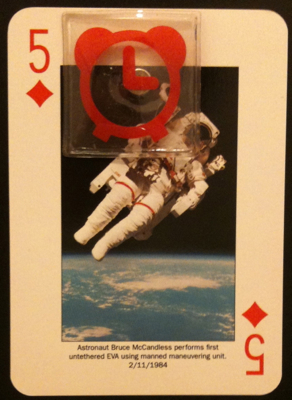
The first few hundred years were okay. I had a lot of thrilling death-defying adventures. I lived the dream.
I got used to my loved ones dying, and got better at meeting new ones, and better at being by myself. Not a problem; before the accident, I’d stayed eight years at a lab full of one- and two-year contractors and students. I stayed there for a while afterwards too, but it seemed silly to chip away at the minutiae when I’d seen how huge and incomprehensible the whole thing was. Even with the amount of time I had, I knew I could never get my head around it.
In any case, the universe would stick around for a while. I wanted to study the things that wouldn’t. I don’t think I realised back then just how little time I had to do that. I always felt like there were so many more people to meet, so much more alone time to savour, so much more to learn, so many more ideas to realise than I had time to, but somewhere in the back of my mind I assumed I could get back to them later. Oh, if only I could.
I travelled the world while there were still means to do so, tried the foods when I could pay for them, smelled the flowers when I found any, learnt the languages, met the people while there still were some. Had a few wives. A few husbands. A few children. Thirty-three thousand, nine hundred and eighty-three known descendants, before I lost count. They all died, of course. I had my alone time to savour.
One by one, then ten by ten, species went extinct. We got used to it. People are good enough at ignoring things as long as they’re still comfortable. Eventually things were stretched too far to be comfortable. After the human race died out, when there was not much left bigger than bacteria, I went through a moody phase. For a millennium I’d be content just wandering around admiring the landscape, watching erosion create interesting patterns. Then I’d occupy myself by carving my own intricately-shaped rivers by hand and swimming back and forth along them. I learnt to shape them in such a way that oxbow lakes would form naturally to complete my designs. Next thing I knew, I’d be in a ten-thousand-year blue period, craving someone to hold, barely noticing as the mountains grew. Those lifelong romances seemed so short.
Sometimes the despair would give way to industriousness. I tried to work out a chemistry that would allow complex life to thrive in the changed environment. I tried to evolve something from lichen using as sole selection criterion ‘something I can talk to.’ Later I changed the goal to something I could enjoy eating. This was rather more successful, maybe because millennia of hunger had made me less picky. Every so often, I’d find little niches where life had figured out how to adapt in ways more ingenious than I’d come up with. I’d sit and watch them for generations upon generations, but nothing complex enough to be worth watching was ever as successful as before.
Time always seems so much shorter when it’s behind you, but in my case, things really did happen more quickly back then. Two-year contracts, 80-year relationships, ten-thousand-year bad moods, million-year species. When finally something interesting happened, it seemed sudden even though by mortal standards it took a long time. I still remember watching the sun expand and redden like it was yesterday, and I suppose it was yesterday, for I wouldn’t define days by that pitiful white dwarf I ended up with.
Boy was it hot when the Sun expanded to near Earth’s orbit. I’d been injured plenty of times, many times enough to kill anyone else, and it hurt a lot. If I was having a bad aeon, there were times when I jumped off cliffs or into volcanoes every day in the hope of dying. But the first time I felt the corona of a red giant, I really thought that was the end. A nanosecond of it was worse than all the pain I’d experienced until then. I did not know why my nerves could even feel pain at such magnitude. I just closed my eyes and waited for death to come. I waited what could have been thousands of years, not like the thousands of therapeutically-dull years of river carving, but thousands of slow, slow years in which I felt every moment.
And then… then it was over, but it still felt like a long time looking back. It took me a while to recover emotionally, and the blood-freezing cold didn’t help. The Earth wasn’t engulfed by the Sun, but just continued orbiting the cool, withdrawn white dwarf. The atmosphere and liquids were lost to space. I didn’t miss breathing as much as I missed eating and speaking; the urge to breathe comes more from the buildup of carbon dioxide than from the lack of oxygen, and I had none of that. There wasn’t any life I could see, but from what I’d already seen, I was sure some had survived somewhere under the surface. Sometimes I’d dig down and have imagined conversations with bacteria I couldn’t detect.
The next life-changing event came when the Earth was knocked out of its orbit. A few chunks came off it, and I had less gravity and some fragments to look at in the sky for a while. I took to jumping around the world, pretending to fly. A couple of destructive meteorites later and I accidentally reached escape velocity. Goodbye, cool world.
There was no such thing as a year for me after that, but it may as well have been ten billion years ago. I haven’t come close to any planets since. I’ve passed through a few stars, and I can tell you it doesn’t get any easier. Spent some time squished inside a black hole waiting for the Hawking radiation to free me. I took little comfort in knowing it was quicker for me than for anything on the outside.
Between stars, with no air or plasma rushing past my skin, no sound, almost no light to prove my fantasies wrong, I could construct worlds in my head that felt more real than anything else. I’d forget I was lost in outer space with nothing to look forward to but that moment of beautiful views and relief from cold that preceded an epoch of burning inside a star.
A frequent dream is that of finding the genie again, the god, that creature I had conversed with through that little tear we’d made in spacetime. Back in the old days, even before feeling the hellfire of a red giant Sun, I used to wish I’d asked to be impervious to pain as well as immortal, but now my only wish is mortality. And once again, I feel like time’s running out. The universe is expanding away from me. If I don’t find a way to summon the genie before the last matter retreats over the de Sitter horizon, I will be stuck with nothing but the taste of my mouth and the feeling of my cold, hungry body, for infinitely more time than I had anything else.
Five of Spades: Options
Posted by Angela Brett in Cadbury Heritage Collection, CERN, Fische, Hunde der Welt, Johnny English, Katzen der Welt, Kennedy Space Center, Lingo Pix, Models, NASA 50 Years, Scenic New Zealand, Space Shuttle, Things To Listen To, Wasservögel, Writing Cards and Letters on April 8, 2012
Note: This is a song-like thing. Here is an mp3 of my Mac singing it to approximately the right tune, just so you can get the same tune in your head that I had in mine when I wrote it.
Feel free to make your own recording of it with human vocals and actual music if you wish. I make no claim of being musical, and I probably accidentally copied the tune from something. Sosumi.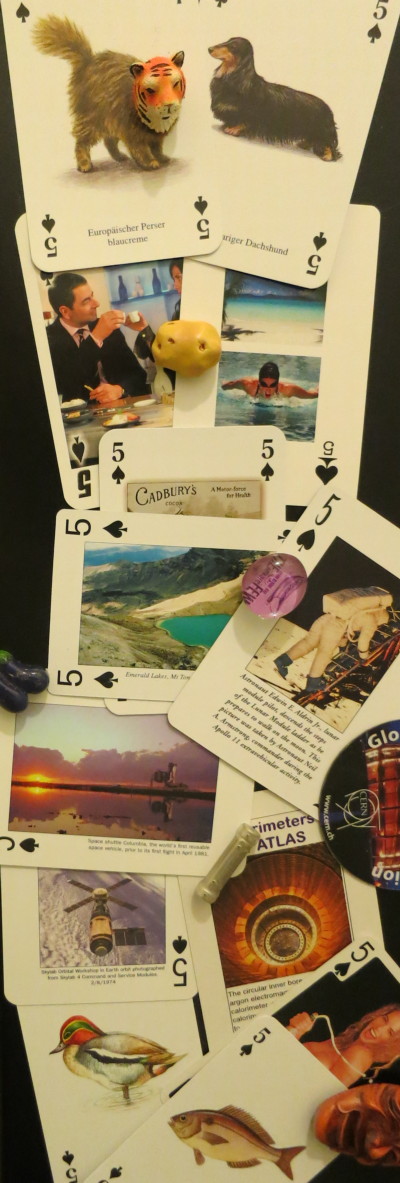
If I can’t have this, then I’ll have that
If I can’t have a dog, I’ll have a cat
If I don’t like today there’s always tomorrow
If I can’t be Superman, I’m Bizarro
If I can’t have coffee I’ll have tea
If I can’t have a pool I’ll have the sea
If I can’t have chocolate, I’ll have cakes
If I can’t have cities, I’ll have lakes
But if I can’t have you there are no good fakes
So I’ll be very sad.
Well you can’t always get what you think that you want
But you can get something that’s just as nice
It is not very likely the thing that you crave
Will be the only thing that will suffice
If I can’t have Mars I’ll take the moon
If I can’t be first I’ll be there soon
If I can’t have shuttles, I’ll have Soyuz
If I can’t fly from you I’ll fly for youse
If I can’t have Skylab I’ll have Mir
If I can’t leave Earth then I’ll stay here
If there’s no zigazig I want all your base
If there’s no E.T. I’ll take the human race
But if I can’t have you there’s an empty space
And I’ll be very sad.
Well you can’t always get what you think that you want
But you can always want what you’ve got
It is not very likely the thing that you crave
Will be the only thing to hit the spot
If I can’t have ATLAS there’s CMS
If I can’t find the Higgs I’ll make another guess
If I can’t prove that, I’ll become a believer
If I can’t go to PAX I won’t be a reaver
If I can’t write songs then I’ll still write Things
and if my voice sounds bad my computer sings
If I can’t have Hexley, I’ll have Tux
If I can’t have a princess, I’ll have ducks
But if I can’t have you then that just sucks
And I’ll be very sad
Well you can’t always get what you think that you want
But you can always rehypothesise
It is not very likely the answer you seek
Is the only one that satisfies
If I can’t have some things I’ll have others
If I can’t have sisters I’ll have brothers
If I can’t have rhythm I’ll have rhyme
If I can’t have space then I’ll have time
If I can’t have proof then I’ll have trust
If I can’t make love then I’ll take lust
If I can’t have lovers, I’ll have nudes
And if I can’t have ladies, I’ll have dudes
But I can’t have you so we’ll have feuds
’cause I am very sad
Well you can’t always get with the person you like
but you can always find someone new
It is not very likely the one that you want
Will be the only one that’s meant for you
Well, they say there are plenty more fish in the sea
Though I don’t think they mean that literally
And while I can’t seem to stop the overfishing
I always can be careful what I’m wishing
‘Cause if I can’t be linked then I’ll be free
If I can’t have you there’s another three
And if I can’t have them then I’ll have me
And you’ll be very sad.
But you can deal with that:
Just find another lad.
Queen of Diamonds: Crossing Over
Posted by Angela Brett in Ireland, Writing Cards and Letters on December 21, 2008
 I look up to the sky in search of you,
to sunlight that you hide your soul above.
You’re on the other side, in heaven’s crown,
in happiness, but I, in longing, weep.
It’s lonely here relying on myself
to hug myself inside and think of you.
I’ll reach the other side and we will meet
Already I am dying for your touch.
The fates are working for us, I’ll be there.
I’m crossing over, sole to interrupt
the festive fuss to mark your change of state.
Around the Stanford torus that’s our world
I’ll take a pleasant stroll to be with you
before we both embark for wedded life.

This work is licensed under a Creative Commons Attribution-Noncommercial-Share Alike 3.0 Unported License.
Please tell me if you do something cool with it.

 Creative Output
.png)