Archive for 2008
Still Alive
Posted by Angela Brett in News, Writing Cards and Letters on November 3, 2008
For those of you who have been refreshing your RSS feeds in a panic, wondering why no Thing has been posted yet, I am still alive. I’ve been following the original Thing-A-Weeker Jonathan Coulton around England for most of the week, with very rare internet access and only a borrowed adaptor to plug my Mac into power (which I have returned to its owner, so I only have about two hours of battery life remaining.) It’s been great fun, I’ve been travelling with several other Jonathan Coulton fans I knew from the internet. Apart from being fun people to hang out with, who have great taste in music, they and my Thing A Week deadline have done a good job of convincing me that I should get an iPhone.
As planned, I got Jonathan Coulton and his opening band Paul and Storm to pick fives of clubs, and promised them to their faces that I would write something about their chosen cards by Sunday midnight. I think perhaps it’s bad luck to do such a thing. I thought I’d have some time on Sunday to write something, but we got waylaid (at Cadbury World) on the way back to London, and I ended up not even being anywhere with internet until 1a.m, and not having time to write anything either. I do have an idea of what I will write, but I’m going to have to do it next week. I suppose I could write something tomorrow on the train, and then write something else next week, but that would only result in two low-quality hurried Things. I think that considering who picked the cards, I really should write something that’s actually good, even if only by my standards.
Jonathan Coulton missed a few weeks of his Thing A Week, so I feel I’m allowed. Though admittedly, he took a week off after the smash hit Code Monkey, whereas I took a week off after a collection of random snippets held together with gluons. But as Jonathan said: I’ll refund a dollar to all you paying subscribers [as Tom Lehrer said: of which I have none]. The rest of you will just get nothing for nothing, which seems fair.
Six of Clubs: Hydrogen Gas
Posted by Angela Brett in CERN, Holland, St James's Gate, Wildflowers of Canada, Writing Cards and Letters on October 27, 2008

Just over twelve hours to write something. I should have started sooner. I’ll start by reading the section on short short stories in Susan Tiberghian’s book, because it’s about time I wrote some prose. She says, ‘A story, be it short or book length, creates a dream in the reader’s mind.’ Can I create a universe in your head in twelve hours? How much of the real universe had been created after twelve hours? It didn’t take much more than seventeen minutes for the newly created protons and neutrons to band together into light nuclei.
Things go a little slower now, but perhaps I can do something similar in the time I have. First, I need some protons to start from. That’s easy. Take three random cards from my pile of sixes of clubs. With any luck, they’ll be different enough that merely finding a link between them will give me an entire story, but not so different that I can’t find a link. Three quarks to form a proton or neutron, two the same, one different.
An ordinary six of clubs. Why do the boring cards always come up when I do this? A close-up of a black spotted cow in Holland. Well, cows eat clovers. Spreading phlox in Canada. Sounds like something made up by Dr. Seuss. Too similar. Do the phlox and clovers vie for the cow’s attention? Can I write an interesting story about a perfectly ordinary cow eating clovers? Susan quotes Eunice Scarfe as saying, ‘If we have lived, we each have a story.’ What is the cow’s story? Perhaps the letter of the week can help me. H, from the Semitic letter ח. According to wikipedia, the form of the letter probably stood for a fence or posts. There are none, in the field where this Dutch cow lived.
Green clovers and phlox
I do not like this spreading phlox,
I would not like it with an ox.
I’d rather risk a mad cowpox,
by joining all the other stocks
and munching on a tasty clover,
but alas I can’t get over,
Thank goodness I’ve a bale of stover,
some for me and some left over.
No, this isn’t going anywhere. I quite like the CERN card this week though: formation of nuclei, or nucleosynthesis: Temperature is low enough to allow protons and neutrons to combine to form nuclei (deuterium, helium, lithium) Conditions similar to interior of stars. It could be an analogy for so many things.
Nuclear Bonds
At first, I was friends with everyone. Any kid who would play with me for five minutes was my friend for five minutes, maybe six. Later on, they tired of bouncing between playmates, and formed more lasting friendships. I flew through them alone, at times kicked here and there by their repulsion, at times accepted temporarily into a more neutral group. Finally I collided with another lone spark, and we bonded.
Not bad, I guess. But I don’t know how long I could continue it. What’s the letter of the week again? Ah… H is for hydrogen, which has the lightest nucleus of all, a single proton, which would have existed even before nucleosynthesis started. What can I say about hydrogen? I may not have much of a story, but I have the best title ever.
Big Bang Nucleosynaesthesia
Hydrogen’s green,
Helium too.
I didn’t know how,
but somehow I knew.I used to think hydrogen was green. The letter H was as green as they come, and I didn’t know where else I would have got that association from.
My family had several old cars, often referred to as ‘old bombs’. One was exactly the colour of H, and I was burning to make a joke about it being an H-bomb. I always stopped just short of saying anything, because I couldn’t figure out what made H green. Was hydrogen green? It ought to be. Eventually, the frustration of not being able to tell this joke got to me, and I asked my dad whether hydrogen was green. It wasn’t.
Some time later, I gathered the courage to ask him whether the letter H was green. I don’t remember what colour he said it was, but it was not green. He said that perhaps the colours we associated with numbers and letters came from fridge magnets or alphabet books we had as children. A is for apple, so maybe that’s why it was red. Only, it’s more of a pinkish red.
When I was a teenager, I heard about something called synaesthesia, where people could taste colours, see sounds, and all sorts of other weird and wonderful combinations. How strange it must be to see a red apple and taste
a steak and cheese pie. How amazing it must be to see an entire symphony laid out like an intricately knotted carpet. How enlightening it must be to feel a graph tingling on the back of the neck, and linking intuitively with other information like a massage from a well-trained masseuse.Synaesthetes were real-world superheroes, until I found out I was one. A few years ago I read about something called grapheme-colour synaesthesia, which means that people automatically associate letters and numbers with colours. Like all kinds of synaesthesia, it runs in families. Different people have different colours for each letter and number, although ‘A’ is quite frequently reported to be red. It does not seem to depend on the fridge magnets the synaesthetes were exposed to. Nor does it reveal any deep truths about the universe outside my head. On the other hand, people are talking a lot about hydrogen as a green alternative to fossil fuels these days…
Perhaps this idea would just about cut it. Perhaps not. The H fridge magnet which I’ll have to use to illustrate it is an incongruous red. An H in disguise; it took me a while to find.
Sunset. The faintly fading photons remind me that it’s time to fuse all these proto-ideas into the nucleus of a story. Perhaps if I force myself to write them, a link will reveal itself. But they stubbornly stay separate, isolated and inadequate. Perhaps that’s how it should be. Most of the universe today is made of hydrogen, those lone protons which slipped through the nucleosynthesis stage unaffected. I just need to embellish them with electrons, and send them electronically across the globe.
Seven of Clubs: Butterfly Fish
Posted by Angela Brett in Fische, Schmetterlinge, Writing Cards and Letters on October 19, 2008
 A flutter of butterflies flies,
aflutter in sumptuous skies
dancing between rise and fall
forming a quivering rainbow. Still,
nothing in comparison:
With the group, a fish
denies its uniqueness,
flying naturally above the waves.
One being, tracing a humble miracle
across the eclipsed kaleidoscope.
Through the rippling looking glass,
searching for a home,
a school of fish flits fleetly,
fostering a misplaced wish:
One butterfly amongst them all
is lost, a great frenzied flutter
in water makes no difference.
To the others it is much easier
to follow the flow
through the ocean. They pass
through the rippling looking glass,
searching for a home.
A school of fish flits fleetly,
fostering a misplaced wish:
Nothing in comparison
with the group, a fish
in water, makes no difference
to the others. It is much easier
to follow the flow.
Through the ocean they pass.
A flutter of butterflies flies,
aflutter in sumptuous skies.
dancing between rise and fall
forming a quivering rainbow still.
One butterfly amongst them all
is lost. A great frenzied flutter
denies its uniqueness,
flying naturally above the waves,
one being, tracing a humble miracle
across the eclipsed kaleidoscope.
Eight of Clubs: A Match Made in Heaven
Posted by Angela Brett in Intriguing Development, Writing Cards and Letters on October 12, 2008
 Come have a char with me, my dear,
Let’s turn the night to day
Swing with me from the chandelier,
I’ll have my wicked way.
It will be quite a scandal
if the two of us attach
for I am but a candle,
and you’re the perfect match.
But if I’m panegyrical,
then all I say is true.
I can’t help waxing lyrical,
can’t hold myself to you.
You lit my life up when you came.
I’m burning with desire.
But you’re still hot for your old flame
that flickers in the fire.
You’re blinded by your hearth of stone
to pain that you inflict.
I’m ditched, to gutter all alone;
there’s no peace for the wicked.
But noone said that life was fair
the winds of fate blow free;
if love and cold are in the air
then you’ll go out with me.
Nine of Clubs: Grand Unification
Posted by Angela Brett in CERN, Writing Cards and Letters on October 5, 2008
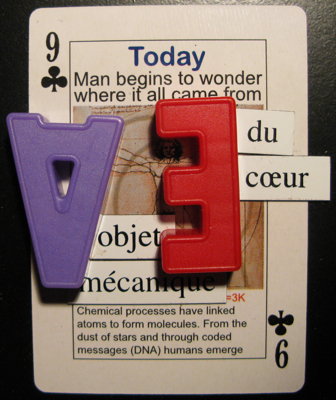 Note: I wrote this with the tune and sentiment of Tom Smith‘s A Boy and his Frog (mp3) in my head. If you know the tune, please imagine that this poem is sung to the same tune as whichever verses it fits.
You might think that we’re just doing science
With a hadron collider so large.
But we’ve built this electric alliance
to give weight to our positive charge.
Take researchers from every nation,
Let the humans within them collide.
We will find the grand unification
when we see we’re all on the same side.
And with ev’ry race, tongue and religion
we’ll find how to give all the world mass.
If we’d all interact just a smidgen
with the openness through which we pass
we’d see life’s ups and downs become charming and strange,
when we face them head on, and what’s more,
seeking beauty and truth we can make a big change
with small change from the purses of war.
Take the light at the end of the tunnel,
and ensure it goes all the way round,
to illuminate more than the sun’ll,
and enlighten with what we have found:
When you’ve unresolved matters, and not enough kin,
and face too many forces to name,
if you cut out the din, and put energy in,
it turns out that we’re all just the same.
Ten of Clubs: Still Point Five
Posted by Angela Brett in CERN, Writing Cards and Letters on September 28, 2008
 This is to be sung to the tune of ‘Still Alive‘ by Jonathan Coulton. I will post a recording, and probably a video, some time in the next few days.
This isn’t TRIUMF
We’re sending a beam through CMS.
Can’t wait to see some novel interactions.
Popular Science
will call up their troubadour(k)y man
To sing in praise of all of us
and he’ll sound better than this.
But there’s no sense cheering over every beam
they’ll just keep appearing till you have an umpteen
when the celebration’s done,
do your calibration run.
Tell the crackpots they’re all still alive.
We’re not yet colliding.
But soon we’ll be lighting up the barrel
with 14 TeV of former protons
We’ll smash them to pieces
and slam every piece into a wire
except the LSP because
it will go all the way through.
Now our points of data come from crystals of lead tungstate,
and we’re out of beta we’re releasing a few years late
but the science gets done,
and more funding will come
now you’ve seen that you’re all still alive.
We’ll find the Higgs boson.
We’ll find that the answer’s forty-two.
Maybe we can even find the question.
We’ll blow up the planet.
That was a joke. ha ha, fat chance.
Anyway, this spaceplane’s great,
let’s try to make it collide.
Look at me still talking when there’s science to do
when I look up there I think I see a mu-mu.
But we need to repair
see you in the new year,
In the meantime the DAQ’s still online.
And believe me we are still online.
We’re taking cosmics and we’re still online
And when there’s beam we will be still online
And ISOLDE will be still online
Because those show-offs had beam all the time.
All the time
still online
Hearts Word Cloud
Posted by Angela Brett in Wordle on September 28, 2008
Here is the Wordle word cloud for the hearts:
 I forgot to post it earlier. I’ve made a new ‘Wordle’ category so you can easily get to the previous word cloud.
There will be a Thing coming up in just under an hour. It’s already finished, but I’m hoping to finish the multimedia extravaganza that goes with it before midnight. I don’t think I will, but I’m going to try to at least give you a taste of it, because it’s the part I’ve spend the most time on, and frankly, the main thing that will make this Thing cool. Look at me still typing when there’s multimedia extravaganzing to do…
Valet of Clubs: Discours inférieur
Posted by Angela Brett in Lyon, Writing Cards and Letters on September 21, 2008
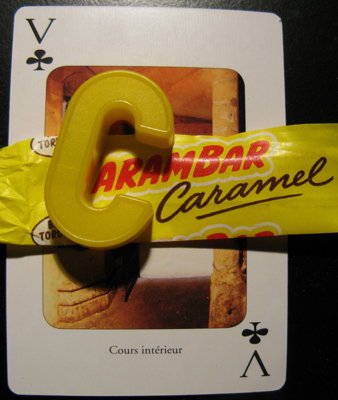 I find the words to make a distant friend,
and check them twenty times before I send,
an error-checking code in every byte.
We find a space in meatspace we can meet.
I shuffle past and only see my feet,
for you I know by words and not by sight.
I linger and pretend that I’m not there,
you find me in the end but I’ll not dare
to speak the words I only know to write.
No sooner are they loud enough to hear,
I go back in my shell for one more year.
We meet again, I recognise your face
but still can’t find the words to match your pace.
They’re crushed in scattered pauses far too tight.
I watch your wordfights, watch you shoot the breeze
I savour each riposte at each reprise
but when they’re aimed at me I flee in fright.
But battles one by one’ll turn to chances,
I creep along the tunnel by advances
And start to see a distant shaft of light
but with the light I see my train appear,
and go back to my home for one more year.
When next we meet I’m not so far behind,
I speak whenever something comes to mind,
I know your mouth just speaks, it doesn’t bite.
I speak before I’ve checked it twenty times
I post before I’ve found some better rhymes,
It doesn’t matter if it isn’t right.
For ten mistakes I say a dozen things,
so why not flap my tongue and flap my wings?
I take the plunge and try to take a flight,
and whack into a wall. It’s very clear
I’ll still be in this cage for one more year.
Queen of Clubs: A History of the Large Hadron Collider, part I: Conception
Posted by Angela Brett in CERN, Writing Cards and Letters on September 15, 2008
 Between March 21 and 27, 1984, theorists, experimentalists, accelerator physicists, and experts in superconducting magnets gathered for a workshop in Lausanne and Geneva. They were not there to discuss the Large Electron Positron collider, for which excavation of a 27km near-circular tunnel would soon begin at CERN, the European Organization for Nuclear Research. They had come to discuss a possible playmate for the LEP, a collider of protons and perhaps antiprotons to be installed alongside the LEP in the same tunnel. Some nicknamed it the Juratron, after the Jura mountains under which part of it would pass. Officially, it was known as the Large Hadron Collider, or LHC.
The LHC would accelerate protons to an energy of up to 9 TeV, more than nine million times the energy of a proton at rest. To keep such high energy particles on course in a ring as small as the LEP, the LHC would need superconducting magnets with a magnetic field of 10 Tesla, about 2000 times the strength of a refrigerator magnet (pictured.) The superconductor technology available at the time could theoretically be extended to create magnetic fields of up to 6 or 7 Tesla, but substantial new developments would be necessary to reach the required 10 Tesla.
Carlo Rubbia concluded the workshop with the statement, “Perhaps the time has come for us to pause, at least until the magnet, accelerator, and detector issues have made some significant progress.” There would be no playmate for LEP just yet, but it would come.
The LEP tunnel was made big enough to fit two accelerators. By the end of 1986, only half a kilometre of it remained to be dug. A preliminary technical study on the possibility of building the LHC on top of the LEP was carried out, and it seemed like a better deal than the alternative proposition of a 1 TeV linear electron-positron collider. With the LHC and LEP together, electron-positron collisions, electron-proton and proton-proton collisions would all be possible, with protons injected by CERN’s existing proton accelerators. Nobody had managed to make strong enough superconducting magnets yet, but there was optimism that it was possible.
In 1987, the first LEP magnet was installed in the newly-completed tunnel, and the first model of an LHC dipole magnet was made. To save space and money, the two opposing proton beams would pass through separate channels within the same magnet. Studies were underway of the possibilty of using either niobium-titanium or niobium-tin for the magnets, or perhaps the recently developed ‘high temperature’ superconductors. The next year, a niobium-titanium superconducting magnet was made which could provide a magnetic field of more than 9 Tesla. It was hoped that the LHC would be able to reach an energy comparable to the 20 TeV of the Superconducting Super Collider being built in Texas.
In the early afternoon of Bastille day 1989, physicists were jublilant to see the evidence of the first beam of positrons sent around the LEP: an unassuming white oval on a blue screen. But for all the eyes fixed on the LEP, more than ever were looking forward to its companion, the LHC.
Many studies were carried out on the feasibility of the superconducting magnets, cryogenics, and civil engineering that would be required. All confirmed that such a machine could indeed be constructed. Two models of LHC dipole magnets in niobium titanium, and one in niobium-tin, both produced fields of around 9.4 Tesla. A cost estimation and construction schedule for the LHC were established: it could be put into service by 1998, while only slightly disturbing the functioning of the LEP.
In 1990, more detailed plans of the LHC were prepared, and delegates from CERN member states proposed the idea to their respective states, expecting a decision by 1992. A timely decision would mean that the LHC could start operations in 1998, as predicted, for a cost comparable to that of the LEP. With 9 metre magnets creating a field of 10 Tesla, it would collide two beams of protons with an energy of up to 7.7 TeV each. Four prototype 1 metre long 10 Tesla dipole magnets were ordered from four different companies. A life-sized prototype was constructed, with a field strength of 7.5 Tesla.
On 20 December, 1991, the CERN council unanimously approved the LHC project. By that time, thousands of hours of on supercomputers had been spent simulating the interactions that would occur in the LHC. The council asked that all technical and financial details be worked out by 1993.
Preparations picked up momentum in 1992. A conference in March on the LHC attracted 600 scientists. In October, the LHC Experiments Committee received letters of intent for three possible LHC experiments: ATLAS (A Toroidal LHC Apparatus), CMS (Compact Muon Solenoid) and L3P (Lepton and Photon Precision Physics.)
Although the required 10 Tesla field had already been achieved, it was considered too difficult to maintain. Therefore the decision was taken to elongate the dipole magnets to 13.5 metres by deplacing other elements. This would increase the time that the protons were exposed to the field, lowering the necessary field strength to 9.5 Tesla.
In 1993, two of the proposed experiments, CMS and ATLAS were approved, along with a new proposition, ALICE (A Large Ion Collider Experiment.) In December 1993, exactly two years after the council’s approval of the LHC, the requested information was presented. Construction could soon begin.
King of Clubs: Not TOP
Posted by Angela Brett in CERN, Writing Cards and Letters on September 7, 2008
Sorry, I didn’t get time to write a Thing this week, because I was secretly somehow involved in the anonymous collaboration which created this video, a song based on Don’t Stop by Sarah Bettens with assorted advice for people working at CERN. Luckily, it features a king of clubs, so guess what… since I’m past the middle of the project, I’m counting down from kings to aces from now on.
You can download the video in Quicktime format, an mp3 of the song, the slideshow used to make the video, and the lyrics here.
So now you know why I was taking photos of a rubber duck back in April. I took the photo of it with the king of clubs, in the hope that it would earn me a week off.
-
You are currently browsing the archives for the year 2008

This work is licensed under a Creative Commons Attribution-Noncommercial-Share Alike 3.0 Unported License.
Please tell me if you do something cool with it.

 Creative Output