Archive for category Writing Cards and Letters
Six of Clubs: Birthday Monduckenen-duckenen
Posted by Angela Brett in Bäume, Writing Cards and Letters on December 21, 2012
First, check out Vi Hart‘s video about the Thanksgiving turduckenen-duckenen:
Now have a look at Mike Phirman‘s song, Chicken Monkey Duck:
Okay, there are monkeys instead of turkeys, and the mathematics isn’t quite as explicit, but it’s pretty similar, don’t you think? Now, let’s imagine that Mike Phirman is actually singing the recipe for a fractal turducken, or rather, monducken. You can imagine all the monkeys are turkeys if you’d rather eat the result than present it to some pretty thing to please them. (Note: Please do not kill any actual monkeys.) Monkeys, like birds, belong in trees, so I wrote an AppleScript to draw binary trees in OmniGraffle based on the text of the song. You can try it for yourself if you like; all you need is a Mac, OmniGraffle, and a text file containing some words. See the bottom of this post for links and instructions.
If Mike’s reading the binary tree recipe layer by layer, like the first example in Vi’s video, one possible tree for the first stanza of Chicken Monkey Duck looks like this, where the orange ovals are monkeys, blue hexagons are chickens and green clouds are ducks. You can click it (or any other diagram in this post) for a scalable pdf version where you can read the words:

I added numbers so you can easily tell the chickens, monkeys and ducks apart and see which way to read the tree. It’s simple enough now, but the numbers will be useful for reading later trees which are not in such a natural reading order. This is called a breadth-first traversal of the tree, in case you’re interested. Now, what do birds and monkeys do in trees? They nest! So I wrote another script that will take any tree-like diagram in OmniGraffle and draw what it would look like if the birds, monkeys, or whatever objects they happen to be (the drawing is pretty abstract) were nested inside each other, just like the quails inside the chickens inside the ducks inside the turkey. This is what the monducken described by the first stanza of Chicken Monkey Duck, in the tree structure shown above, would look like:

The Monducken script allows using a different shape for each animal as redundant coding for colourblind people, even though it already chooses colours which most colourblind people should be able to distinguish. But that makes the nested version look a little messy, so here’s the above diagram using only ovals:
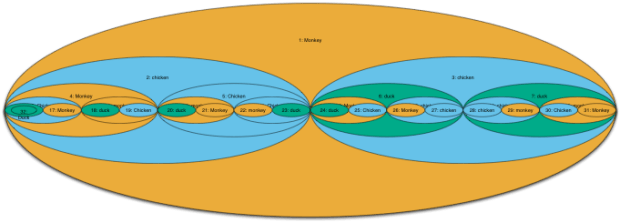
If you named this particular recipe in the other way, going down the left side of the tree and then reading each branch in turn in what is known as a pre-order traversal, it would be called a Monenmonenduckduckmon-monmonducken-enenmonduckmon-enmonduck-enduckmonducken-enmonen-duckenenmon-monenmon. It doesn’t sound nearly as nice as Turduckenailailenailail-duckenailailenailail because Mike Phirman didn’t take care to always put smaller animals inside large ones. I’m not holding that against him, because he didn’t realise he was writing a recipe, and besides, it’s his birthday. For reasons I’m not sure I can adequately explain, it’s always his birthday.
But what if I completely misunderstood the song, and his recipe is already describing the fractal monducken as a pre-order traversal, always singing a bird or monkey immediately before the birds and monkeys inside it? Well, don’t worry, I added a ‘pre-order’ option to the script, so you can see what that would look like. Here’s the tree:

and here’s how the actual birds/monkeys would look if you cut them in some way that showed all the animals, dyed them the correct colours, and looked through something blurry (here’s the version with different shapes):

Okay, but that’s only the first stanza. What if we use the whole song? If we pretend the recipe is breadth-first, this just means all the extra monkeys and birds will be at the bottom levels of the tree, so the outer few layers of our monducken will be the same, but they’ll have a whole lot of other things inside them:


Here’s a close-up. Isn’t it beautiful?

If the entire song were treated as a pre-order monducken recipe, we’d still have the same monkey on the outside, but the rest would be quite different:

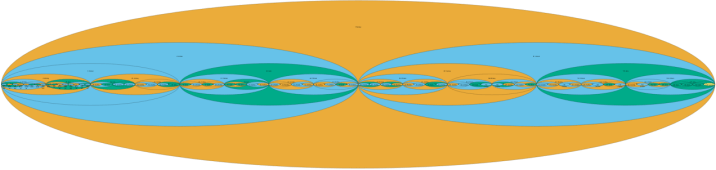
We could also read the birds and monkeys from left to right, as Vi did in her video. That’s what’s called an in-order tree traversal. But as delicious as they are mathematically, none of these orderings make much sense from a culinary perspective. Even if the monkeys were turkeys, it’s obvious that a nice big goose should be the outer bird. Vi suggested that herself. Of course, we could put the goose on the outside simply by reversing the song so it started with goose. But it would be much more fun and practical to pretend that Mike is naming the two inner birds before the one that contains them. This is called a post-order traversal, because you name the containing bird after the two birds or monkeys it will contain. It makes sense for a recipe. First you prepare a monkey (or turkey) and a chicken, then you immediately prepare a chicken and put them into it. You don’t have your workspace taken up with a whole lot of deboned birds you’re not ready to put anything into yet. Here’s one way the recipe could be done:

Note that no matter what kind of traversal we use, there are actually several ways the recipe could be interpreted. If Mike says ‘monkey chicken chicken’ you know you should take a monkey and a chicken and put them in a chicken. But if the next words are ‘monkey chicken’, do you take that stuffed chicken and a monkey and put them inside a chicken? Do you debone the monkey and the chicken and wait for the next bird to find out what to put them into? What if there’s no next bird? What if there’s only one more bird (let’s say a duck) and you end up with a stuffed chicken, a stuffed duck, and nothing to stuff them into? You’d have to throw one of them out, because obviously your oven only has room for one monducken. Assuming you want two things in each thing, and you don’t know how long the song’s going to be, the best way to minimise this kind of problem is to always take your latest stuffed thing and the next, unstuffed thing, and put them inside the thing after that. The worst that’ll happen is you’ll have to throw out one unstuffed bird or monkey. But then you end up with a really unbalanced monducken, with a whole lot of layers in one part and lonely debonely birdies floating around in the rest.
It helps to have a robot chef on hand to figure out how many full layers of monducken you can make without it being too asymmetric. Mine makes the trees completely balanced as deeply as possible, and then does whatever was easiest to program with the remaining birds and monkeys. In this case it was easiest for my program to stuff a whole lot of extra animals into that one monkey on the left. This is what it looks like, with the varied shapes this time. Luckily, geese are rectangular, so they fill your oven quite efficiently:
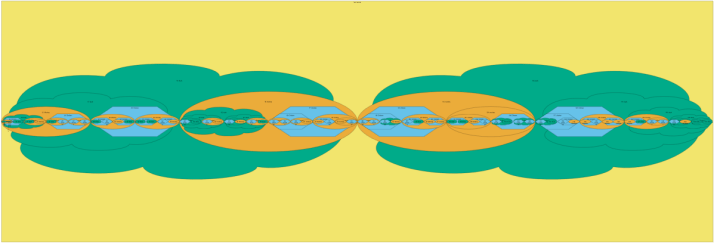
I like how you can see the explosion of duck radiating out from the inner left, engulfing all the other birds and monkeys before itself being swallowed by a goose. Such is life.
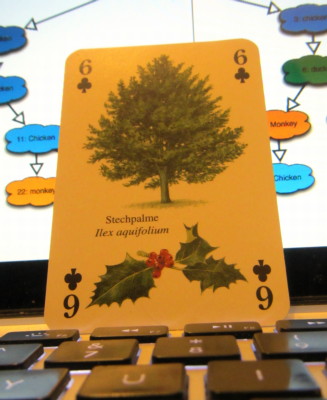 If you would like to make diagrams like this yourself, there are two AppleScripts you can use. Both of them require OmniGraffle 5 for Mac, and if you want to make trees with more than 20 nodes you’ll probably need to register OmniGraffle.
The first is Monducken diagrammer, which you can download either as a standalone application (best if you don’t know what AppleScript is) or source code (if you want to tweak and critique my algorithms, or change it to use OmniGraffle Professional 5 instead of OmniGraffle 5.) Because it’s AppleScript, it works by telling other applications what to do, rather than doing things itself. So when you run it, TextEdit will ask you to open the text file you want to turn into a tree. Once you’ve opened one, OmniGraffle will start up (you may need to create a new document if it’s just started up) and ask you two things. First it will ask what kind of tree traversal the text file represents. Then it will ask you what kinds of shapes you want to use in your tree. You can select several shapes using the shift and command keys, just as you would for selecting multiple of just about anything on your Mac. Then you can sit back and watch as it creates some shapes and turns them into a tree.
The other one is Tree nester (standalone application/source code) You should have an OmniGraffle document open with a tree-like diagram in it (I suggest a tree generated using Monducken diagrammer; it has not been tested on anything else, and will probably just duplicate most of the shapes that aren’t trees or end up in an infinite loop if there’s a loopy tree) before you run this. It won’t ask any questions; it’ll just create a new layer in the front OmniGraffle document and draw nested versions of any trees into that layer.
If you’re looking at the source code, please bear in mind that I wrote most of this while on a train to Cologne last weekend, based on some code I wrote a while ago to draw other silly diagrams, and I really only dabble in AppleScript, and I forgot about the ‘outgoing lines’ and ‘incoming lines’ properties until I’d almost finished, so it probably isn’t the best quality AppleScript code. Not the worst either though. I welcome any tips.
Five of Clubs: Marmites
Posted by Angela Brett in Culture, Vasa Museet, Writing Cards and Letters on December 9, 2012
This weekend Geneva celebrates the Fête de l’Escalade, so I made a video of the piece I wrote about various things called marmites, their nutritional value, use in soup cooking, and effectiveness against invading Savoyards. It’s been adapted slightly to work on video, and includes some destruction, a dangerous stunt, and a slight tilt I didn’t have time to correct.

I read this at the Geneva Writers’ Group on Saturday, using all the same props, and the Marmite was smashed in a way probably closer to the tradition than all the other Marmite-smashings I’ve induced. It’s the last one in the video. I am not sure how many people tried the various yeast spreads, but several told me of their preexisting preferences.
Four of Clubs: On Hospitals and Reality
Posted by Angela Brett in Lingo Pix, Writing Cards and Letters on December 7, 2012
I felt like reading this one aloud. In retrospect, I should have taken the trouble to memorise it and set up a proper camera rather than recording it with a webcam while reading it from a screen. The story I refer to, which I did not actually reread before writing this, is after the break.

When I was a teenager I wrote a story about my experience staying in Starship Children’s hospital for a while, and presented it to a writing class. I mentioned that I was somewhat glad, after several weeks there, to get back to the real world.
“But surely you can’t get much more real than a hospital,” a middle-aged woman in the class responded.
This puzzled me at the time, but I think I understand now. Reality is pain, and sickness, and IV drips, and wheelchairs, and bed pans, and rarely going outside, and machines that beep all night, and parades of doctors taking turns prodding and asking if it hurts, and teenagers who know they will not live to adulthood, and healing, and nurses at your beck and call, and surprisingly good food delivered to you in bed, and visitors that bring better food to overcompensate, and a play specialist who comes by regularly to play with you, and a games cart that comes by less often with new games, and glass lifts facing the atrium that have a view of the playground and all seven different-coloured storeys, and an in-house movie channel that shows mostly The Lion King, by request, and an in-house radio station that plays mostly Mysterious Girl and Wonderwall, also by request.
Anything else you think you experience is merely the product of your deranged imagination.
Let’s pretend this is the three of clubs: JoCo Day
Posted by Angela Brett in CERN, Writing Cards and Letters on December 2, 2012
 This is a collaboration by many fans on Jonathan Coulton’s forums to celebrate Jonathan’s birthday, and it would have been nothing but an idea without everyone else, but I think I put enough effort into it (lyrics based on Pizza Day, video editing, and even singing) to count it as a card towards this Writing Cards project. It happens to feature the Jack of Spades, but I’ve already done two of those, so how about calling it a grand unification of JoCo fans. It’s the continuation of a tradition that started in 2009; I recommend watching the previous videos if you like this one. He seemed to like it.
This afternoon I might already record a video of what will probably be the four of clubs, a very short piece I wrote in the middle of the night which I feel like reading aloud. Then I’ll have brought my average back up toward one a week.
Two of Clubs: The Last Generation
Posted by Angela Brett in Kennedy Space Center, Pirates, Writing Cards and Letters on November 30, 2012
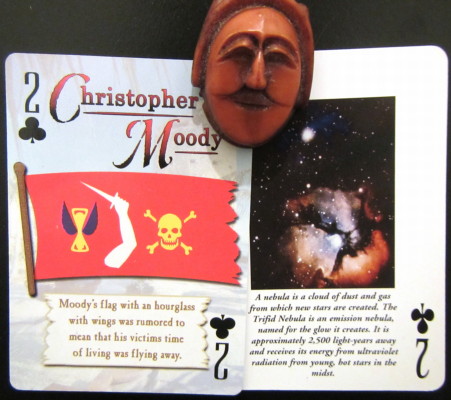
Mildred Feldnether was on her way to take birth for the twenty-eighth time when she found the creature. She heard it first; a call that didn’t belong to any animal she’d heard in the forest before. The sound came from a bundle of clothes behind a tree just off the track. She squatted and gingerly pulled away some of the fabric to reveal a red, bloody thing. She didn’t immediately recognise it as a human baby; it had been more than a millennium since she’d seen one.
“Hello,” she said to it. “What’s your name?”
It wailed.
“What’s wrong?” she asked, first in the most popular local language and then in several others she knew.
The baby continued to wail. Mildred’s foetus kicked her from the inside.
“Where are you from? Where do you work? Are you lost?”
At the last question, Mildred noticed that the baby didn’t seem to have a navigator. She took out hers and showed it to the baby, who stopped wailing and gurgled at it.
Mildred sighed with relief. It was just lost. Soon it would get on its way. She said goodbye and continued walking to the extraction clinic.
It wailed again.
Mildred turned back towards it. “What do you want?” It seemed so upset. Most of it was still wrapped in a sweater, and Mildred suddenly wondered whether babies even had arms and legs like normal people.
Her sister had had a baby once. Or maybe her sister had been a baby. Or had she just heard a legend about a baby? It was so long ago.
She sat next to the baby and tried to remember other languages to speak to it in. She remembered how frustrating it had been when when she was just a few centuries old, and only knew a few languages. She could imagine wanting to wail when she couldn’t express herself. She was frustrated just trying to remember what the thing was called. Baby. Baby. Like in the old fairy tales. She looked it up in the encyclopaedia:
A baby is a juvenile form of human, commonly created in the pre-extraction era as a means to perpetuate the human species when it was possible that existing individuals may succumb to death (q.v.) In modern times, a baby may develop from a foetus whose life is not fully extracted after removal. This is effectively remedied by further extraction.
From a foetus? Mildred burst out laughing. Foetuses grew inside people. This thing was outside and it looked like a little human that could only speak wail. Somebody must have vandalised the entry. The baby ceased crying and seemed to look at Mildred. Mildred watched it, enchanted. It was hard to believe it really existed.
The forest they were in was even older than Mildred, and offered a secluded path to the clinic, where those unable to carry foetuses wouldn’t plead with the pregnant women for a share of the life within them. They weren’t needy, just lazy; less than a year’s work as a manservant protecting a pregnant woman and they’d have decades more life. Mildred had already made a contract with her friend and three-time manservant James, who had made sure she stayed safe and healthy and didn’t need any infusions of life which could delay or destroy the pregnancy. Four decades for her, four for him, and the rest to the clinic for miscellaneous healing. She always preferred to make the last walk to the clinic alone though, so that she wouldn’t have to explain the knot in her throat that she didn’t understand herself. Most women were excited at the prospect of becoming four decades younger. Mildred was nervous. With the crying baby tugging at it, the knot in her throat unraveled into tears.
Just then, James called her. “We’re waiting for you at the clinic. Are you on your way? Do you need me to help you with anything?”
“I’m fine, I just… I found something. But I’ll be right there.”
The baby started to wail again. “Right,” she said to it. “I don’t know what’s wrong with you, but if you’re sick maybe half a decade could fix you. Unless you’re already too young for that. Well, the clinicians should know the right dosage.” By this time she was almost certain the baby could not understand her, but it was hard to get used to.
The baby had freed a hand from its cocoon, so Mildred took it to lead it to the clinic. The baby gripped her finger, but didn’t get up. Mildred looked at its face for a second. So tiny. So new. Too new even to walk?
Mildred felt uncomfortable carrying someone she barely knew, but there didn’t seem to be much choice. She picked up the baby, finding the underside of its wrap to be soaked with dew, and tried to find a way to hold it that was comfortable for both of them. The baby did not stop crying for the rest of the way to the clinic.
“Oh dear,” said the clinician. “A baby?” The other clinicians gathered around to look at the specimen. “Oh, that must have been a disturbing thing to find. Don’t worry, we’ll do the extraction for you. It doesn’t look like you need any decades yourself,” she looked down at Mildred’s pregnant belly, “but if you’d like to donate them to the sick or less fertile, we’ll make sure you get something nice as a thank-you.”
“I’ll take them if you like!” grinned James.
“But… isn’t it like a person? I mean… can you really extract… It’s crying. I think it needs to be healed.”
“We’ll take care of that. It’s just crying because it’s not supposed to be outside the womb.”
Mildred felt a bit like crying again herself. “But is a baby a person?”
“Oh, no. I’m not a specialist in antiquities, but from what I’ve heard it takes decades of round-the-clock treatment before a baby can turn into anything like a normal person, and even then it would be centuries behind in general knowledge; it would be a complete stranger in society.”
“Oh.”
They were silent for a few seconds, then they both started talking at once.
“Let’s get that…” began the clinician.
“Did you have a baby? In the beginning… when you were new?”
“Yes I… think I did. This is my daughter,” she gestured to one of the other clinicians.
“What was it like?”
The clinician’s eyes glazed over for a second. “It was… centuries ago. I don’t know if the things I remember about it are even real. Now let’s get these extractions underway.”
“If you… this sounds ridiculous, I know, but if you… if you removed my foetus without extracting its life, would it be a baby?”
“Yes, but don’t worry, we won’t let that happen. We have strict quality standards here.”
“So babies do come from foetuses? And people come from babies?” Mildred felt a little lightheaded.
The clinician shook her head slowly, as if Mildred were a few decades too senile. “And people need life, and life comes from foetuses, and babies are just primitive remnants from a millennium ago. Don’t you worry about it, love. You’ve found yourself some free decades!”
The baby cried even louder, and Mildred almost wanted the clinician to make it quiet. It was driving her crazy. Crazy enough that in an instant she was running out of the clinic and screaming over the noise, “I found myself a free person!”
“You can’t make a new person!” the clinician shouted after her. “They’ll have no records! They won’t know anyone! There won’t be enough food for them! It probably doesn’t even speak!”
She ran without thinking, without being aware of anything except the wailing coming from the thing in her arms. She only realised what she had done when she found herself twisted on the ground, having turned to protect the baby and her belly when she tripped. Her back hurt and her eyes were wet and the baby’s wrap was still soaked and the baby was still screaming and her mind was a cacophony of new information clanging into memories. Twenty-seven extractions, more than two millennia for her and her manservants, not a year for twenty-seven potential people. But wasn’t it just like eating meat? Some creatures give life to others. Twenty-seven more people would mean less meat for others and less space for the forests and fauna that kept humanity and the rest of the biosphere alive and prosperous. Twenty-seven stunted proto-people who knew nothing and nobody, taking life when they should be giving it. As Mildred’s head started to clear, she began thinking about how to apologise when she went back to the clinic.
As Mildred’s eyes started to dry, she realised a woman was leaning over her. What was her name? Sandra? They’d been good friends a century or so ago, and lost touch. “Milly, are you okay?” Sandra asked.
“Sandy, what are you doing here?”
“Milly, are you okay?” panted James as he arrived. He was getting old, and could do with those decades she owed him. “Sandy?! What are you doing here?”
Just as Mildred realised the wailing had stopped, it started again.
“That’s my sweater! Is that…” Sandra went white. “Is that m…mm” she stopped speaking seemed to be concentrating on not crying. Mildred stroked the baby’s face, momentarily forgetting she was caressing a complete stranger.
“It’s okay, Sandy. Take your time. What happened?”
Sandra took her time. Finally, she managed to cry, “My foetus came out! It was horrible; it hurt so much! It came out by itself, out my vagina; there must be something wrong with me. It hurt so much. I never want to take birth again; I’ll just take a manservant contract whenever I need more life.”
“That’s your baby?” said James. Sandra didn’t hear.
“I wasn’t due for extraction yet but I was feeling sore and my manservant’s run off to do some kind of crazy botanical research so I started going to the clinic but then…” She broke into sobs as the baby screamed. “Is it… is it the foetus? How come it’s alive? It wasn’t… I mean I don’t think it… It didn’t move. I thought it was just a foetus. It was horrible and bloody and blue and it had almost like a face on it. I covered it up so nobody would find it.”
“It’s a baby,” sniffed Mildred. “A… a juvenile form of human, often created in pre-extraction times as a means to perpetuate the human species… at the clinic they said it can turn into a person with a few decades of round-the-clock treatment. But it’s a foetus. They can still extract. They want to and it’s kind of… kind of like eating meat…” In the face of Sandra’s tears, Mildred’s own conclusion seemed silly again. How could they extract life from a thing that could become a person?
They were silent for a while. Even the baby quieted down. James leaned against a tree for support and flexed his creaking knees.
“Can I hold it? Does it mind?”
“I don’t know. It seems to mind everything.” Mildred passed the baby to Sandra.
“Milly, I think I’m really sick,” she confided. “First my foetus came out and now there’s yellow stuff coming out of my nipples. Can you take me to the clinic? I know they expect me to give them some life rather than take it, but maybe I could use some from your foetus.”
“Hey, you know half of that foetus is for me, right?” said James. “Nah, you can have a some of my share. Anything to help a fetching fertile lady.”
The foetus kicked, and she realised that the word was not metaphorical; it was kicking with actual legs. “I don’t know if I want it to be extracted today.” Mildred said quietly.
Sandra reached out and held her hand. They were silent, except for the baby.
Suddenly, Mildred thought of something. “What if it’s hungry?”
“I have some bacon sushi,” said James. The soon learnt that the baby could not use chopsticks.
Once again, Mildred checked the encyclopedia for information on babies. “You’re not going to believe what it says about feeding them…”
*
Over the next week, while Sandra and James tried to figure out how and whether to keep the baby alive, and how to keep it quiet, Mildred researched the early history of extraction. Of course there was the ugly time they all commemorated each decade on Death Day, the time when people would kidnap and extract the remaining life out of strangers. It must have been horrible to live in fear of dying. Nine out of ten of them did die. Nine out of ten adults died so that the rest could live longer.
Then perinatal extraction, called today simply extraction, solved everything. More life with no killing, and no fear of accidental breeding creating an infinite number of hungry immortals. The inventor shared the technique with the oldest and newest people he knew, the ones who hadn’t stolen anyone else’s life. They won round extractors with their ethically-sourced life, and soon nobody would extract from an adult, and nobody would give life to those known to have done so. Over the next century, the life thieves died of old age and the rest bred up to the capacity they knew they could sustain without competition for resources, and then ceased with the bother of people-making. Most of this was familiar to Mildred; the well-known story told each decade on Life Day. She’d even seen the inventor of perinatal extraction telling the story in person. Though she’d all but forgotten the meaning of the archaic words such as ‘perinatal’ and ‘breeding’.
It wasn’t quite so pretty, though. As she read older and older memoirs, Mildred discovered that many people had actually protested, saying foetuses were people; some even thought that embryos were people. And some even thought that animals should not be eaten; not just because of the unsustainable farming practices back then, but because animals were also a sort of people. Mildred wondered why nobody thought of things like that any more.
Further into her research, she came across an old journal entry which struck her:
I took my first birth today. I know it isn’t right, but I was getting old, almost too old to be coaxed into fertility, and if I die the foetuses will have nobody to fight for them. Thirty more years should give me the time to fix things. I need to find a way to prevent both death and overpopulation without sacrificing living humans.
That’s what happened to people who thought foetuses were people. They either took life anyway, or they died. She checked the author to see which group this one had ended up in.
Mildred Feldnether
Mildred felt lightheaded at the sight of her own name, and saw the edges of her vision prickle black. Her foetus turned, and so did her stomach. She fought to stay conscious for fear of what people might do to help her.
She’d been one of the people who’d fought to stop perinatal extraction. She’d been one of the people who’d let her survival instinct change her mind. On the backs of those she’d claimed to want to save, she’d lived long enough to forget they existed. And she would forget again.
Unless she fixed things soon.
Mildred switched her attention to learning all she could about the science of life extraction. It came to her easily at first, as if she’d learnt it all before, which she probably had. She felt less familiar with the breakthroughs that led to increased efficiency in more recent centuries. She enrolled in some classes and followed the century-old standard practical experiments involving extraction and infusion in small plants.
One night she was idly dissecting a piece of sushi, picking out the individual grains of rice and twirling the meat between her chopsticks. That meat had been in a pig once. Pigs were probably smarter than babies. She put it aside and ate the rice and seaweed thoughtfully. Just like eating meat…
She jumped up and ran to the bedroom. “Sandy!” she called out loudly before realising that it was past midnight. “Sandy, come here,” she whispered, but the baby was already gearing up to surpass her careless loudness.
“What is it?” Sandra asked groggily, before gasping in horror, “is yours coming out too?”
“No, no, it’s not that! What did you say your manservant went to do?”
“Botany. Some nutso alternative healing thing.”
“Listen, I think he might be onto something. I was thinking, we can live without meat, right? So we can live without foetuses! It’s so obvious!”
“Hey, you didn’t get me out of bed to tell me you’ve gone as crazy as Jezdimir, did you?”
James wandered in holding the screaming baby.
“Look, there are trees out there that’ve lived longer than us, right? What if we could extract life from them? I mean their seedlings? There’d be millennia! They’ve made a lot of improvements in extraction lately. Did you know that even plant extraction was not possible a few centuries ago, and now they teach it in introductory classes? All we’d need to do is figure out how to convert their life to ours, and no more foetus-killing!”
James squinted his reddened eyes and looked down at the noise-maker in his arms. “Are you sure you want more of these around?”
“No, you see that’s the other thing. If anyone gets pregnant by mistake, which, let’s face it, hardly ever happens, they can take enough life, plant life, to make the embryo regress back into nothing. Or wait, maybe that’s bad too, I don’t know. But some of them could make babies. Did you know that fish are edible; they were just banned back when there weren’t enough of them? And that there’s way more of everything now than back at the beginning of extraction? And that you can feed way more people with plants than with meat? The population limits they set back then are way lower than they need to be now. We could have new people!”
“Hey hold on there… is that even possible? What about the new people? They’re not going to know anything,” said James.
“But even at our ages, everyone knows different things,” answered Sandra before Mildred could think of an answer. She pointed at the baby. “He’s the only one who knows what it is to be new in an old world. That’s worth knowing.”
“So we need to contact this, what was his name? Jezdimir? Your manservant, and see if they can help us. I reckon we’re only a few decades away from converting plant life into…”
Mildred stopped and winced as a pain surged through her belly. Sandra stared at her with a terrified look in her eyes. Mildred regained her composure in order not to upset Sandra. “…converting plant life into human. I’ll never have to have another extraction.”
Then she collapsed in agony. James and Sandra practically carried her to the clinic, Sandra holding the baby in her free arm, and James clutching at trees with his.
“Are you back for your extraction, finally? It’s about time,” said the clinician.
“Noo…” moaned Mildred. The clinician laid her on the bed.
“What do you mean no? You clearly need the life,” said James. “I hate to see you like this.”
“No,” said Sandra. “She doesn’t want any more extractions. You’re going to take this foetus out of her and let it become a baby.”
“But she said she didn’t want another extraction. She meant after this one. I’m sure!”
Mildred filled her lungs to protest but the breath hurt so much that she let it out in a moan. Her head felt as bad as the rest of her. For a moment she thought she remembered being a child, watching her mother cry over her brother. But she had no brother.
“No, no, she doesn’t want to take any life! Haven’t you seen her? She’s been obsessed with this idea of foetuses being people.” The baby screamed louder as if to affirm its personhood.
“Well no, I haven’t seen her, because I’ve been trying to keep this thing alive! She doesn’t want one of these!”
“She does. She does. She wants the baby to live.”
“It’s not a baby! Look, she owes me four decades. She owes herself four decades. How could she just let herself die in this day and age? I’d miss her! We all would! And she needs time to finish that plant thing.”
“Sure, but the baby…”
“foetus!”
“…doesn’t owe anyone anything.”
“But you can’t privilege this useless little thing that can’t even eat or speak over someone with a millennium of knowledge and skills and hundreds of people who love her! I know your baby is cute and it brings a fresh perspective and blah blah blah but you can’t have both, and I’m choosing Milly.”
“I love her too! But she doesn’t want to kill babies any more and we have to respect…”
“For goodness’ sake, you’re not killing anything! You’re just extracting the life out of something that isn’t alive yet to begin with!”
“Extracting the what? If it’s not alive, then…”
“Look, your friend’s not doing well. I’m going to need a decision,” urged the clinician, as Mildred slipped into unconsciousness.
∎
Ace of Clubs: The Bravest
Posted by Angela Brett in Kennedy Space Center, The Best of Switzerland, Vienna, Writing Cards and Letters on November 11, 2012
 Whenever, on my personal adventure quest
I come across two paths, I know that I’ll
Inevitably find the biggest treasure chest
along the road that’s scares me wordless, worldless and worthwhile.
Now sometimes I can feel which one’s the bravest way,
like: do I vaunt my head or write my heart?
Outcome, I’m gearing up to tell you this today:
I don’t know which is bravest: leave home, leave job, or restart?
Continue as things are, I’ll have to transfer, flee
the only home I’ve made; time, brain, backbone
gone into now-familiar things that anchor me
weigh anchor, sail away to sunsets, fun fêtes and unknown.
Or change things, follow heroes who have dared to quit,
start new in the surroundings I’ve enjoyed,
arrange things so this country lets me stay a bit
for study? One more contract, endless? Centless? Self-employed?
I’ve hemmed and hawed and ranked and scored and felt and thought and swung my sword, delayed, ignored, gone back and forward, and this is all it’s led me toward:
Whichever path is scary (therefore good)
The bravest cut their own paths through the wood.
King of Diamonds: **** FLASH **** National Treasure Stolen From San Francisco
Posted by Angela Brett in Alcatraz Rules and Regulations, Golden Gate Bridge, Writing Cards and Letters on November 4, 2012
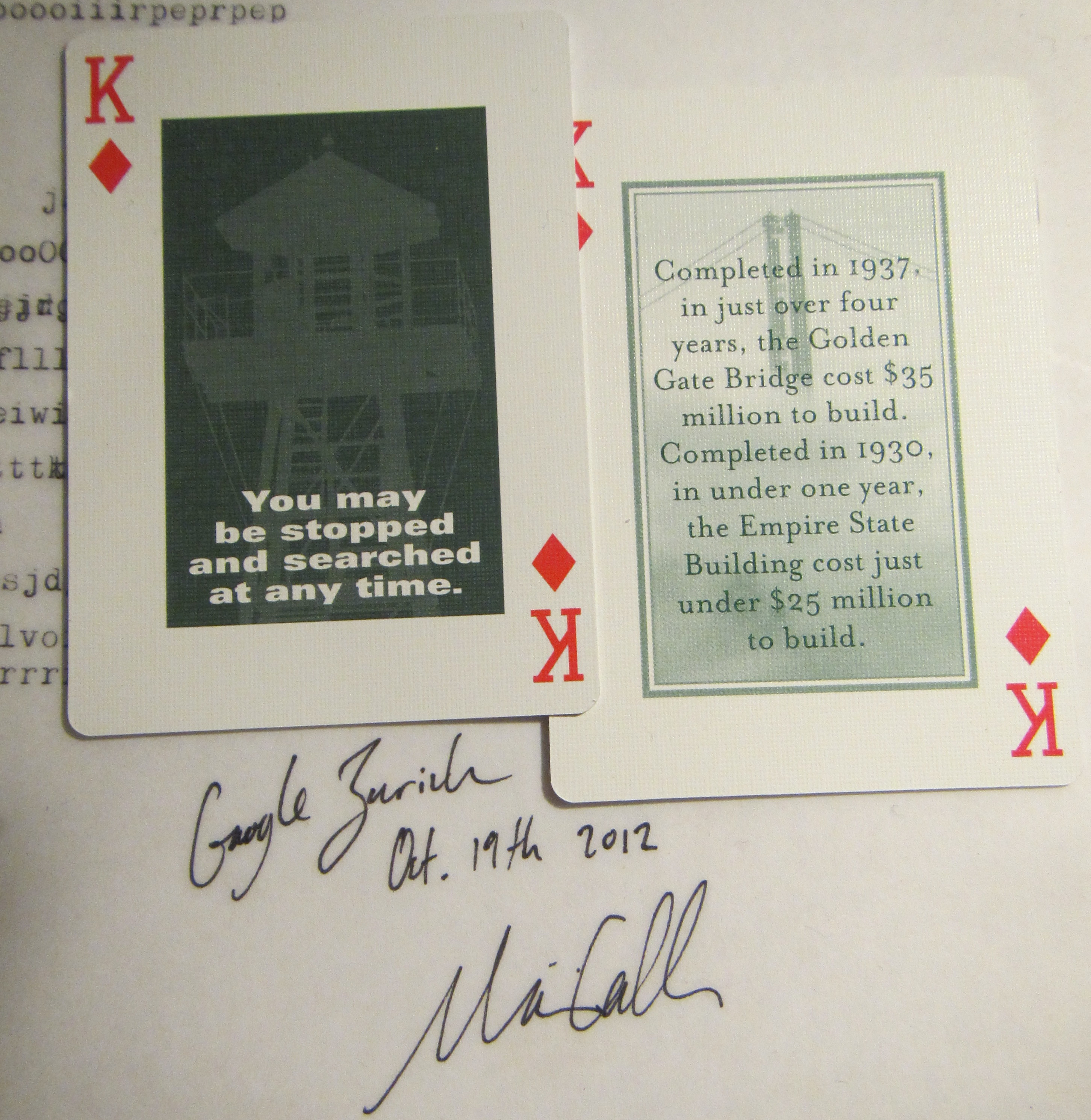
Lady Agatha Wayland fingered her diamond ring nervously. The engraving on it was barely noticeable next to the grapefruit-sized diamond, but never failed to help her: WWBD. What Would Buffy Do?
Buffy would be confident. Buffy wouldn’t act suspicious. Buffy would walk around with her head high despite the weight of the Golden Gate Bridge in a secret compartment in her brassiere. Buffy would not call attention to herself. Carmen “Buffy” Sandiego would ask a perfectly normal question, and fly as if on a perfectly normal holiday.
Agatha walked into the nearest store. “Excuse me, I’m looking for some travel advice.”
“Ma’am, I’m a butcher. I’m afraid I can’t help you with that. Can I interest you in a sirloin steak?”
Agatha touched her ring, and stuck out her chest as if it didn’t weigh 887 000 tons. “I’m planning a taco party. I’ll just take a few pounds of ground beef.” She took the beef and ran out of the shop before her confidence dissolved, not so much forgetting to pay as reverting to an old habit. Okay, new tactic.
She sped away in her Denghby speedster convertible, hoping the butcher wouldn’t call the police over a bit of beef. She tried to think of the least-obvious city to escape to. With any luck, ACME Detective Agency’s headquarters were on the other side of the now-bridgeless Bay, so their super sleuths would take some time to get to her, but she still had to get out of San Francisco quickly.
What would Buffy do? She’d get rid of the loot, that’s what she’d do. Agatha tried to think of places with bays or rivers in need of bridges. Hudson Bay had already been stolen by Fast Eddie B. a few years before, so that was out. Where were there rivers? Didn’t ‘Rio’ mean river? Perfect. She called a henchman to arrange a plane ticket to Rio de Janeiro and a fake passport.
Half an hour later, Agatha was browsing mystery novels in a bookstore when she caught a henchman’s eye between the shelves. He passed her a book titled ‘1001 Perfectly Legal Ways to Make $35 Million’ and shuffled off. She put the book into her secret coat pocket, and went to the counter with a novel, and a Portuguese phrasebook to help her out in Rio.
Her speedster was gone by the time Agatha left the bookstore. Surely taken away by the henchman and prepared for smuggling to Brazil. Agatha opened the book the henchman had given her, and found it had been hollowed out to make room for a passport, a plane ticket, and a pair of disguise glasses. V.I.L.E. never let her down.
*
Lady Agatha Wayland felt good. She had a destination. She had a plane ticket. She had a fake passport. She had the bridge hidden in her bosoms, where nobody would dare search. She had a safe way out of this place, and the police probably didn’t even have a warrant for her arrest. Compared with the native San Franciscans, she looked downright boring. To blend in a little more, she stopped at a Starbucks and ordered a frappuccino and a limousine to the airport. The only crime she needed to worry about was in the murder mystery she was reading.
Agatha felt a familiar thrill as the limo flying a green, blue and yellow flag pulled up. Soon she’d sell the bridge and live like a queen again. She should be able to live at least another twenty years before needing to pull another heist. She grew more and more confident as she checked in for her flight. Her luggage was respectably underweight, and her passport passed the security tests. Despite surprise at the new procedures, she obligingly removed her tennis shoes and cockily presented her hastily-prepared clear plastic bag of perfectly innocuous bottles of liquid — just a little shampoo and some diamond polish. She strutted through the metal detector, knowing she’d left her knives in her checked-in luggage, and the Golden Gate Bridge was safely masked within her chest TARDIS.
As she was gathering up her things from the conveyor belt, a security guard approached. “Ma’am, we’ve picked up something unusual on the millimeter wave scanner. We’re going to have to take you aside for some further screening. ”
Millimeter wave scanner? Agatha cursed her habit of rarely reading past the crossword page to the Life & Crime section of the V.I.L.E newsletters while she was out of the game.
Agatha was ushered into a small room by two female security agents. One of them patted her down, paying extra attention to her chest area. When they asked her to remove her top, Agatha was at the same time white with fear and blushing, which gave her a somewhat normal appearance.
No doubt newer chest TARDISes were thinner and lacier than her decades-old model, but Agatha never bothered with the fashion pages of the newsletter either. The agents prodded at her rock-hard brassiere, looking for secret pockets.
Until one of them found the button.
The Golden Gate Bridge exploded out of the bra, destroying a large section of the airport and bopping a taxiing plane into the Bay. Agatha was thrown back by the force unleashed by her undergarment, and was quickly detained by unfazed security personnel without so much as an arrest warrant.
The airport bridge became San Francisco’s most famous tourist attraction. In a bid to win back some of their tourism dollars, Alcatraz Federal Penitentiary erected a particularly Carmen-Sandiego-esque statue of Agatha in one of their rooms, claiming that she had been held at the prison after the attempted heist. Carmen Sandiego started up a legal landmark-moving business with the slogan ‘Anywhere in the world’, and became richer than ever, eventually starring in a business startup reality show entitled ‘What Would Carmen Do?’ Lady Agatha Wayland spent the rest of her life conning other Guantanamo Bay detainees into giving her advance payments on the bridge they needed to cross the bay.
Queen of Diamonds: A Tale of Two Dinosaurs
Posted by Angela Brett in Dinosaurier, Writing Cards and Letters on October 14, 2012
 This dinosaur’s preserved for all to see,
so you and I can tell how life got wings.
That dinosaur’s preserved in you and me;
its atoms passed the years in living things.
“This dinosaur the fossil represents,
has lasted so much longer than I will,”
that dinosaur (in human shape) laments
while cleaning off a bone upon a hill.
This dinosaur’s remains lay still through eras
to show us that its kin were once alive.
That dinosaur’s remains run through chimeras
though consciousness of neither can survive.
This dinosaur thinks nothing in its head.
That dinosaur as well will soon be dead.
Yesterday I went on a fairly spontaneous trip to the Jura with some friends. We parked the car in a Jurassic park, and saw some dinosaur tracks; not too surprising, I suppose, since the Jurassic period was named after this region. I’ve hastily put up a few unedited, barely-viewed photographs; you can read more about what’s in them at the dinoplagne site.
Anyway, a friend said something about her remains not lasting that long, and it occurred to me that if everything were fossilised there’d be nothing left to make new things with, and we were actually made of atoms that had been in dinosaurs. I didn’t think that was necessarily good enough to write about, but I still hadn’t come up with a better idea by this evening. In search of a better idea, I looked at last cycle’s Queen of diamonds (which I think is better than this one, although it’s a little weird) and was reminded that there’s such a thing as a sonnet, and they only take 14 lines and have plenty of structure to help the uninspired writer fill them in. So I wrote this first draft of a sonnet about dinosaurs. Oddly enough, odd-numbered lines in odd-numbered stanzas, and both lines of the final couplet, start with spondees instead of iambs, or at least that’s they way they should be read.
Jack of Diamonds: They might not be giants
Posted by Angela Brett in 54 Costumes of Manneken-Pis, Writing Cards and Letters on October 7, 2012
 Note: this poem is now available on a poster!
“If I have seen farther,” the scientist said,
“it’s not because I am a giant.
“Great minds of the past have helped me get ahead;
it’s their shoulders on which I’m reliant.”
“Now listen to me!” said the great on whose shoulder
the first one was glad to have stood.
“I’m quite short of stature, it’s just that I’m older
and those before me were so good.”
And sure enough, this one was perched on the neck
of a giantist of great renown
who balanced in turn on another; by heck!
It’s little guys all the way down.
And some were thought giants, and some were thought midgets
and some were thought nothing at all,
but each would insist, “Those below were no idjits.
It’s them that have made me so tall.”
And scrambling around them their fans would aspire,
to see something not seen before
by climbing the tower of dwarves, ever higher
for glimpses, or footholds, or more.
Most could not scale to the summit in time,
before their peak fitness would end.
Some found it tough and abandoned the climb
while some would, with vigor, descend:
Aware that such heights were so taxing to reach,
they helped to lift people and hopes,
inventing new ladders and platforms to teach,
securing and showing the ropes.
“They might not be giants, but they must go far
and that journey isn’t for me.
I’ll boost them through science, raise them and the bar
and profit from what they will see.”
So said the teacher while lifting a child
on shoulders so humble and stressed.
The youth saw a vista that had them beguiled
and bounded straight up to the crest.
Quotes similar to “If I have seen farther, it is by standing on the shoulders of giants” have been attributed to many scientists and scholars. It’s been bugging me for a while, because even if the people whose shoulders they’re standing on are metaphorically taller than average, they’re nowhere near as big as how giants are imagined today, and they’re surely standing on someone else’s shoulders. There are no giants; it’s a tower of dwarves, and if it ever looks like it’s made of ivory, it’s just because the dwarves don’t spend enough time in the sun. You don’t need to be a giant to get up onto the topmost shoulders, but you need to do an awful lot of climbing; there’s a lot to learn before you can discover something new these days. Enjoy the view on the way up.
Luckily, we have people who invent new climbing techniques and equipment, and telescopes to see more when we get up there. This poem focusses more on teachers, but they could be science writers, YouTubers, educational charities, scientific songwriters (yes, even the ones that might be giants), inventors of more efficient lab equipment (the real or metaphorical telescope), maybe even code monkeys like me. Now that I’ve listed those things, it reminds me of the song ‘Somebody Will‘ by Sassafrass.
I would love to see illustrations of the tower of dwarves.
Ten of Diamonds: Another Perspective
Posted by Angela Brett in Declaration of Independence, Golden Gate Bridge, Katzen der Welt, Writing Cards and Letters on September 30, 2012
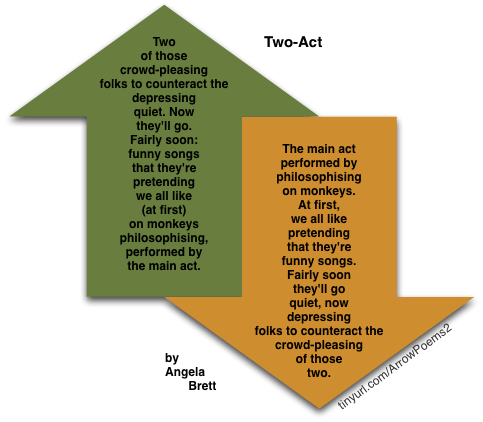
Here are some more arrow poems. Click the poems for pdf versions you can enlarge and copy the text from.

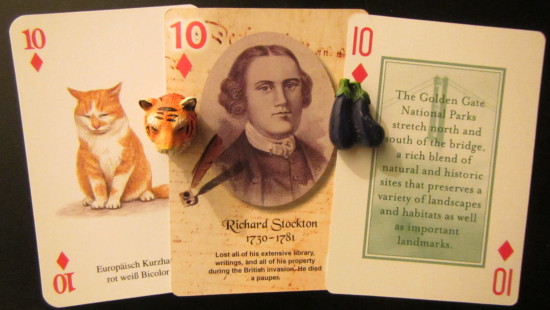 As promised, I got Jonathan Coulton and Paul and Storm to pick the cards this week. Jonathan chose Richard Stockton, and Paul chose first the European shorthair cat, and then the Golden Gate National Parks card on behalf of Storm, who had just gone to do something else at the time. I’m fairly sure Paul and Storm are entangled, so I accept this as a valid Storm choice.
I read that there’s a large homeless population in Golden Gate Park, and also that European shorthairs are not popular outside of Scandinavia because they resemble a lot of homeless cats. Richard Stockton died a pauper, maybe not homeless, but close enough. Given that it’s a natural state for a cat to roam, and the idea of owning a human family or two might seem strange and restrictive to one who hasn’t previously tasted cat food, I wondered what would happen if a sad, newly-homeless Stockton had encountered a happily ‘homeless’ cat in the then-nonexistent Golden Gate Park. Probably some hissing, a rift in space time, and either a nourishing kitty stew or a very scratched-up politician. I couldn’t think of a storyline that wouldn’t be trite and generally the worst fable of all time, so I fell back on the arrow poem form I invented previously. It’s easier than it looks.
If you like, you can think of the up arrow as being from the perspective of a cat and the down arrow from that of Richard Stockton. Perhaps Jonathan subconsciously chose this card for the same reason he writes so many sad songs.
And on the subject of Jonathan writing sad songs (some of which are funny because they’re about monkeys and cephalopods and vampires) he’s also the down arrow in the second poem. Opening band Paul and Storm are the up arrow, because they’ve only written one sad song that I know of. That’s not to say that Jonathan is a downer; plenty of his songs are funny without being sad, and I love funny sad songs (and non-funny sad songs) anyway.
In case you were wondering, following the tour was awesome as always. I met a lot of nice people, caught up with several I already knew, discovered a new sciency songwriter when she gave her CDs to Jonathan, and also visited Bath. I’m uploading videos of the Union Chapel show now, and will put up the rest over the next few weeks, and in the mean time you could watch the Susie Asado videos I’ve put up. Next stops: Wax Mannequin at my favourite venue on land, and Marian Call at CERN (which will probably become my new favourite venue on land once I have reason to call it a venue. But then again, it already has Hardronic.) Would you believe I’d never been to a concert of my own volition until December 2008?
-
You are currently browsing the archives for the Writing Cards and Letters category.

This work is licensed under a Creative Commons Attribution-Noncommercial-Share Alike 3.0 Unported License.
Please tell me if you do something cool with it.

 Creative Output